
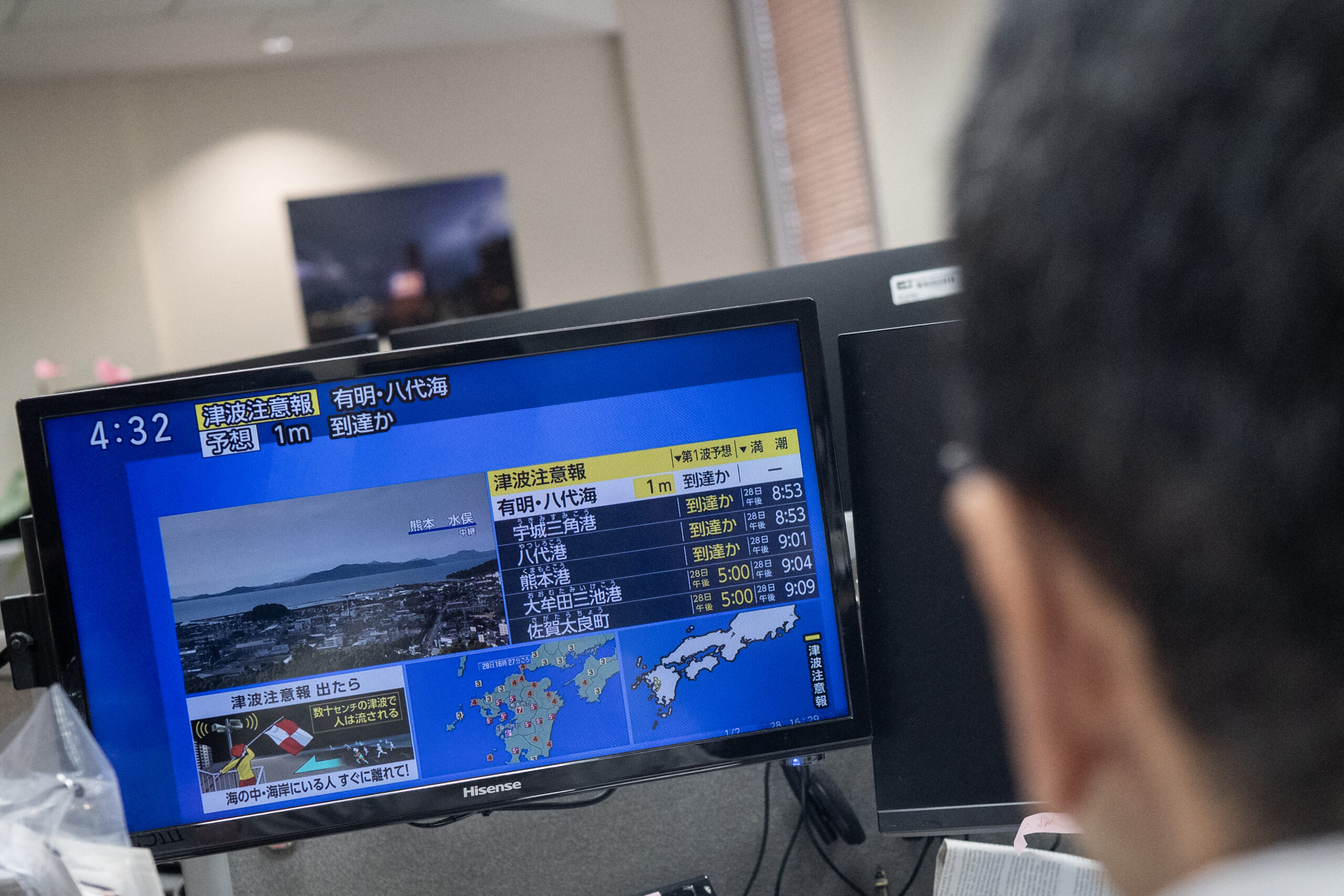
On Tuesday afternoon at 4:27 p.m., a powerful magnitude 7.1 earthquake struck Kumamoto Prefecture in Kyushu, Japan, with a depth of approximately 10 kilometers. The cities of Uki and Hitoyoshi in Kumamoto Prefecture recorded the highest intensity level of 7 on the seismic scale issued by the Japan Meteorological Agency. This is the first time Japan has experienced a magnitude 7 earthquake since the Noto Peninsula earthquake on New Year’s Day in 2024.
Following the earthquake, the Japan Meteorological Agency issued a tsunami advisory for the Ariake Sea and the Yatsushiro Sea, estimating that waves could reach up to 1 meter in height, with the possibility that parts of the coastal areas may already be affected by a tsunami.
The agency urged people to evacuate to higher ground immediately and stay away from the coast, emphasizing not to enter the ocean or approach the shoreline until the advisory is lifted. Coastal topography may cause tsunamis in some areas to exceed predicted heights.
In addition to strong ground shaking, Kumamoto Prefecture also reported the highest level of “long-period ground motion level 4” with cities like Amakusa and Ashikita experiencing level 3 shaking.
“Long-period ground motion” refers to slow shaking with a period of over 2 seconds, particularly affecting tall buildings. During level 4 shaking, individuals may have to crawl to move, and occupants in tall buildings may have difficulty standing, while unsecured furniture could move or topple over significantly.
Due to the earthquake, all trains operated by JR Kyushu, including the Kyushu Shinkansen, the Nishi-Kyushu Shinkansen, and local lines, were temporarily suspended.
In Kumamoto Prefecture’s Kikuyo town, where Taiwan Semiconductor Manufacturing Company’s Japan subsidiary, Japan Advanced Semiconductor Manufacturing (JASM), is located, an intensity level of 5 was observed. TSMC has evacuated personnel according to emergency procedures and is assessing the status of employees, facilities, and production equipment.
The Japanese Nuclear Regulation Authority stated that there were no abnormalities detected at the Sendai, Genkai, and Ikata nuclear power plants. Kyushu Electric Power Company reported no changes in radiation monitoring values at Genkai and Sendai nuclear power plants following the earthquake.
Prime Minister Sanae Takamichi has instructed relevant departments to quickly assess the situation, implement life-saving, rescue, and emergency response measures, and promptly provide the public with evacuation and disaster information.
The Uki Fire Department in Kumamoto Prefecture reported receiving numerous emergency calls post-earthquake, with several people injured and fires breaking out.
Authorities and local governments in Kumamoto Prefecture are still collecting information on the disaster, with full details on casualties and building damage yet to be confirmed. It is known that Kumamoto Castle, with a history of 400 years, suffered damages to its walls during the earthquake.
This marks the strongest seismic activity in Kumamoto Prefecture since the 2016 Kumamoto earthquakes, where magnitude 7 earthquakes were recorded twice, nearly a decade later in 2026.
The recurrence of a magnitude 7 earthquake in Kumamoto, exactly a decade after the devastating 2016 earthquake, highlights the region’s vulnerability to seismic events.