
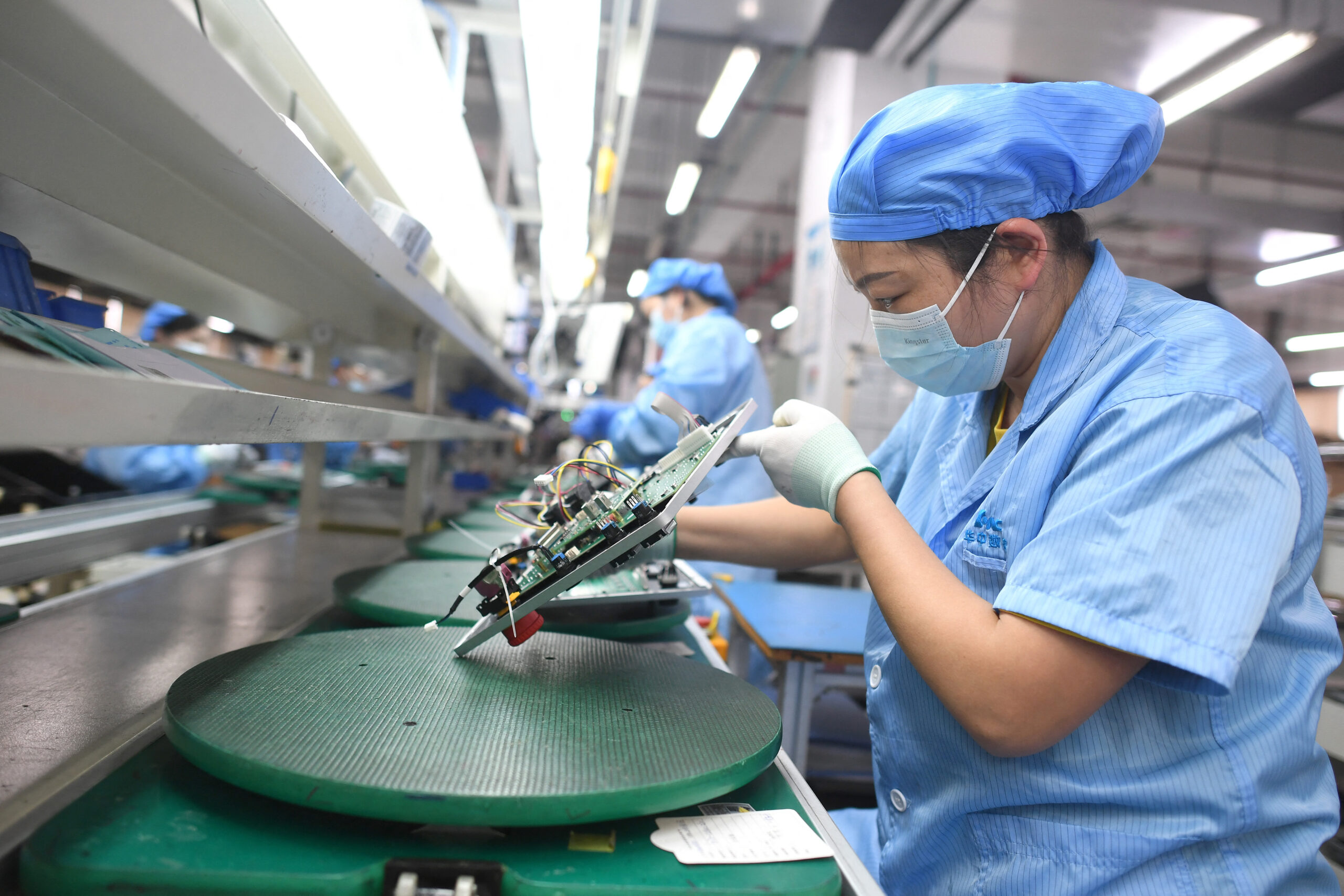
The latest data from China’s economy in June revealed that the growth rate of industrial profits for enterprises above a certain scale slowed down by 6 percentage points. The profits across different industries showed a polarization trend. While industries such as electronic manufacturing, non-ferrous metals, and chemical raw materials experienced significant profit growth, traditional labor-intensive sectors like automobiles, clothing, and furniture saw a sharp decline in profits, leading to a continuous worsened employment situation in China.
According to the National Bureau of Statistics of the Communist Party of China, data released on Monday, July 27th, indicated that the growth rate of industrial profits for enterprises above designated size in June decreased from 21.1% in May to 15.1%. Profits for the first half of the year grew by 18.7% year-on-year, slightly lower than the 18.8% growth rate from January to May.
Enterprises above designated size refer to those with annual operating incomes of 20 million Chinese yuan or more (approximately 2.95 million US dollars).
Looking at different industries, there is a significant polarization in profit trends. Sectors such as chemical fibers, chemical raw materials, electronic manufacturing, and non-ferrous metal mining and processing showed faster profit growth rates, with industries like integrated circuits and computers recording a growth rate of 96.9%. Conversely, profits in traditional manufacturing sectors generally declined, with industries such as furniture manufacturing, non-metallic mineral products (building materials), clothing, ferrous metal smelting (steel), automobiles, alcoholic beverages, and cultural and recreational products witnessing respective profit decreases of 52.7%, 47.8%, 20%, 25%, 19.5%, 17.7%, and 13.8%.
The furniture manufacturing, non-metallic mineral products (building materials), and ferrous metal smelting (steel) industries act as bellwethers for traditional real estate and infrastructure sectors. The significant drop in profits indicates the challenging survival conditions for enterprises within the vast traditional real estate and construction industries.
The overall decline in profits for the automobile, clothing, alcoholic beverages, and cultural and recreational industries signals severe industry internalization, inadequate market demand, and consumer weakness. Reuters suggests that the ongoing weakness in consumer and real estate sectors has dragged down economic growth in the second quarter, leading GDP growth to its lowest level in over three years.
Yu Weineng, a statistician at the Industrial Division of the National Bureau of Statistics, acknowledged that China’s economy is facing issues of insufficient consumption. He mentioned, “There is uncertainty in the prices of international commodities. Industrial enterprises are also facing weak demand and cash flow pressures.”
Despite the significant increase in industrial profits in the first half of this year based on official reports, the number of employees in large-scale industrial enterprises continues to decrease, indicating a continuously deteriorating employment situation.
Upon verification of data from the Communist Party’s National Bureau of Statistics, it was discovered that as of May this year, the cumulative number of employees in large-scale industries averaged 72,211 (data for June has not yet been released), representing a 0.9% year-on-year decrease. Over the past 24 months, excluding February and March 2025 where there was a marginal 0.1% increase in the number of employees, the rest of the months showed reductions ranging from 0.9% to 1.8%.
Regarding the paradox of increasing industrial profits but decreasing employment numbers, an analysis from “Finance and Economics” magazine on Monday, July 27th, based on profit data from January to May, stated that the substantial increase in profits primarily concentrated in capital-intensive and technology-intensive high-tech and resource-based industries, where labor is limited, while labor-intensive traditional manufacturing sectors are facing widespread operational difficulties.
The profit trends from January to May were closely mirrored in the situation from January to June, with profits in furniture manufacturing, non-metallic minerals, ferrous metals, automobile manufacturing, and alcoholic beverages declining by 58.4%, 48.9%, 37.4%, 19.8%, and 15.6% respectively.
The article further explains that industries such as electronics, integrated circuits, non-ferrous metals, and new materials rely heavily on automation equipment, algorithms, and capital inputs, offering very limited direct employment opportunities for ordinary labor. In contrast, traditional manufacturing, processing, and basic industries in China (such as automobiles, electronics, ferrous metals, agricultural and sideline products), which have historically absorbed the majority of the labor force, are currently facing a daunting situation of significantly declining profits and challenging operations.
Based on calculations of employment proportions in different industries, the ratio of the total workforce in industries experiencing “economic growth” as opposed to those in “no growth/decreasing” industries from January to May 2026 was approximately 1:1.8. This implies that nearly two-thirds of industrial workers are employed in sectors experiencing shrinking profits.
“Finance and Economics” magazine was co-founded by veteran media personality Hu Shuli in 1998 and is currently supervised by CITIC Group Limited and hosted by the China Securities Market Research and Design Center.