
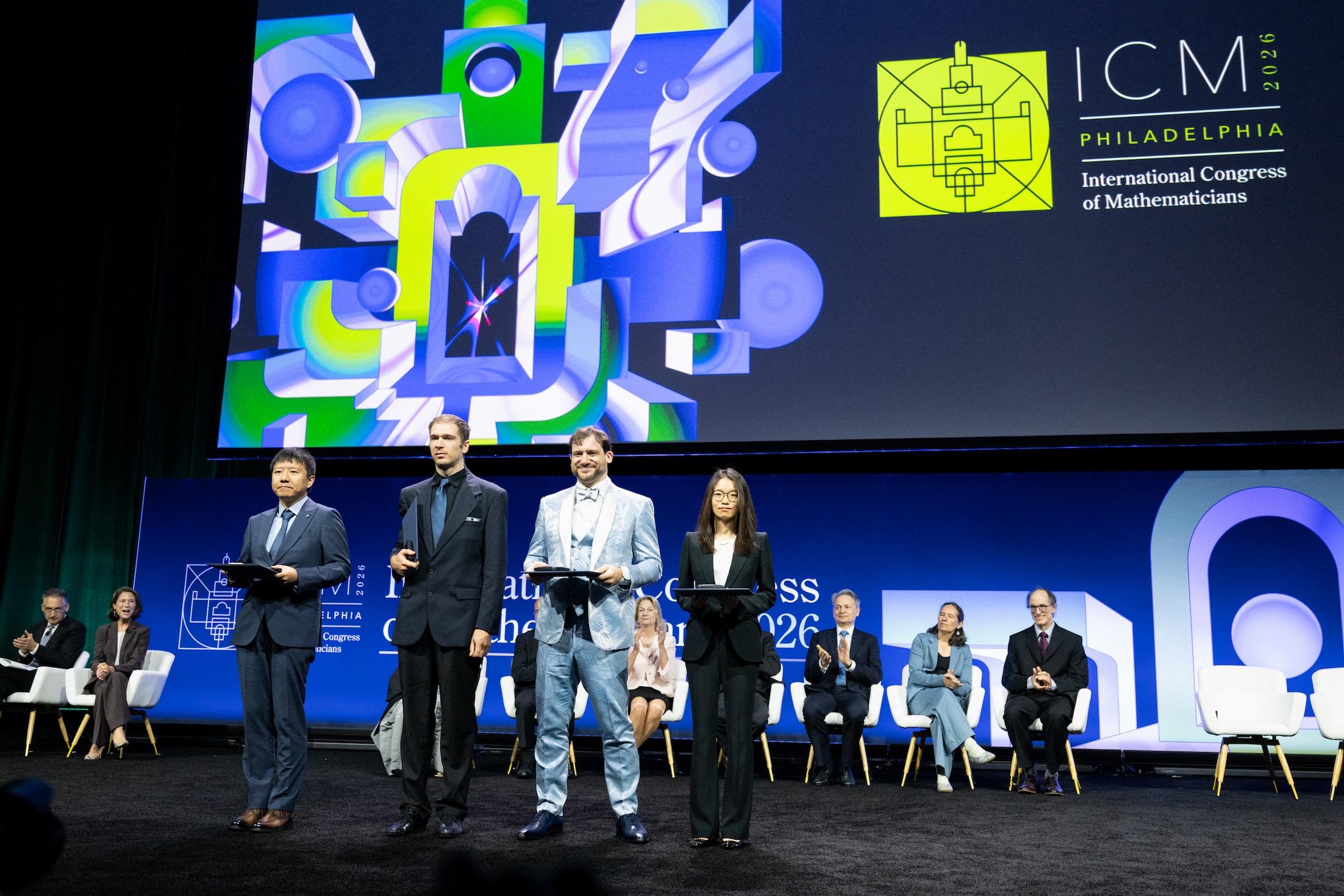
Chinese mathematicians Deng Yu and Wang Hong recently won the prestigious Fields Medal, with both having studied at Peking University in China. Upon receiving the award, Chinese state media and Peking University rushed to bask in the “glory” and conducted interviews with the two scholars. However, an official WeChat post from Peking University deleted Deng Yu’s remarks supporting studying abroad, sparking controversy.
Wang Hong, born in 1991 in Guilin, Guangxi, China, entered Peking University at the age of 16 before transferring to the School of Mathematical Sciences. After graduating, Wang Hong pursued further studies in France, obtaining dual degrees from Ecole Polytechnique and Paris-Sud University in 2014, and a doctorate from MIT in 2019. In 2023, Wang Hong became a professor at the Courant Institute of Mathematical Sciences at NYU, and since September 2025, she has been a permanent professor at the Institute of Advanced Scientific Studies (IHES) in France.
Deng Yu, born in Kaifeng, Henan, China in 1989, represented China in the International Mathematical Olympiad in 2006, winning a gold medal. He studied at Peking University’s School of Mathematical Sciences for only two years before transferring to MIT and later continuing his studies at Princeton University. After obtaining his Ph.D., Deng Yu worked as a postdoctoral researcher at the Courant Institute of Mathematical Sciences at NYU in 2015, became an assistant professor at USC in 2018, was promoted to associate professor with tenure in 2022, and has been a professor at the University of Chicago since 2024.
On the evening of July 24th, Peking University illuminated lights to celebrate the achievements of Wang Hong and Deng Yu with a banner reading “Congratulations Wang Hong and Deng Yu” and “Congratulations to Chinese Mathematics.”
Subsequently, an interview with Deng Yu was published by the WeChat account of Peking University’s School of Mathematical Sciences, titled “Navigating Between Criticality and Long Durations| Interview with Deng Yu, Alumnus Invited to ICM2026,” which included a highly publicized question: “Should one study abroad? When should they go? Opt for overseas or return to the home country for long-term development?”
Deng Yu responded that the choice should consider various factors like geopolitical environment, domestic discipline development, and there is no one-size-fits-all answer. If circumstances allow, it is beneficial for an academic career to have a complete overseas experience, to directly experience different academic ecosystems. Ultimately, whether choosing to work overseas or return to China is entirely feasible, with the only criterion being “where the environment suits your deep cultivation of genuine issues.”
However, when Peking University’s official WeChat account reposted the article, the title was changed to “Interview with Peking University Alumnus Deng Yu” and this portion of the content was deleted.
This deleted content has not completely disappeared from the Chinese mainland internet, as many mainland media outlets have preserved Deng Yu’s relevant statements in full.
A post on Zhihu titled “Peking University Deleted Deng Yu’s Answer because the public arena cannot tolerate the truth!” was also deleted.
Some netizens commented, “Why delete it? Because originally attributing the credit to domestic self-cultivation was already quite strained – the key master’s and Ph.D. stages for both were completed abroad; following Deng Yu’s statement, wouldn’t that strained credit be lost?”
Another comment read, “Everyone saw this passage, and then you deleted it, this is turning a deaf ear to the truth,” and “a thief who cries ‘stop thief.'”
An article in Ming Pao commented that this might be Peking University’s cautious move to avoid linking studying abroad with being unpatriotic in public opinion.
On the other hand, fellow awardee Wang Hong, when talking about her growth in an interview, mentioned parents, Paris, NYU, IHES, but rarely mentioned Peking University. In an interview with “China Science Tribune,” she expressed feeling like she was “struggling for survival” there (at Peking University) and that “just being able to survive was considered fortunate.”
Reportedly, in 2007, Wang Hong from Guangxi scored 653 points in China’s college entrance exam but did not enter the math department at Peking University; instead, she was placed in the School of Earth and Space Sciences. She planned to transfer departments upon admission. Entering the math department in her second year, she found herself in hell: the class was full of Olympiad gold medalists; without a competition background and with mediocre grades, she was long doubted as “not fit for studying math,” even considering switching to architecture. After graduating with her bachelor’s degree, Wang Hong pursued further studies in France.
In an interview with AFP, Wang Hong mentioned that the IHES in France recruits solely based on scientific excellence, then completely trusts the researchers afterward. There are no teaching duties or administrative work, allowing researchers to freely and fully dedicate themselves to long-term research. Environmental factors also play a significant role.
As a result, some netizens commented that perhaps these recent days have been the most embarrassing for Peking University.