
With the increasing global health awareness, the natural health, preventive medicine, and functional food markets are growing rapidly. The Taiwanese traditional Chinese medicine industry is also actively expanding into the international market. In the past, Chinese communities were the main consumers of Taiwanese traditional Chinese medicine products. In recent years, the products have gradually crossed ethnic boundaries and attracted the attention of consumers from various ethnicities in the United States.
Taiwanese businesses have identified the rising demand for health management in the post-pandemic era and have set their sights on using San Francisco and Los Angeles on the U.S. West Coast as vital starting points for entering the American market. They are vigorously promoting Taiwanese herbal health products that integrate traditional wisdom with modern technology.
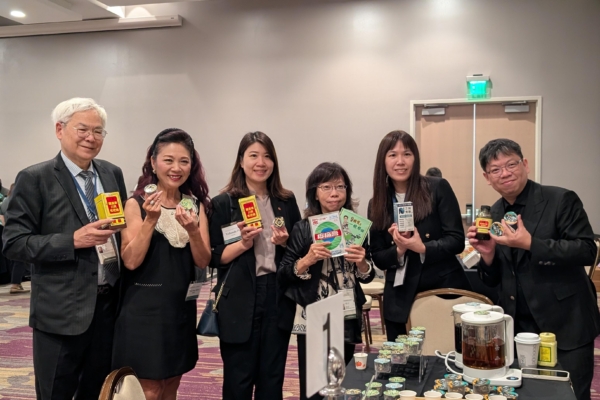
Organized by the Taiwan External Trade Development Council (TAITRA), the “Taiwan Biotech Traditional Chinese Medicine Industry Delegation to the U.S. Western Region” held a business networking event in Los Angeles on Thursday (23rd). The event brought together 14 Taiwanese traditional Chinese medicine, biotech, and health food companies to engage in deep discussions with American importers, agents, distributors, TCM clinics, and health industry professionals, aiming to seek opportunities for international cooperation.
The Director of the Taiwan Trade Center in Los Angeles, Bi Da-Yu, stated that the main purpose of this event is to establish a cooperation platform between Taiwanese manufacturers and the American market. By inviting local importers, distributors, and TCM practitioners to visit and exchange ideas, the event aims to assist Taiwanese high-quality brands in expanding their overseas distribution channels. She believes that the large size of the Chinese community in Los Angeles, the established Asian market foundation, and the mature environment for TCM usage make it the ideal gateway for Taiwanese businesses to enter the U.S. market.
Bi Da-Yu pointed out that in the past, the U.S. market’s awareness of traditional Chinese medicine was mainly focused on Asian ethnic groups. However, in recent years, with the popularization of concepts such as natural botanical extracts and herbal health, the acceptance of traditional Chinese medicine has significantly increased among different ethnicities.
“Traditional Chinese medicine comes from natural plant extracts, which consumers believe align more with the concept of natural health compared to some Western medicines,” she said. Besides the Chinese market, in recent years, including the Mexican American community and other ethnic groups, have also begun to explore TCM practices and herbal health products, indicating broader market potential for TCM in the U.S.
The Taiwanese companies participating in this exhibition have decades of industry experience, with some being established for over 30 years. In addition to well-known products like Zhang Guo-Zhou’s Stomach Remedy and Zheng Guang’s Herbal Paste, there are also companies like Sanfan Pharmaceuticals, which combines AI technology with traditional Chinese and Western medicine principles, and Tai Chi Hall, which develops herbal biotechnology in line with the trend of medical aesthetics. The exhibits cover scientific Chinese medicine, herbal health food, functional foods, biotech products, and health management services, showcasing Taiwan’s health industry’s traditional heritage and innovative research and development features.
The Chairman of the Chinese Medical Association of the Republic of China, Gu Ming-Jin, expressed that this delegation to the U.S. aims to not only promote products but also to introduce Taiwan’s TCM culture and health concepts to the American public.
Gu Ming-Jin introduced that the variety of products exhibited this time is diverse, including traditional and scientific Chinese medicine, modern production processes, external patches (such as the “Yitiaogen” series), and herbal products for gastrointestinal health, demonstrating the modernization of Taiwanese TCM’s development achievements.
Gu Ming-Jin noted that the COVID-19 pandemic has led to a heightened global focus on traditional medicine and preventive healthcare. The attention generated internationally by “Qingguan No.1” has successfully showcased Taiwan’s TCM capabilities to the world. Post-pandemic, many people are facing fatigue, sleep disorders, and the need for body regulation, and TCM’s treatment principles based on individual body constitutions align well with modern health trends.
“The value of Chinese medicine lies not only in treatment but also in adjusting the body’s overall function,” Gu Ming-Jin added. Common functional issues among modern people, such as gastrointestinal discomfort and metabolic imbalance, are long-standing concerns of TCM.
He also mentioned the differences in the markets of the two regions: unlike Taiwan, where TCM is integrated into the mainstream healthcare system, American consumers currently view Chinese herbs mostly as dietary supplements. Therefore, when expanding into the market, Taiwanese businesses not only need to comply with local regulations but also require scientific research, educational promotion, and cultural exchanges to help consumers understand the product’s application and underlying theories.
Facing the challenges of the international market, Gu Ming-Jin emphasized that the internationalization of TCM is not just about selling products but more importantly about establishing consumers’ understanding of Chinese medical culture.
“Many people around the world are using Chinese herbs, but they may not necessarily understand why they are effective,” he stated. Taiwan can play a role in promoting and educating by introducing TCM theories and health concepts to the global market.
Looking to the future, Gu Ming-Jin said that the Taiwanese TCM industry will continue to invest in scientific research and international certification to enhance product transparency. With a complete system, excellent manufacturing quality, and research and development capabilities, combined with regulatory compliance and international marketing, Taiwan is confident in securing a position in the global health industry wave, allowing thousands of years of Chinese medical wisdom to stride into the world in a modernized manner. ◇