
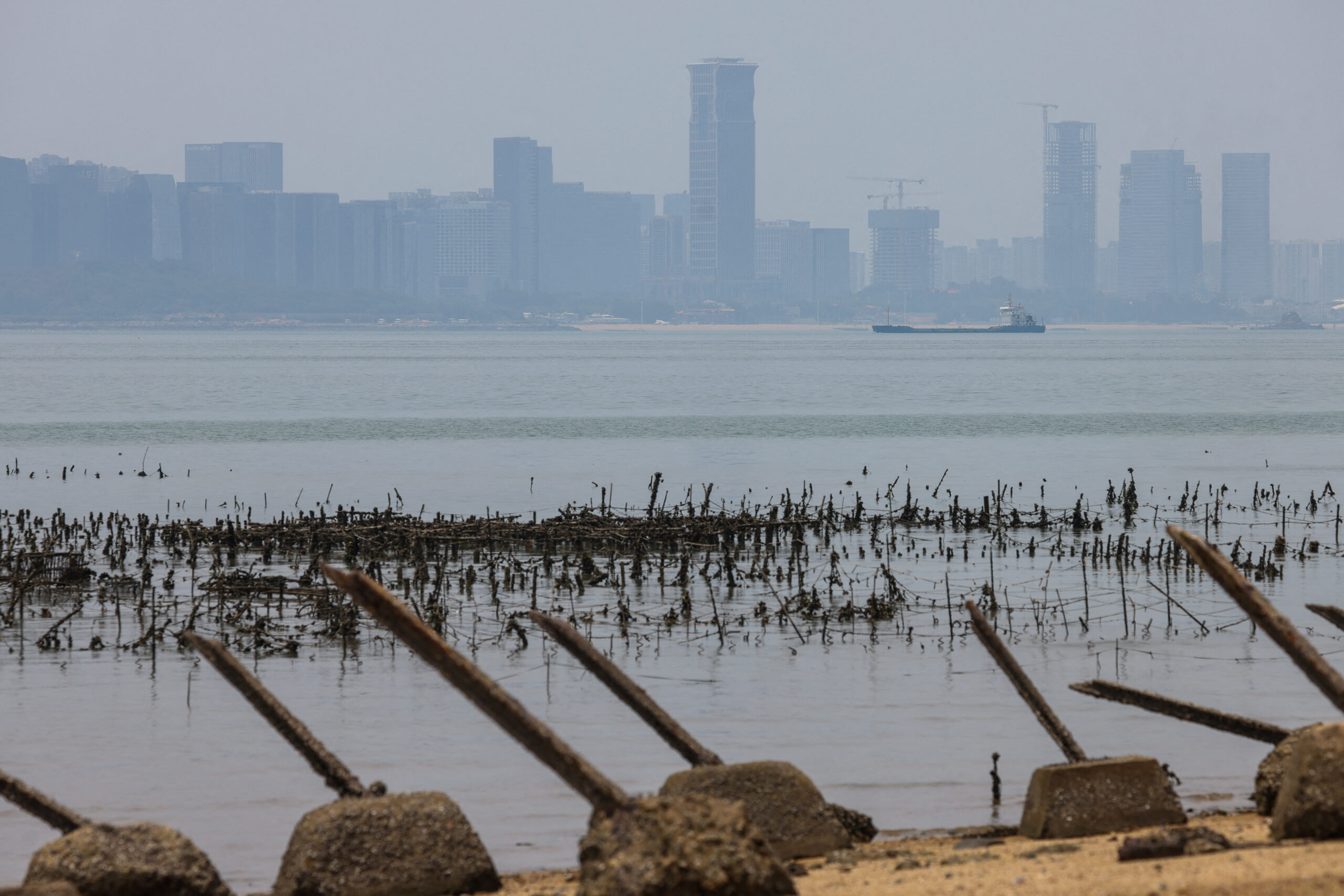
The new Xiang’an Airport in Xiamen, Fujian Province, China, is set to commence operations by the end of this year. Located less than three kilometers away from Kinmen Island in Taiwan, the airport’s proximity is considered highly sensitive. Experts believe that such a close airport not only poses a threat to the aviation safety of Kinmen but also raises concerns for Taiwan’s national security.
Xiang’an Airport started construction in September 2019 and is situated at the southeastern tip of Dadeng Island in Xiang’an District of Xiamen City. Dadeng Island is the largest island in the Dadeng archipelago and has nearly doubled in size due to extensive land reclamation by the Chinese Communist authorities. Upon completion, Xiang’an Airport will be less than three kilometers away from Kinmen in Taiwan.
According to reports from Chinese state media, Xiang’an Airport was completed at the end of last year and is currently undergoing acceptance, test flights, and preparations for operational use, with plans to begin commercial flights by the end of this year. The initial phase will involve dual runways to accommodate an annual passenger throughput of 45 million, cargo and mail throughput of 750,000 tons, and 380,000 aircraft movements.
As per the official master plan, Xiang’an Airport is designated as a regional hub airport with the ultimate goal of constructing four runways, three terminal buildings, and becoming a mega airport with an annual passenger throughput of 85 million. According to general standards, an airport with an annual throughput exceeding 70 million passengers is classified as a “mega airport.”
This mega airport is built opposite Kinmen. It is reported that standing on the beach on the northwest coast of Kinmen, one can clearly see the control tower, terminal buildings, and airport runways of Xiang’an Airport across the sea.
Experts analyze that the construction of Xiang’an Airport poses multiple threats to the aviation safety of Kinmen flights and to Taiwan’s national security.
Kinmen Island already has Shang Yi Airport, located roughly ten kilometers from Xiang’an Airport. Xiang’an Airport is capable of handling large jet flights, while the Shang Yi Airport, built in 1949, mainly services propeller or medium-sized carrier flights. Several Taiwanese experts have pointed out that the flight paths of the two airports are prone to overlap, potentially causing mutual interference during flight operations.
Yeh Yunhu, Secretary-General of the Chinese Association of Seas Patrol and Professor of Maritime Police at the Central Police University, stated to Dajiyuan on July 22 that large jet flights at Xiang’an Airport would produce strong wake turbulence during takeoff and landing, leading to the possibility of mutual interference if the two airports are too close. This is especially critical in scenarios where an aircraft needs to abort landings, go around, or engage in emergency climbs.
Moreover, Yeh Yunhu mentioned that under extreme weather conditions such as crosswinds or thunderstorms, pilots’ judgment could be significantly limited, leading to increased likelihood of aircraft veering off course. The permissible deviation range under such circumstances remains unclear, raising the risk of potential collisions.
The Chinese government has never consulted with the Taiwanese authorities regarding the construction of an airport at such close proximity. Taiwan’s Mainland Affairs Council has previously indicated that Taiwan was informed of China’s plans to build Xiang’an Airport as early as 2015, repeatedly requesting relevant information and engaging in discussions on certain issues, but China has consistently failed to respond.
During a routine press conference held by the Taiwan Affairs Office of the Chinese Communist Party on June 17 this year, a Taiwanese journalist raised concerns about the close distance between Xiang’an Airport in Xiamen and Shang Yi Airport in Kinmen, citing potential airspace overlap and flight safety concerns. The Taiwanese government advocates for “new airport construction to consider existing airport flight routes.” The journalist inquired whether both sides have communicated on relevant flight routes and airspace control and whether the Chinese side would proactively coordinate with Taiwan in the future to avoid aviation safety issues.
In response, the spokesperson for the Taiwan Affairs Office, Chen Binhua, evaded the question and merely stated that Xiang’an Airport, as an internationally top-notch modern aviation hub, would benefit both Xiamen and Kinmen, facilitating people’s travel and promoting regional development.
Xiang’an Airport is part of China’s “Jin Xia Twin Cities” plan. The concept of “Jin Xia Twin Cities” was formally proposed by the Chinese party leader in 2019, aiming to create a shared living circle and economic integration between Jinmen and Xiamen, encompassing transportation, economic and trade connectivity, and shared living.
According to Chinese state media claims, Xiang’an Airport will incorporate the Dadeng Passenger Terminal, plan a five-terminal passageway (the largest mainland-to-Taiwan passenger port) to the airport express line, establish a dedicated passage for Kinmen passengers, reserve a separate terminal building for Kinmen, reserve Kinmen’s cross-strait channel interface, and plan to connect Kinmen via the “Xiamen-Kinmen Bridge.”
The “Xiamen-Kinmen Bridge” is a cross-sea bridge proposed by China, starting from Xiamen Island, passing through Xiang’an Airport, and connecting to Kinmen Island, enabling direct road access. The Xiamen section of the bridge started construction in October 2023, while the Kinmen section currently remains at the conceptual planning stage, with cautious governmental stance in Taiwan.
Analyzing the situation, observer Xia Shuo pointed out that the completion of Xiang’an Airport does indeed present convenience temptations for Kinmen residents. Since Shang Yi Airport in Kinmen currently lacks regular international flights, Kinmen residents must first fly to the main island of Taiwan for transfers. China is leveraging this situation to its advantage.
Yeh Yunhu expressed that this initiative is part of China’s united front strategy, aiming to realize the so-called “Jin Xia Integration” (also known as “Jin Xia Twin Cities”), while simultaneously gathering personal information and biological features of Kinmen residents. One of China’s main objectives in creating “Jin Xia Integration” is to blur the national boundaries.
He believes that once Xiang’an Airport is operational, there will be more reasons for the Chinese Coast Guard vessels to conduct routine law enforcement patrols, including using “ensuring airport perimeter security” as a pretext, despite being highly conspicuous.
In 2024, a Chinese speedboat intruded into the prohibited waters of Kinmen, accidentally capsizing while illegal fishing, resulting in the drowning of two crew members. The incident sparked a dispute over maritime jurisdiction and law enforcement between the two sides. At that time, the Taiwan Affairs Office of the Chinese Communist Party claimed that there were “no restricted waters” in the area between Kinmen and Xiamen. The Chinese Coast Guard announced the normalization of law enforcement patrols in the region.
Political commentator Henghe analyzed on the June episode of “News Discussion” on New Tang Dynasty Television that China’s establishment of a joint community between Kinmen and Xiamen has gone beyond the scope of united front tactics, effectively encroaching on Taiwan’s sovereignty. Under this strategic framework, China would gradually erode Taiwan’s sovereignty.
The design of Xiang’an Airport includes air transport logistics hub functions, with railway and road connections, large warehouses, and rapid transfer equipment, offering military value. The military significance of Xiang’an Airport has also garnered attention.
Zhong Zidong, a researcher at the Taiwan Institute for National Defense Security, stated to Dajiyuan on July 22 that there are numerous international airports along the Chinese coast, some with relatively short distances. Xiamen Gaoqi International Airport is 23 kilometers from Kinmen, and Quanzhou’s Jinjiang International Airport is 36 kilometers away, distances that are insignificant for aircraft. “If it were truly for military purposes, they wouldn’t need this airport.”
Zhong Zidong further mentioned that Xiang’an Airport is within firing range of small arms and well within the range of Hamas missiles. Therefore, unless China occupies Kinmen, the military value of the airport is somewhat limited.
With Xiang’an Airport being less than three kilometers away from Taiwan’s Kinmen Island, the island holds strategic importance for Taiwan.
Kinmen Island is one of Taiwan’s frontline outlying islands, located approximately 10 kilometers from Xiamen City on the mainland and around 270 kilometers from the main island of Taiwan. Its unique geographical location dictates its crucial role as a significant barrier for Taiwan’s security.
On October 24, 1949, just twenty-three days after the Chinese Communist Party seized power, they launched an assault on Kinmen Island. Due to the Communist forces underestimating the resistance and rushing in, over 9,000 soldiers were martyred. The Battle of Kinmen (known as the Battle of Guningtou in the history of the Republic of China) marked a crucial turning point in the Chinese Civil War, solidifying the separation between the two sides.
Unsatisfied, the Chinese Communist Party instigated the “823 Artillery Battle” several years later, subjecting Kinmen to almost 480,000 shell attacks over 44 intense days. This battle became another significant milestone in Taiwan’s modern history concerning the defense of sovereignty. Following that, sporadic shelling by the Chinese Communist side persisted for twenty-one years until China declared a halt on January 1, 1979, after establishing diplomatic relations with the United States.
Nowadays, although Taiwan’s overall defense focus has shifted towards the main island of Taiwan, Kinmen remains a crucial outpost on the western front of Taiwan, serving as a deterrence or obstruction in the early stages of any conflict.
(Reporter Yi Ru contributed to this article)