
Recently, a video portraying Filipinos as monkeys released by the Chinese state media “China Daily” has sparked strong protests from various sectors in the Philippines. In the face of external criticism, the Chinese Ambassador to the Philippines, Jīng Quán, attempted to distance the Beijing authorities from responsibility, emphasizing that it was a “media behavior” rather than an official stance. However, his statement was immediately questioned by Filipino lawmakers, criticizing him for “publicly misleading” the people.
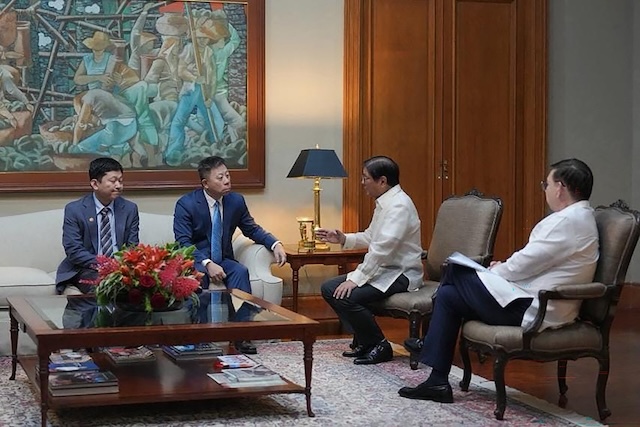
Philippine President Ferdinand Marcos Jr. met with Jīng Quán on Tuesday (July 21) following the latest conflict in the South China Sea the previous day. After holding closed-door talks with Marcos Jr. for several hours, Jīng Quán responded to media interviews by claiming that the Chinese government could not control the content of every media outlet in the country.
According to local media reports, Perci Cendaña, a representative of the left-wing Akbayan Party in the Philippines, released a statement on Wednesday (July 22) criticizing Jīng Quán’s remarks as a blatant attempt to mislead the Filipino people.
The statement pointed out, “Firstly, no media outlet can operate freely within China without explicit approval from the Chinese Communist Party regime. Secondly, ‘China Daily’ is owned by the Chinese Communist Party’s propaganda department.”
On July 10, the Chinese state media “China Daily” posted a roughly 1-minute video on its social media accounts, coinciding with the 10th anniversary of the Philippines commemorating the arbitration ruling on the South China Sea dispute.
In the video, a monkey dressed in traditional Filipino attire called “Barong” was seen singing under the control of arms bearing the flags of the United States and Japan. The monkey was then insulted as “stupid,” and a piece of lyrics paper bearing the words “South China Sea Arbitration Ruling” was pulled out before being thrown into the sea and sprayed with high-pressure water cannons by a ship.
Cendaña sarcastically suggested that the next move by the Chinese Communist Party might be to portray the incident where Chinese coast guard forces beat Filipino Navy personnel’s heads using sticks at Ren’ai Reef as an “expression of goodwill.”
Following the latest standoff at Ren’ai Reef, where Filipino Navy personnel were injured by Chinese coast guard forces using sticks, the Philippine Department of National Defense (DND) issued a statement indicating that it once again demonstrated the Chinese authorities’ “repeated breach of trust,” and bluntly stated, “We simply cannot trust this belligerent neighbor.”
The Philippine Defense Department stated that the Philippines will continue to enhance its defense capabilities, deepen cooperation with allies, and defend its sovereignty according to international law.