
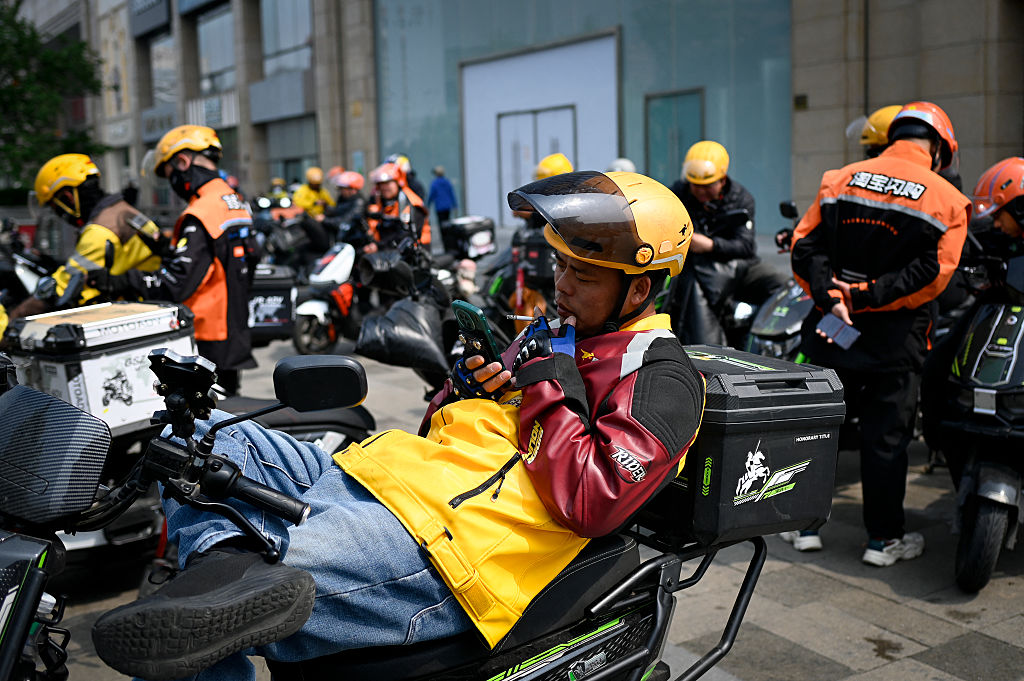
【Epoch Times July 24, 2026】The Chinese Communist Party (CCP) issued a document on July 23, expanding the reach of party organizations and political propaganda to internet platforms, private enterprises, social organizations, and new employment groups. The document directly links social work with the CCP’s “long-term governance,” targeting delivery drivers, ride-hailing drivers, and other laborers outside the traditional employment system as focal points for the expanded grassroots control.
According to state-run media Xinhua News Agency, the document mandates that party committees at all levels unify control over so-called social work and advance CCP political propaganda in rural areas, communities, businesses, new economic organizations, new social organizations, and new employment groups.
The CCP is broadening its control to encompass internet platforms, tech companies, small and micro-enterprises, individual businesses, industry associations, and social intermediaries. Delivery drivers, ride-hailing drivers, and other laborers outside the traditional employment system are also included in the scope of political propaganda and personnel control.
Regarding petitioning and social conflicts, the document stresses the ongoing handling of backlogged cases, leaving related issues for grassroots resolution, while integrating grassroots networks and expanding digital management. These measures further strengthen the control of grassroots party organizations over petitions and other social affairs.
The CCP’s Ministry of Social Work previously acknowledged the high mobility of delivery drivers, ride-hailing drivers, and similar laborers, making it difficult for the CCP to assimilate them into party organization management through fixed work units like traditional employees. Therefore, the CCP demands the establishment of party organizations in platform companies, affiliated sites, and distribution points to extend organizational control over these mobile laborers.
Since the establishment of the CCP’s Central Department of Social Work in 2023, functions related to petitions, grassroots party building, and party building for new employment groups have been centralized within this party institution, further strengthening control over the social sphere.
In July of this year, the National Development and Reform Commission of China stated that the number of so-called “new forms of employment laborers” on the mainland has reached 84 million. The China Center for New Employment Forms estimates that by 2026, the broader category of flexible employment personnel could reach 320 million, accounting for about 44% of the employed population.
The CCP has previously initiated organizational control and information collection on delivery drivers. In 2024, the CCP’s market supervision department issued a directive to identify party members among online delivery drivers, establish industry party committees as needed, and conduct political propaganda to guide delivery drivers to “be grateful to the Party, listen to the Party, and follow the Party.”
The document also calls for selecting delivery drivers to serve as “part-time social supervisors,” utilizing their frequent entry into communities and businesses to collect and upload information through methods like “quick snapshots” and “instant reporting.”
In April this year, Chinese state media revealed that 112 delivery riders in Yongji County, Jilin were classified as “mobile sentries.” They were instructed to take photos, track locations, and report findings while delivering meals, with the media even referring to them as “mobile probes.”
Chinese political analyst Wang He previously told Epoch Times that the CCP is concerned about new employment groups breaking free from control and is attempting to integrate these laborers into the control system through the Central Department of Social Work, grassroots networks, and technological monitoring.
Wang stated that this group is primarily composed of young people closely connected to the internet, with high mobility and strong ability to voice their concerns and gather. If they collectively protest due to income or rights issues, they could potentially disrupt the CCP’s stability maintenance system. He emphasized that the authorities are strengthening control over this group because they fear rebellion.
Xu Zhen, a senior expert in the Chinese capital market, remarked that the CCP consolidates the social control functions previously dispersed among civil affairs, labor unions, political and legal departments, and propaganda departments. By establishing platform party branches, intervening in algorithms, and enhancing personnel management, the CCP subjects delivery drivers, ride-hailing drivers, and similar groups to stricter control measures.
In recent years, delivery drivers in many parts of mainland China have erupted in collective protests due to issues such as lowered delivery rates, platform exploitation, management disputes, and restricted access to residential areas. Following the CCP’s directive for delivery drivers to “follow the Party,” some internet users sarcastically commented, “Shouldn’t delivery drivers just follow the navigation?”