
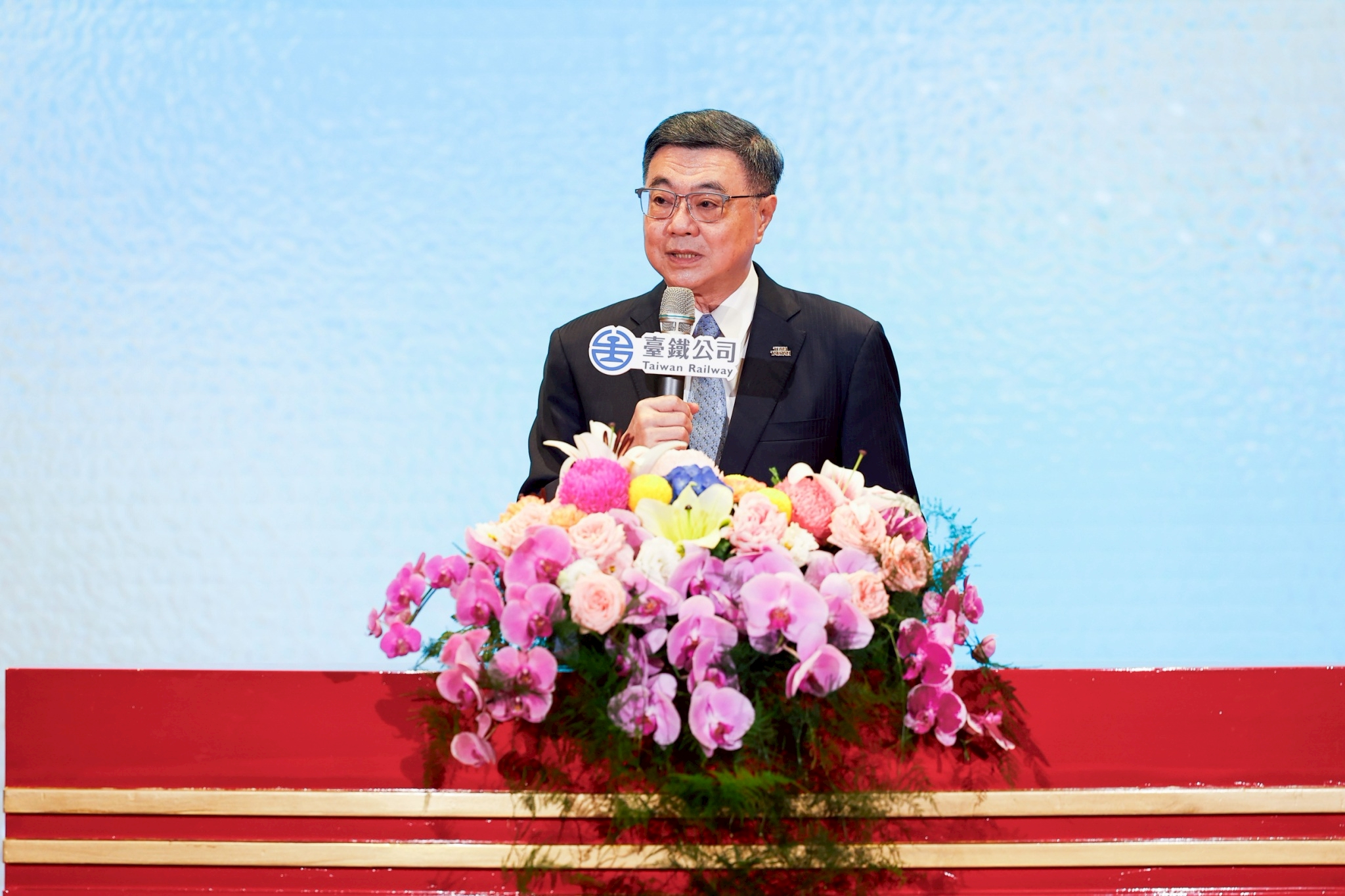
The Executive Yuan of the Republic of China held a meeting today to listen to the report from the Ministry of Transportation. Premier Cho Jung-tai emphasized the government’s initiative to build an efficient island-wide railway network called the “4 90-minute” plan. This plan aims to enhance transportation resilience and implement the concept of “Balanced Taiwan”.
Premier Cho Jung-tai stated that the average daily ridership of high-speed rail, Taiwan Railways, and metro systems this year has reached 3.524 million passengers. In order to realize the concept of “Balanced Taiwan”, the government has proposed the vision of the “4 90-minute” efficient island-wide railway network. The goal is to connect major cities such as Taipei to Kaohsiung in 90 minutes, Kaohsiung to Taitung in 90 minutes, Taitung to Hualien in 90 minutes, and Hualien to Taipei in 90 minutes. This not only aims to create a well-connected transportation artery but also strengthen Taiwan’s island-wide transportation resilience.
Premier Cho Jung-tai highlighted the four key initiatives of the “4 90-minute” efficient island-wide railway network:
Firstly, the Executive Yuan has officially approved the “Yilan Extension Plan” for the high-speed rail. This project, which has passed the environmental impact assessment, will not only alleviate the congestion on National Highway 5 but also improve transportation convenience between northern Yilan. By providing the eastern part of Taiwan, which has long relied on Taiwan Railways, with the option of high-speed rail, the 60.6-kilometer extension will become a new starting point in enhancing the transportation resilience of eastern Taiwan.
Secondly, two months ago, Premier Cho Jung-tai inspected the area around Liukuaicuo in Pingtung, including the proposed high-speed rail Pingtung Station, Taiwan Railways Liukuaicuo Station, expansion of the Pingtung Technology Industrial Park, Pingtung Science Park, Pingtung Experimental High School, and Pingtung International Baseball Stadium. The “Pingtung Extension Plan” for the high-speed rail has adopted the “Kaohsiung Plan”, which will extend from Zuoying Station in Kaohsiung to Liukuaicuo in Pingtung, covering a total of 26.2 kilometers. The plan aims to pass the environmental impact assessment in 2027 and expedite its completion.
Thirdly, the 140.7-kilometer-long Nanhuai Railway currently has an 85-kilometer single-track section that requires improvements for the remaining 44 kilometers. The Executive Yuan approved the feasibility study at the end of December 2025 and will commence comprehensive planning in September of this year to actively promote the “Taiwan Railways Nanhuai Line Improvement and Double-Tracking of Bottleneck Sections Project”.
Fourthly, in March of this year, the Executive Yuan approved the “Hualien-Taitung Railway Double-Tracking Electrification Correction Plan” to convert the 112.6-kilometer single-track section between Hualien and Zhiben Station in Taitung to double-track, with a phased rollout to significantly enhance the transportation capacity between Hualien and Taitung.
Premier Cho Jung-tai also shared his personal connection to railway transportation, with both his grandfather and father being employees of Taiwan Railways. He was born along the old Tamsui Line of the railway and recalls hearing the train sounds on the first night he was born. With the development of Taiwan’s rail transportation, the Tamsui Line ceased operations in 1988, replaced by the Taipei Metro Tamsui-Xinyi Line. The commencement of the high-speed rail in 2007 ushered in a one-day living circle for the western corridor of Taiwan.
Premier Cho Jung-tai urged the Ministry of Transportation and related agencies to continue promoting the construction of the efficient island-wide railway network, enhancing social connectivity, and realizing the vision of the “4 90-minute” island-wide transportation. This is essential in achieving Taiwan’s national goal of balance. Building a sustainable transportation network, akin to a train of progress, will advance the nation and bring hope to the people.