
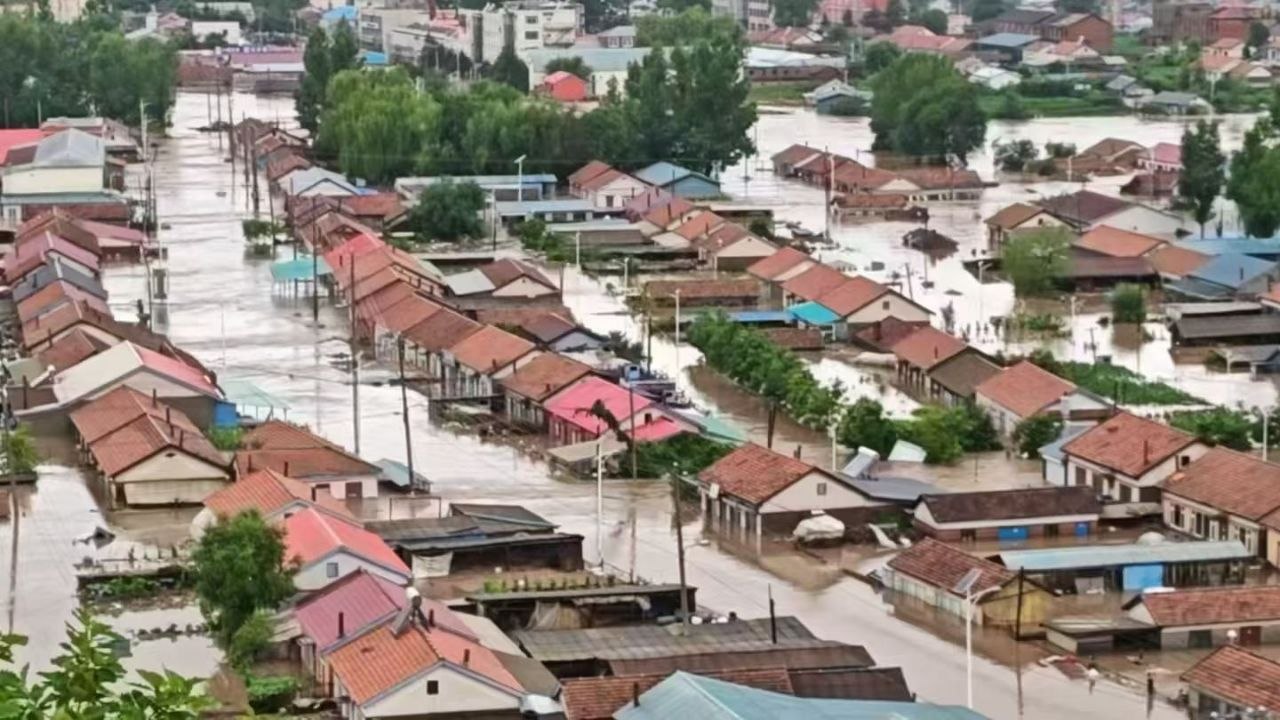
Super Typhoon “Bavi” made landfall in Zhejiang and headed north, causing flooding in eastern, northern, and northeastern China. Several reservoirs in Jilin province released water simultaneously, leading to severe flooding in places like Dunhua. Local residents shared harrowing tales of escape and the dire conditions in the disaster area, while farmers expressed being caught off guard by the sudden releases and suffering heavy losses. Despite seeking help from authorities repeatedly with no avail, they turned to the internet for assistance, only to be met with demands from officials to delete their posts.
Since July 13, Jilin province has been hit by continuous heavy rainfall, with multiple reservoirs releasing water, causing river levels to rise rapidly and even reports of breaches. Public records show that there are over 116 large and medium-sized reservoirs in Jilin, with Dunhua alone having nearly 38 small and medium-sized reservoirs.
According to several residents in Dunhua, the relevant authorities did not issue timely warnings before the sudden rise in water levels caused by intense releases from the reservoirs. Rivers quickly inundated city streets, leading to severe urban flooding in places like Meihuakou and Dunhua.
In the aftermath of the disaster, official media extensively showcased rescue efforts in urban areas. However, the vast rural areas bore the brunt of the disaster, with extensive farmland submerged, and many remote villages becoming inaccessible “islands” in terms of relief supplies.
A local resident of Shaheyan Village in Dunhua, Zhou Huijuan, recently recounted her firsthand experience during the darkest hours.
Zhou Huijuan recalled, “The flooding in our area started around 7:30 p.m. on the 14th, and then there was a blackout and no water supply, then we heard that the reservoir had been released.” She said.
The flood’s progression far exceeded people’s expectations, with Zhou Huijuan further detailing, “Initially, residents on the first floor and those living in low-lying areas near the river evacuated to higher ground. As the water levels kept rising, eventually everyone below the third floor had to evacuate.”
According to Zhou Huijuan, several surrounding villages of Shaheyan Town were also affected by the floods, including Yangjiadian, Shaheyan, Bajiazi, Xiaowutun, Hedong, and Changle. She described the depth of the floodwaters, saying, “In northeastern rural areas where houses are usually one-story, after the flood, in shallow areas, only the ridges of roofs were visible, while in deeper areas, entire houses disappeared from sight.”
On the night the flooding occurred, Zhou Huijuan and her husband attempted to evacuate by car, planning to go to the urban area of Dunhua. However, their route was obstructed, and she said, “Around 9 o’clock, we reached Dunbai Highway, but it was all water, so we couldn’t enter the city at all.” Subsequently, the couple turned to Dashitou Town, only to be surrounded by floodwaters. “Around midnight, we arrived at Dashitou Town, and the next morning, water also flooded Dashitou Town, and we were stuck there for a whole day and night.”
Eventually, the couple decided to try to escape by crossing mountain roads. Zhou Huijuan recalled, “I told my husband that when I was in school, I knew a mountain road, if nothing works, we’ll take that road. Later, we took that road, which was also devastated by the flood.”
Due to driving an off-road vehicle, the couple managed to escape in the end. “Later we found out that the two small SUVs following us didn’t make it.”
The road blockage made it difficult for external relief supplies to reach them, and Zhou Huijuan subsequently described the dire conditions at the shelter.
She mentioned that due to road closures in the entire area, external relief supplies could not enter promptly, causing people in the disaster zone to face water and food shortages, with local villagers helping each other out. “Those with more water in their homes would steam buns and cook food to share with the displaced villagers, all we could eat were buns and pickled vegetables.”
For instance, in Yangjiadian Village, around a hundred villagers were sheltered near Fugui Village. “For those who had nowhere to stay, they just covered a farm vehicle with a plastic sheet and slept underneath, it looked quite pitiful.”
After the floodwaters receded, the scene in the disaster area was shocking.
Zhou Huijuan said, “The roads were filled with dead pigs, cows, sheep, cats, dogs, all sorts of corpses.” She also saw numerous vehicles washed in by the floodwaters and a significant number of rural houses that were no longer habitable, “Many houses have become unsafe to live in.”
She mentioned that the disaster was not limited to rural areas, as urban areas in Dunhua also faced severe flooding. “The Yiyang City area in Dunhua was completely submerged, from the first floor to the second floor.”
According to her, in addition to Shaheyan Town, several other areas such as Dashitou Town, Heishi Township, Huangnigou Town, and Emu Town were also inundated. She also mentioned that she was aware of multiple casualties.
Zhou Huijuan said, “This flooding this year not only submerged homes, but also led to a complete loss of crops in the fields.” The region mainly grows corn, soybeans, and some rice, and in northeast China, there is only one crop season per year. She said, “They sow in May and harvest in October, but now everything is gone.”
Regarding future life, she mentioned, “Those with savings may be better off, as they still have themselves, and can replace what they lost, but for the elderly or those with poor family conditions, it’s even more tragic.”
Likewise residing in Dunhua, Han Chunmei, a livestock farmer from Dashitou Town, shared her ordeal with a reporter. According to her account, the losses this time amounted to millions.
Han Chunmei recalled that during the previous flood in 2017, the water levels “had not reached the kang bed,” but this time it was entirely different. She believed that the rapid rise in water levels was not purely a natural disaster.
“It was clearly controlled releasing of water; if it weren’t for the reservoirs releasing water upstream, the water wouldn’t have risen so quickly,” she said.
What made her even angrier was the handling of downstream power plants. “While the upstream reservoirs discharged water, the downstream hydropower plants blocked the water, elevating the water levels in the area around Hebei Cun. Eventually, the houses were all flooded, and the plant was destroyed, too,” she explained.
The flood came too swiftly, and the official evacuation notices were vague. Han Chunmei said, “If they had informed us about the severity of the situation, we could have taken our clothes, jewelry, everything when leaving. Now we have nothing.”
She described the dire situation at the pig farm, saying, “I had over 800 pigs in total, and now only about a hundred dead pigs are left in the yard, the rest ran away. They were struggling for survival, scratching at the walls, trying to climb out. Some couldn’t make it, the walls are filled with pig claw marks, and many piglets drowned.”
She mentioned that after the floodwaters receded, the pig farm was a “white mess.” Due to the heat and being submerged for a night, all the pigs’ bellies burst. “Apart from the epidemic prevention personnel coming to remove the dead pigs, there was no government assistance or even disinfection,” she added.
Facing enormous loss, Han Chunmei roughly counted the losses, including over 800 sow pigs, amounting to over 800,000 yuan in value, hundreds of piglets, loader trucks, feed trucks, feed tanks, motorcycles, all lost, several tons of corn feedstock, 300 square meters of factory and residential space, and all furniture bought new in the past two to three years. She estimated the direct losses at the pig farm to be in the millions.
Adding to her woes, she is battling a serious illness (leukemia) and still has to bear high medical expenses. Juggling the responsibilities of raising a child and caring for elderly relatives, her husband, a former prison releasee, has no other skills apart from pig farming. With mounting debts at the pig farm, it’s impossible to repay solely by working outside.
Regarding the rumored government relief funds, she expressed doubts. “I heard that the government allocated over 30 million in relief funds. I haven’t even seen any government personnel; the news said they comforted the affected people, but I haven’t even had a sip of their bottled water.”
Han Chunmei said that despite approaching government departments, she was ignored by officials. When left with no other options, she turned to platforms like Douyin (TikTok) to seek help via videos, only to receive calls demanding she delete her posts.
“They called me today to delete it, and tomorrow they’ll call again. I asked them if they have any assistance or support for us after deleting the posts to help us through this crisis,” she said. “We’ve been affected by the disaster, they didn’t even offer any comforting words; when I posted seeking help, they asked me to stay silent.”
She emphasized that her family is not the only one affected. “In Dashitou Town, many are livestock farmers, with over 800, 1000, or 500 pigs each, several wood processing plants, furniture factories, restaurants, and with the roadsides all flooded, every household suffered significant losses, that’s the truth.”
When asked about her hopes for the future, Han Chunmei bluntly stated:
Firstly, the issue with the power station must be addressed. “If the power station has collapsed, it shouldn’t be rebuilt. If the upstream releases water and the power station blocks it, we will still suffer here.”
Secondly, she mentioned both natural and man-made disasters, expressing hope for compensation from the government.
Finally, she called for loan extensions or renewals. “I hope they provide loans for us livestock farmers to start afresh, or extend the existing loans appropriately to give us some breathing room.”
She said that she wants to start over, as she only knows pig farming. (For safety reasons, all interviewees mentioned above are using aliases, and their villages are not named.)