
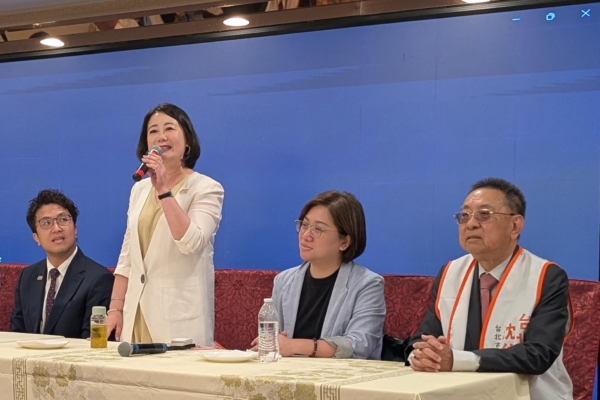
【Epoch Times, July 23, 2026】Taiwan-US cooperation continues to heat up, with Democratic Progressive Party (DPP) legislator Wu Si-yao visiting the United States on July 21st (Tuesday) to strengthen ties. The itinerary includes Los Angeles, Washington DC, and New York, focusing on “election exchanges, city exchanges, and congressional diplomacy.”
Wu Si-yao stated that the first goal is to connect with overseas support networks. She will assist legislator Shen Bo-yang in his campaign for Taipei mayor by establishing support associations in both the west and east coasts of the United States. These associations bring together Taiwanese expatriates from over 15 cities and regions, symbolizing the global support network for Shen Bo-yang being officially launched from North America.
Next is promoting city international exchanges, in line with Shen Bo-yang’s future plan to hold the “Infinite City Forum,” advocating for Taiwan to establish cooperation with major global cities through democracy, technology, and cultural soft power. Cooperation topics include climate change, aging society, human-centered transportation, urban governance, and industrial development, with the hope of drawing from US experiences for future policy references.
Lastly, Wu Si-yao aims to deepen Taiwan-US congressional and party diplomacy, with the delegation visiting Washington DC to meet with various American political figures for in-depth discussions on bilateral cooperation, regional security, and the Indo-Pacific situation.
When discussing the message to the overseas community, Wu Si-yao emphasized that “Taiwan is experiencing its peak national strength.” She pointed out Taiwan’s impressive economic performance, ranking among the top twenty global economies and leading in high-tech and semiconductor industries that continue to drive global supply chain development. The government is also transforming economic success into public welfare by expanding investments in education, healthcare, social welfare, and public infrastructure resources.
In terms of national defense and security, facing ongoing military pressure from China, Taiwan is actively enhancing defense self-sufficiency, asymmetric warfare capabilities, and societal defense resilience, while deepening security cooperation with the US to jointly maintain peace and stability in the Indo-Pacific region.
“We hope to show our friends overseas that Taiwan not only possesses a robust economic power but also has a strong determination to safeguard democracy, freedom, and national security,” Wu Si-yao stated.
Looking towards the future development of Taiwan-US relations, Wu Si-yao proposed three major areas for deepening cooperation:
1. Economic and trade cooperation: Building on a solid foundation of Taiwan-US tariff negotiations, leveraging advantages in the semiconductor and high-tech industries to extend Taiwan’s successful tech park model to the United States, working together to create a “non-red supply chain” of democratic nations.
2. Security cooperation: Continuing to promote arms sales, defense cooperation, and regional security exchanges to address challenges in the Indo-Pacific region.
3. Soft power exchanges: Combining strengths in education, culture, technology, healthcare, and social welfare systems to deepen bilateral societal and academic network connections.
To strengthen the connection between overseas second and third-generation Taiwanese youths and Taiwan, Wu Si-yao mentioned the government’s “Billion Youth Overseas Dream Program,” which aims to invest billions of dollars over the next decade to support young generations in studying abroad and pursuing their dreams, making the youth key players in public diplomacy. Additionally, she advocates for expanding academic cooperation and exchange programs between Taiwanese universities and international institutions to enhance Taiwan’s international visibility comprehensively.
Wu Si-yao expressed special gratitude to overseas compatriots for their long-term support for Taiwan. She acknowledged that as Taiwan gains increasing international attention, pressure from the Chinese Communist Party is also growing. She urged compatriots to maintain confidence and continue to be Taiwan’s strongest support, so the world can see Taiwan’s crucial values.