
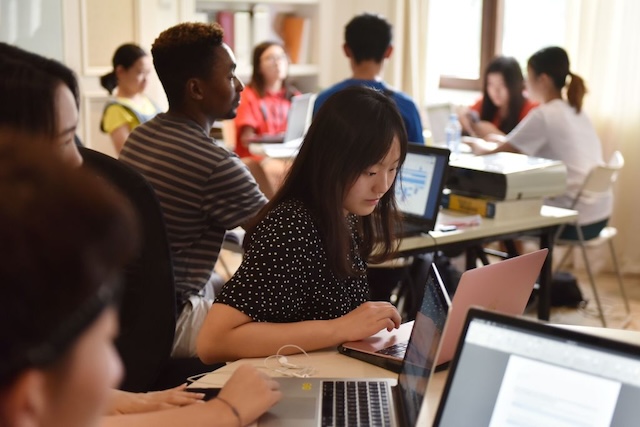
Under the influence of tense and fierce geopolitical relations between the United States and China, educational exchanges between the two countries are facing one of the most challenging periods in recent years. A report released by the US-China Education Trust (USCET) in 2026 indicates that the number of American students studying in China has dropped to less than 2,000, a significant decrease of over 80% compared to around 11,000 in 2019.
This decline is not a sudden development this year but has been ongoing for the past four to five years since the outbreak of the pandemic in 2020. During the 2011/2012 academic year, the peak number of American students studying in China reached around 15,000. By the eve of the pandemic in 2019, the number had remained at approximately 11,000.
Between 2020 and 2022, due to the impact of pandemic lockdowns and border restrictions, the number of American students studying in China experienced a steep decline, reaching only around 300 to 350 at its lowest point.
According to data from the Institute of International Education (IIE) “Open Doors” and official estimates, in the 2023/2024 academic year, the number was about 1,749, and by 2025/2026, it still hovered below 2,000. Although there has been some recovery compared to the extreme lows during the pandemic, the numbers have still plummeted by more than 80% compared to pre-2019 levels.
USCET stated that the sharp decrease in the number of American students going to China is not only a lingering effect of the pandemic but also reflects the deterioration of US-China relations, competition in defense technology between the two countries, Chinese national security policies, travel bans, and personal security concerns, among other factors.
Former US Ambassador to China, Nicholas Burns, warned that if this trend continues, the United States may face a severe shortage of professionals with expertise in understanding Chinese language, culture, society, and politics in the next decade, affecting the government, businesses, and academia’s understanding and policymaking abilities regarding China.
The report revealed that many Americans are concerned that their experiences in China may have negative implications for future employment in the US government. They generally believe that their experiences in China may hinder their ability to obtain the security clearances necessary for positions in the US government, thus hesitating to study in China.
Moreover, to prevent China from stealing advanced US research, protect American innovation, and national security, many US universities have complied with federal and state government requirements by closing programs sending students and scholars for exchanges in China.
USCET pointed out that the majority of American students currently studying in China are participating in short-term university exchange programs, while the number of those pursuing graduate studies or engaging in long-term research has decreased.
At a workshop report release event held in March this year, experts including the working group chairman, American scholar David M. Lampton, urged the United States to reestablish mechanisms for studying in China and academic exchanges.
The report suggested that the education sector collaborate with US policymakers to establish more comprehensive safety and risk management systems, provide pre-departure training for students and scholars going to China, guide them on how to protect electronic devices and data from theft and leakage, and enhance awareness of security and intelligence risks.
The report particularly emphasized the need for Americans to understand that American students in China have been approached by Chinese intelligence operatives, and there have been a few confirmed cases of recruitment, indicating that individuals planning to stay in China long-term need to be aware of the characteristics of Chinese intelligence operations.
The organization believes that if the US wants to cultivate a new generation of professionals who truly understand China, the experience of students directly studying, living, and researching in China remains irreplaceably important. Currently, not only has the number of undergraduate short-term programs decreased, but more significantly, the lack of in-depth experiences in China for graduate students and research-oriented talent (especially in the humanities and social sciences) is alarming.
Continuing in this manner poses the risk of a fracture in research-oriented talent, and solely relying on distance learning or studying in Taiwan/other Chinese-speaking regions cannot fully substitute for “on-the-ground” insights. As China becomes more closed off and data remains opaque, the necessity of real-world experiences becomes even more pronounced.