
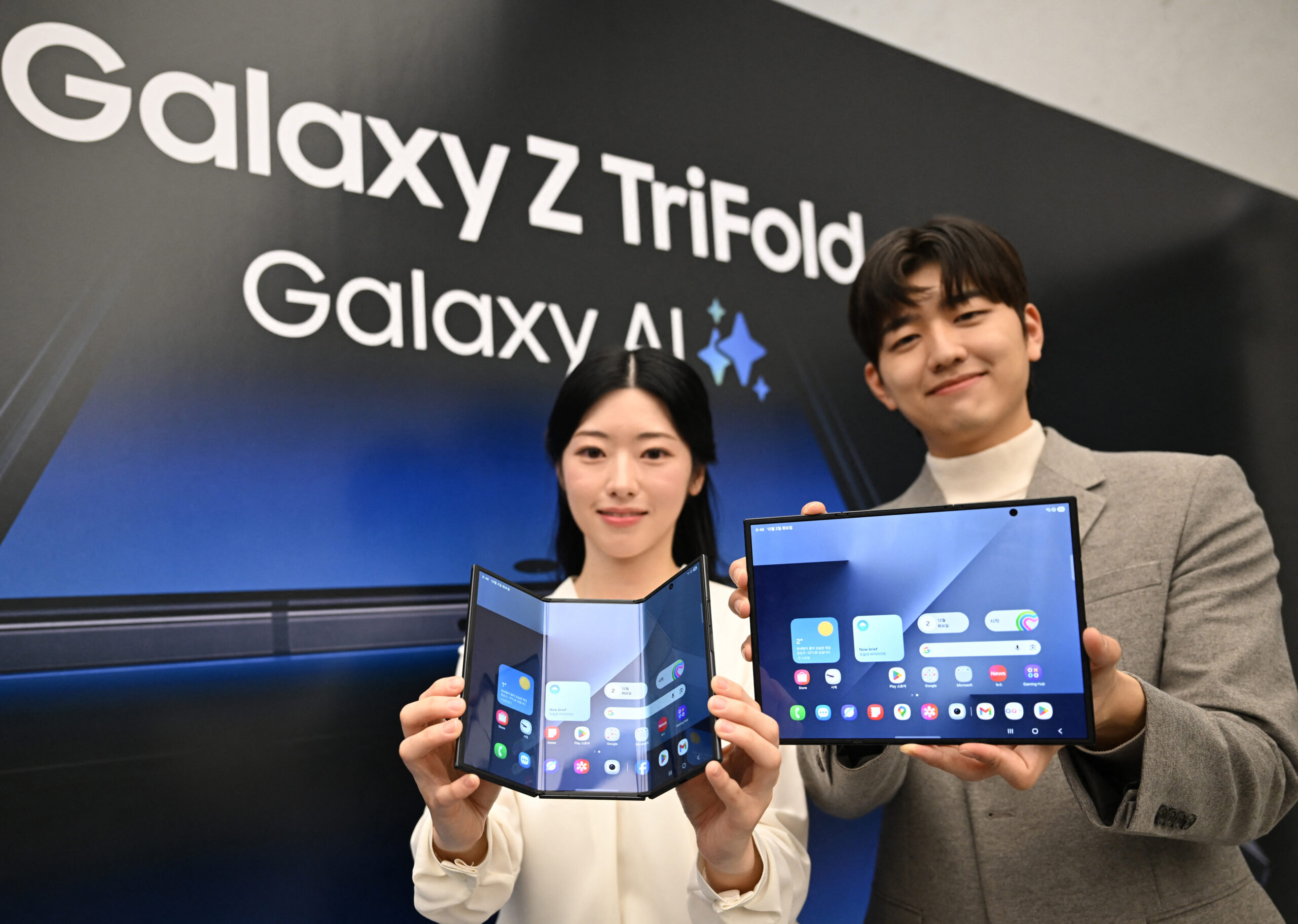
On Wednesday, July 22nd, in order to compete with Apple, South Korean smartphone giant Samsung took the lead in launching three new foldable screen devices: Galaxy Z Flip 8, Z Fold 8, and Z Fold 8 Ultra.
The high-end Ultra model continues Samsung’s long-standing foldable screen design, while the mid-range Fold 8 model, targeting the majority of consumers, features a shorter and wider design with a screen ratio of 4:3, more suitable for watching videos, reading books, and playing games. The FlexWindow feature of the Galaxy’s outer screen has also been enhanced.
Samsung started accepting pre-orders for the new devices on Wednesday and will officially begin shipping on August 7th.
The release of these new models by Samsung in late July is ahead of Apple’s launch of the first foldable screen iPhone in September. While foldable screen phones have long been introduced by Chinese manufacturers like Huawei, with Samsung and Apple joining the trend, it signifies a new phase of competition in the largest consumer market in the world, the United States.
Here are the key features of Samsung’s new phones summarized by Bloomberg.
At the media briefing before the Wednesday launch event, Samsung introduced that the Fold 8 is the lightest model in the series so far. A reporter from Bloomberg mentioned that during hands-on experience, it felt easy to reach the top of the 5.5-inch outer screen without having to strain the thumb for operation.
The unfolded screen of the Fold 8 measures 7.6 inches with a screen ratio of 4:3, allowing videos to occupy a larger screen space. The viewing experience was notably better compared to traditional phones like the Galaxy S26 or iPhone 17 Pro Max, according to a Bloomberg reporter.
Samsung addressed some complaints from heavy users by enhancing the charging speed of the Ultra. It now supports 45-watt wired charging and 20-watt wireless charging, while the wired and wireless charging speeds of the Fold 7 were 25 watts and 15 watts respectively. Despite being thinner than the Fold 7, the Ultra is equipped with a larger 5000mAh battery.
Samsung also took measures to alleviate the long-standing issue of fold marks. The company used a new titanium alloy film on the screen of the Fold 8 Ultra to make the fold marks less noticeable, and there is also a thin titanium plate beneath the screen to further reduce the fold marks. These two upgrades also apply to the standard Fold 8.
However, a Bloomberg reporter mentioned that when viewed from certain angles during the hands-on experience, the fold marks were still visible, although not as pronounced.
During the launch event, Byung Duk Yang, the Executive Vice President of Samsung’s Core Component Technology Team, stated that they cannot sacrifice other technological advantages in order to reduce the visibility of fold marks. He pointed out that Samsung’s hardware engineering team has put in a significant amount of time and effort to minimize fold marks to the fullest extent.
The Galaxy Z Flip 8 has minimal changes in appearance and hardware, but the outer screen’s “FlexWindow” function has been enhanced to run more applications without having to unfold the phone. The processor has returned to Qualcomm after briefly using Samsung’s own Exynos chip last year, and the device features a thinner body.
The prices for the Galaxy Z Flip 8, Z Fold 8, and Z Fold 8 Ultra are $1,200, $1,900, and $2,100 respectively. The Flip series saw a $100 increase from last year’s models, the Fold 8 maintained its price, while the Ultra saw a $100 rise.
All three new devices incorporate artificial intelligence (AI) features, including Google’s chatbot Gemini for “agent-like” automated tasks such as ticket booking, “My FanCam” for automatic tracking and editing of videos, and the ability for users to create their own main screen widgets.