
Taiwan’s President, Lai Ching-te, stated on the 21st that he is currently promoting the organization of an “Education and Employment Expo” with the aim of attracting outstanding students from around the world to study in Taiwan and stay for employment. Presidential spokesperson, Guo Ya-hui, mentioned that President Lai’s new blueprint is gradually being implemented, hoping to attract international talented professors to teach in Taiwan through support from the business sector. This initiative also encourages more excellent foreign students to come to Taiwan for studies with scholarships funded by enterprises, thus enhancing Taiwan’s international appeal in higher education and industrial environment.
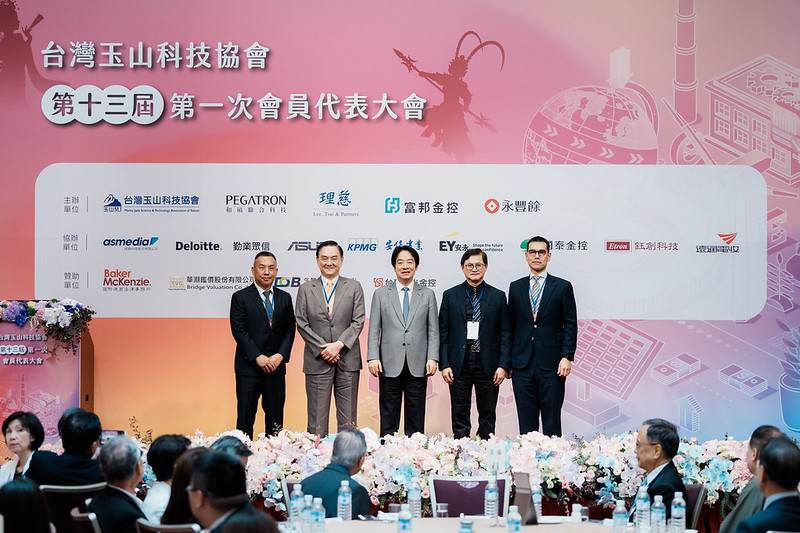
On the evening of July 21st, President Lai Ching-te attended the “13th Annual General Meeting of the Taiwan Yushan Technology Association” and delivered a speech. He first expressed gratitude to the Chairman of the Taiwan Yushan Technology Association for the invitation, acknowledging the collaborative efforts of the association, various industries, and the government in overcoming challenges through innovation and upgrading, ultimately contributing to Taiwan’s continuous enhancement of overall competitiveness.
President Lai pointed out that Taiwan’s economic growth rate reached 5.6% two years ago, surged to 8.76% last year, and achieved 14.55% in the first quarter of this year. The estimated annual economic growth rate for this year is 9.64%, with recent forecasts from the Central Research Institute suggesting it could surpass 10%. Furthermore, according to the IMD World Competitiveness Yearbook published by IMD in Lausanne, Switzerland, Taiwan has been ranked first among economies with over 20 million people for six consecutive years. This year, Taiwan reached its best historical ranking, standing at 4th globally, all of which are attributed to the collective efforts of the nation.
Regarding education and democracy, Lai Ching-te emphasized that this year marks the 30th anniversary of Taiwan’s direct presidential election, held for the first time in 1996. At that time, during the presidential election, the mainland China launched missiles over Taiwan, and the United States dispatched two aircraft carriers to the Taiwan Strait, ensuring the continuation of Taiwan’s democracy. Lai highlighted the courage of the Taiwanese people in electing their first president through sacred votes, affirming to the international community that Taiwan is a democratic nation, where the people are the masters of the nation and its future lies in the hands of the people, non-subjugated by external influences.
President Lai mentioned that the systematization of direct presidential elections has prompted the Democratic Progressive Party (DPP) to adjust its positioning in national matters. In 1999, the DPP passed the “Resolution on Taiwan’s Future,” advocating that Taiwan, as the Republic of China, is a sovereign independent country with a constitutional name of the Republic of China, and that the sovereignty of Taiwan and the People’s Republic of China are not subordinate to each other, emphasizing that Taiwan’s future must be determined by the Taiwanese people.
He further explained that this resolution became a fundamental basis for former President Tsai Ing-wen’s “Four Holds” proposed in her National Day speech in 2021. These four principles include steadfastly upholding the constitutional system of freedom and democracy, maintaining non-subordination between the Republic of China and the People’s Republic of China, safeguarding sovereignty from encroachment and annexation, and asserting that the future of Taiwan, as part of the Republic of China, must be decided by its 23 million people. A few months after the proposal of the “Four Holds,” related public opinion surveys showed that approximately eighty percent of people, regardless of party affiliation, supported these principles.
“Currently, there is no Taiwan independence issue in Taiwanese society. The focus lies on ensuring national sovereignty, continuing to uphold a way of life that values freedom, democracy, and human rights,” stated Lai Ching-te. He emphasized that the vast majority of Taiwanese people do not want to accept Communist Party rule. Safeguarding national sovereignty, preserving a way of life that values freedom, democracy, and human rights, becomes one of his most important responsibilities as President to prevent Communist Party governance.
President Lai mentioned that since taking office, he has been actively promoting educational equity. The government not only implemented a tuition-free policy for senior high schools but also provides an annual subsidy of 35,000 yuan for students in private colleges; additionally, an extra 20,000 yuan subsidy for students from low-income families and a 15,000 yuan subsidy for students from middle and low-income households. He highlighted that in rural areas and regions with relatively limited educational resources, children have fewer opportunities to enroll in public universities, thus, the government aims to reduce the gap in tuition fees between public and private schools to ensure educational equity. The fundamental spirit behind these initiatives is the promotion of equal educational opportunities for all, regardless of their family background, with the government’s full support for those willing to seek education, aiming to equip children with wings to pursue their dreams.
He believed that a country’s development is intertwined with nurturing talents through education. The more and better talents a country has, the better its society will be. Through education, individuals can acquire professional knowledge and improve their lives, leading to personal prosperity and a thriving society.
To ensure a worry-free education for children, the government is pushing for the “Higher Education Student On-Campus Accommodation Subsidy.” Each student will receive a subsidy of 5,000 yuan per semester. Additionally, the Ministry of Education is offering subsidies for the reconstruction of public and private university student dormitories, along with a rental subsidy program to assist students living off-campus. Furthermore, the government provides interest rate subsidies for new green safe loans, and promotes the “TPASS Commuter Monthly Pass” to reduce transportation costs, aiming to assist young people during their educational and employment phases.
Furthermore, the government recently introduced the “Aid for Growth Allowance for 0-18-year-olds.” Families will receive a monthly allowance of 5,000 yuan for children aged 0-6, and 2,500 yuan for children aged 6-18. The remaining 2,500 yuan for children aged 6-18 will be stored by the government as growth assistance. Children can receive a total of 1.08 million yuan from birth to the age of 18, with 360,000 yuan being saved by the government over the span of 12 years. This fund guarantees a minimum interest rate for a two-year fixed deposit so that children have financial support for future education or vocational training.
Lai Ching-te mentioned that due to economic progress in Taiwan, the government can use tax revenues to care for young people and implement educational equity. It is his hope that every child born and raised in Taiwan in the future will be able to chase their dreams, making Taiwan their ideal dreamland. To support young people aged 15 to 30, the government has introduced the “Youth Overseas Dream Fund Project,” allowing children to broaden their horizons and acquire skills abroad, such as studying makeup and beauty in Japan, or learning street dance in Korea or New York, providing opportunities for young people to explore the world and showcasing Taiwan to the global stage.
As President, he emphasized the importance of safeguarding national security and maintaining democratic freedom. In such a system, ensuring that all industries flourish is vital. He expressed his commitment to considering future generations, providing equal opportunities for all, irrespective of their family background, to pursue their dreams.
Lai Ching-te mentioned that he is currently pushing for the organization of an “Education and Employment Expo” in Taiwan. This initiative is driven by the substantial demand for talent in Taiwan from a plethora of international renowned corporations. President Lai aims for the top 100 companies in Taiwan to donate scholarships, attracting outstanding students from different countries to come to Taiwan for education and employment. This endeavor satisfies Taiwan’s urgent need for talent while fostering the growth of Taiwan with international talent.
President Lai’s plans also include the establishment of the “Taiwan Lecture” and “Taiwan Scholarship” concepts, aiming to attract outstanding international professors to teach in Taiwan and encourage more excellent foreign students to pursue studies in Taiwan with scholarships funded by enterprises. Through these measures, the international appeal of Taiwan’s higher education and industrial environment is expected to be significantly enhanced.