
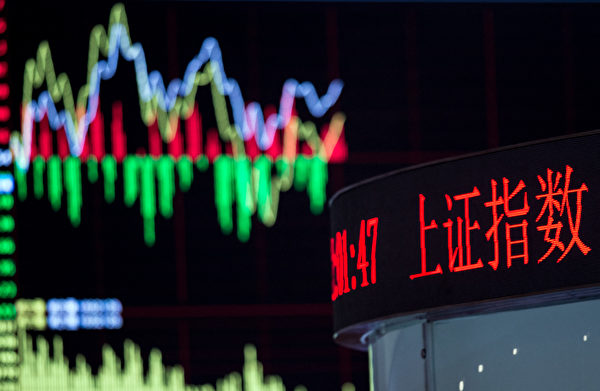
Recently, the A-share market has been tumbling non-stop, with the Shanghai Composite Index plummeting more than 230 points within a week (from July 10 to July 17), returning to the level of September 2025, and the market sentiment is extremely pessimistic. Over the weekend, the Chinese authorities released positive news, and on Monday (July 20), the A-share market opened high and then fell, still fluctuating and diving. The national team intervened half an hour before the market closing to stabilize, but the effect was not significant. The Shanghai Composite Index closed slightly up by 0.85%, with over 200 individual stocks hitting the limit down.
On July 20, the A-share market experienced fluctuations throughout the day. By the closing bell, the Shanghai Composite Index rose by 0.85% to close at 3796.28 points; the Shenzhen Component Index fell by 0.71% to close at 13610.23 points; the ChiNext Index rose by 0.42% to close at 3443.10 points. The turnover of the two exchanges amounted to 2.7 trillion Renminbi (RMB), an increase of 47.2 billion from the previous trading day. In terms of market performance, there was a chaotic mix in the market: 3710 individual stocks declined, with over 200 stock prices hitting the limit down, 1740 individual stocks rose, and 54 individual stocks hit the limit up.
In terms of capital flow, the main board saw a net outflow of 61.783 billion yuan throughout the day, with 20.228 billion yuan outflow from the Shanghai Stock Exchange and 41.555 billion yuan outflow from the Shenzhen Stock Exchange.
Looking at the sector performance, the power sector experienced collective gains, with Huaan Power, Leshan Power seeing consecutive gains, Fuling Power, Jinkong Power hitting the limit up; the coal sector strengthened with Daoyou Energy, Zhengzhou Coal Power hitting the limit up. On the downside, the PCB concept sector underwent collective adjustments, with CCL leading the decline, Baoding Technology, Jin’an National Records, Tung Crown Copper Foil hitting the limit down. The PO concept retreated during trading, with Yuanjie Technology hitting a 20% decline. The electronic special gas concept continued to decline, with China Ship Special Gas hitting a 20% decline.
In the afternoon, the Shanghai Composite Index fell by 0.3%, the Shenzhen Component Index fell by 2.23%, the ChiNext Index dropped over 2% at one point, the Growth Enterprise Market Index plunged by about 4%, and the ChiNext Comprehensive Index fell by over 5%. More than 4200 individual stocks in the overall market declined, nearly 300 individual stocks hit the limit down. Around two-thirty in the afternoon, the national team intervened to stabilize, with several broad-based ETFs showing significant increases in trading volume, leading to a rebound in the A-share index.
Despite the national team’s intervention to support the market, they could not halt the overall downward trend in the A-share market. The stock indices like the Shanghai Composite Index and the ChiNext Index reversed slightly into the green by the end of the trading session.
In recent times, the A-share market has been consistently declining, severely damaging market confidence.
On the evening of July 19, the China Securities Regulatory Commission (CSRC) and China Chengtong announced simultaneously that they would continue to increase their holdings of central enterprise stocks. On July 20, the insurance giants China Life Insurance, China Pacific Insurance, and Ping An Insurance announced their support for the development of the capital market. At the same time, three major securities firms and 154 listed companies announced buybacks, and eight private equity firms and 30 mutual funds announced self-purchases.
On the morning of July 20, Wu Qing, the Chairman of the CSRC, conducted an investigation at the Beijing securities business department and chaired an investor symposium, engaging in face-to-face discussions with 8 representatives from various types of investors, including retail investors, to seek advice on stabilizing the capital market.
After the A-share market closed, renowned Chinese financial commentator Shui Pi (formerly known as Lu Pingbo) posted on social media stating, “The market is rapidly cooling down, with intensive market support policies in place, faster than the market’s expectations, and the market performance is somewhat abnormal. The current round of positive policies includes the State-owned Assets Supervision and Administration Commission’s stance, CSRC’s special meeting, listed companies’ buybacks, and major shareholders’ increased holdings. During trading, news emerged one after another about insurance companies and fund companies announcing self-purchases. However, the market ultimately experienced a situation of high opening but low closing, which has become a reality.”
Economic blogger “Chaos20000” warned, “If the market rescue funds mainly concentrate on buying broad-based ETFs like the Shanghai-Shenzhen 300, ChiNext 50, and the Growth Enterprise Market, while funds continue to concentrate on index-weighted stocks, with technology small caps and a large number of non-index-weighted stocks continuing to decline, the market should be wary of a risk—the small caps may enter a panic decline due to further deterioration of liquidity.”
Knowledgeable blogger “Non_Nervous_Nuisance” posted, stating, “If you can’t make money in the A-share market, don’t blame yourself. This is not our fault; it’s the market’s problem. We have already tried very hard…”