
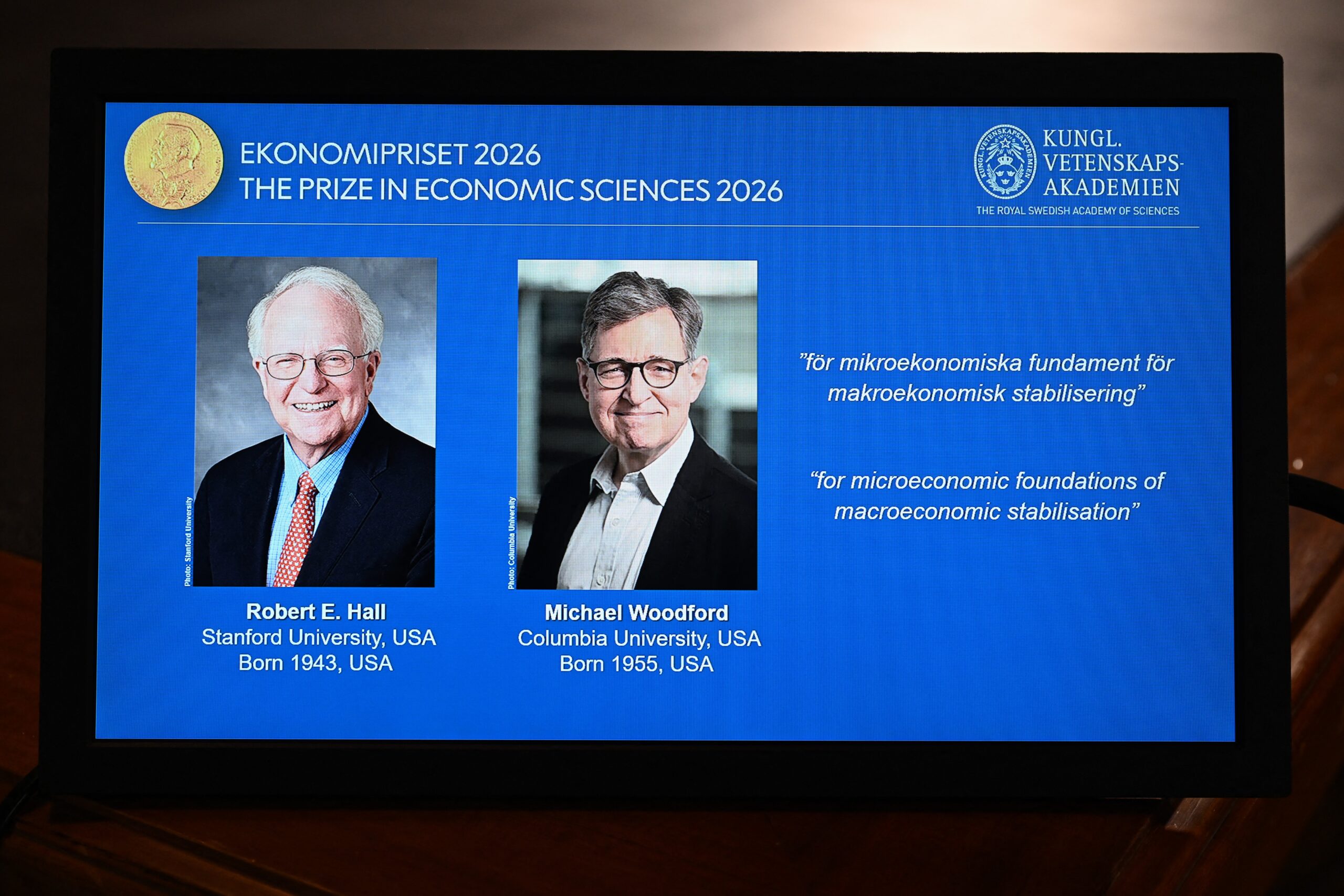
The Royal Swedish Academy of Sciences (RSAS) awarded the 2026 Nobel Prize in Economics to American scholars Robert E. Hall and Michael Woodford on Monday, October 12th, in recognition of their contributions to researching the microeconomic foundations of macroeconomic stabilization policies.
The Economics Prize is the last Nobel Prize announced this year, with a prize sum of 12 million Swedish Krona (approximately 1.2 million USD), to be shared equally by the two laureates. The Nobel Prizes in Medicine, Physics, Chemistry, Literature, and Peace were unveiled in the previous week.
According to the announcement by the Royal Swedish Academy of Sciences on that day, economic operations often involve cycles of recession and recovery. Stimulating or cooling the economy at the right time can help maintain economic stability, avoid prolonged recessions, or uncontrolled inflation.
The announcement stated that the research findings of Hall and Woodford have given birth to the New Keynesian models, which explain and quantify how stabilization policies impact business cycles. These models are currently widely used by central banks and finance ministries worldwide in policy-making.
“This new macroeconomic model developed by the two laureates has enhanced our ability to implement effective stabilization policies, supporting timely fiscal and monetary policy measures to mitigate the destructive impacts of severe economic fluctuations,” the announcement said. Governments and central banks utilize these models to decide on tax adjustments, policies like child welfare, and to handle economic shocks.
Chairman of the award committee, John Hassler, stated in a release, “The laureates’ research has provided a robust theoretical foundation for the models currently employed by central banks and governments globally.”
Robert E. Hall was born in 1943 in Palo Alto, California, USA, and obtained his Ph.D. from the Massachusetts Institute of Technology in 1967. He is currently a professor at Stanford University.
Michael Woodford, born in Chicopee, Massachusetts, USA, in 1955, earned his Ph.D. from the Massachusetts Institute of Technology in 1983. He is currently a professor at Columbia University in New York.
Last year’s Economics Prize was jointly awarded to Joel Mokyr, Philippe Aghion, and Peter Howitt for their research on “creative destruction” and how new technologies and production methods drive economic growth and improve living standards.