
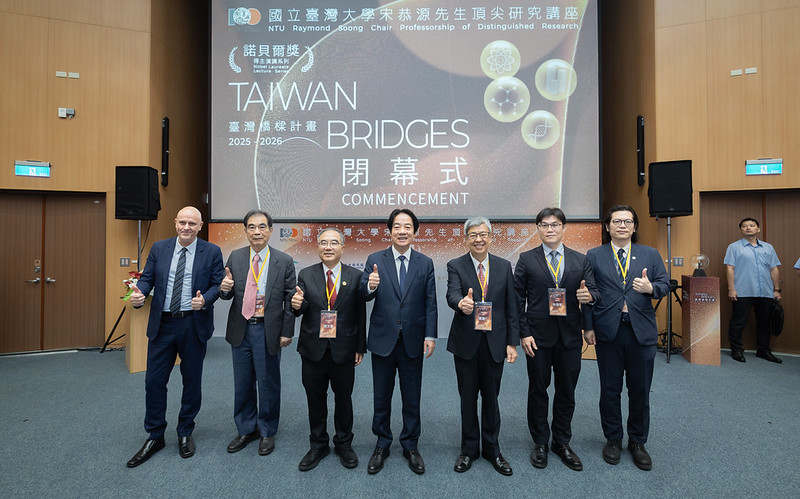
Taiwan President Lai Ching-te attended the closing ceremony of the “Taiwan Bridge Project” today (12th), stating that the project has brought top knowledge into Taiwan and has also allowed Taiwan’s research, talent, and ideals to reach out to the world. The government will continue to solidify basic research and higher education, nurture talents, provide a better research environment, expand cooperation and exchanges with top international academic institutions, and hope that Taiwan will become a key hub for global knowledge and talent exchange.
President Lai Ching-te attended the closing ceremony of the “Taiwan Bridge Project” this morning, along with Chen Chien-jen, President of the Academia Sinica, Chu Chun-chang, Deputy Minister of the Ministry of Education, Chen Ping-yu, Deputy Executive Secretary of the National Science and Technology Commission, Chen Wen-jen, President of National Taiwan University, Song Kung-yuan, founder of the Kuang Pao Group, and Uwe Morawetz, Chairman of the World Peace Foundation.
Upon arrival, President Lai Ching-te first watched the video showcasing the achievements of the “Taiwan Bridge Project.” In his speech, he expressed his delight at being invited to the closing ceremony and was deeply moved by the speeches delivered by President Chen Wen-jen and President Chen Chien-jen. The initial idea of President Chen Wen-jen was focused on how National Taiwan University could become a world-class institution and attract international resources to provide students with more knowledge. After discussions, the scale of the project was further expanded, with the number of invited Nobel Prize winners increased to 31.
President Lai Ching-te noted that in addition to the expansion of the project’s scale, its breadth continues to increase, benefiting universities in different regions of Taiwan. Furthermore, science camps were held in high schools to actively engage students and provide them with the opportunity to interact closely with Nobel Prize winners. The enthusiasm of students engaging with Nobel laureates reflects their thirst for knowledge and technology, which is believed to have a profound impact on Taiwan’s future.
President Lai Ching-te expressed his gratitude to President Chen Chien-jen for leading the Academia Sinica to fully engage in the project. He gained much from President Chen Chien-jen’s sharing, especially the inspiration of “finding a good question without an answer” and the journey of scientists from nothing to success after experiencing setbacks, which deeply impressed him on the challenges of scientific research and provided inspiration to young people aspiring to engage in scientific research.
President Lai Ching-te also thanked the Ministry of Education, the National Science Council, Chairman Uwe Morawetz of the World Peace Foundation, and Song Kung-yuan, founder of the Kuang Pao Group, for their joint efforts in promoting this important public-private cooperation project. He believed that the “Taiwan Bridge Project” has built three bridges for Taiwan:
The first bridge is the “Bridge of Knowledge,” inviting top knowledge from around the world into Taiwan and facilitating Taiwan’s research, talents, and ideals to reach the world. Faced with challenges such as climate change, artificial intelligence, disease threats, and geopolitical changes, no country can find all the answers alone.
Taiwan has a strong foundation in semiconductor, information and communication technology, biotechnology, and other fields. By building the “Bridge of Knowledge,” Taiwan aims to pose questions alongside the world and collectively search for solutions. Hence, this project invited international Nobel laureates to Taiwan, bringing their wealth of expertise into the country.
The second bridge is the “Bridge of Generations,” with 31 scholars who have changed the world coming to lecture at Taiwanese campuses. Among the students in the audience may be future scientists who will deeply influence a scientific field’s development twenty years from now. Taiwan has erected the “Bridge of Generations,” hoping that one day the world will be made better by Taiwan’s talents.
The third bridge is the “Bridge of Peace.” During the lectures, laureates mentioned how science is a common bridge for humanity and how it can promote peace. As divisions in the world increase, there needs to be more dialogue; Taiwan has built the “Bridge of Peace,” urging individuals across various fields to consider how they can use their expertise to promote peace and prosperity globally.
President Lai Ching-te mentioned that last November, he put forth a vision that within 30 years, Taiwan should add at least three Nobel laureates in the fields of physics, chemistry, and medicine. To achieve this goal, the government must allow room for curiosity, provide time for research, offer a stage for talents, and establish connections between Taiwan and the world.
He emphasized that the government would continue to focus on nurturing talents, providing a better research environment, strengthening basic research and higher education, enabling researchers to challenge the unknown, dedicate themselves to long-term and important research, and expand collaborations and talent exchanges with top international academic institutions for continued growth. By combining the efforts of the government, companies, foundations, and societal forces, a more stable and long-term support system will be established for basic research and talent cultivation.
President Lai Ching-te stated that the spirit of the Nobel Prize is to enhance human welfare through knowledge. He firmly believes that a free academic environment encourages questioning, and a democratic society promotes dialogue. In the future, Taiwan aims to become a key hub for global knowledge and talent exchange. With the power of science, education, and democracy, Taiwan will pursue peace, prosperity, and a better future for all humanity together with the world.