
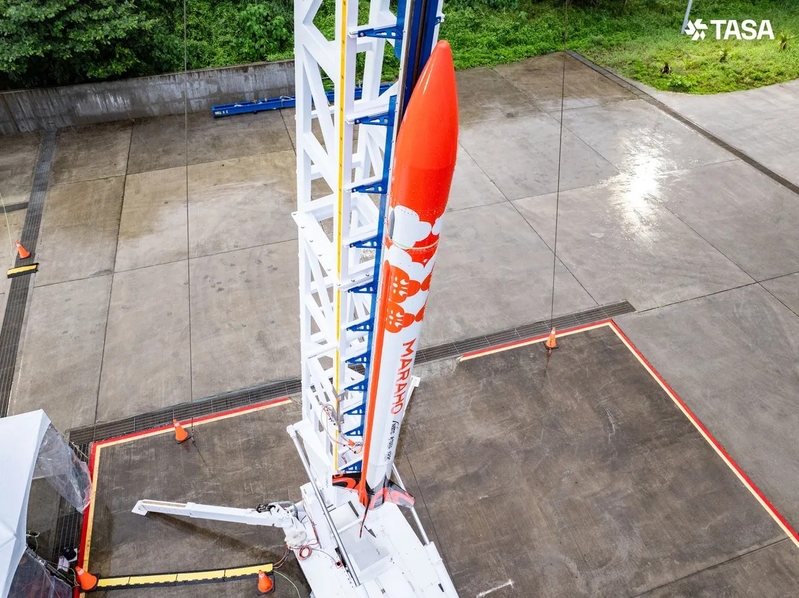
Following the successful launch of Taiwan’s first domestically developed sounding rocket “Island Veins MARAHO” by the Taiwan National Space Center (TASA) on the morning of the 22nd, two research rockets led by the National Yang Ming Chiao Tung University’s Institute of Space Systems Engineering and the Forward-looking Rocket Research Center completed their flight tests today (24th).
The Taiwan National Space Center announced in a press release that the two research rockets, named “SST3” with a length of 3.5 meters and altitude of 8.3 kilometers and “FARCX-1” with a length of 4.1 meters and altitude of 532 meters, were launched consecutively at the Xuhai Short-term Scientific Rocket Launch Site in Pingtung.
According to TASA, to nurture domestic rocket transportation talent, the National Science Council commissioned TASA to carry out research rocket development projects, entrusting the academic research community to develop research rockets and advance rocket technology through flight tests and verification. “SST3” has become the largest solid-state propellant sounding rocket launched in Taiwan to date, while FARCX-1 is Taiwan’s first student-developed and flight-tested liquid-propellant sounding rocket.
The SST3 mission team consists of 33 individuals, comprising members from ARRC, iSSE, ASARe Labs, the National Yang Ming Chiao Tung University’s Department of Mechanical Engineering, the National Cheng Kung University’s Department of Mechanical Engineering, and the Yang Ming Chiao Tung Formosan Fox student team. The rocket utilized the Pioneer-50K RNX solid fuel propulsion system, reaching a maximum altitude of 8.3 kilometers after 40 seconds of launch, with successful communication transmission at key stages despite the parachute failing to deploy for rocket recovery.
Dr. Wey Shi-Sin, assistant professor at the National Yang Ming Chiao Tung University’s Institute of Space Systems Engineering, noted that SST3 builds upon the achievements of the SSTO with a flight altitude of 1 kilometer in 2024 and the SSTT challenging 3 kilometers in 2025. The goal this year was to increase the target altitude to 9 kilometers, successfully verifying propulsion system and structural strength, aiming to provide a more diverse public propulsion system for future Rocket Taiwan Cup (RTC) competitions in Taiwan.
While SST3 aimed for higher flight altitudes, FARCX-1’s technical highlight lies in its independently developed liquid rocket propulsion system executed by ARRC. FARCX-1, involving iSSE, ARRC, the National Yang Ming Chiao Tung University’s Department of Mechanical Engineering, the Yang Ming Chiao Tung Formosan Fox student team, and the Central University ATLab team, employed a liquid propulsion system using high-concentration hydrogen peroxide as oxidizer and kerosene as fuel, with an initial propulsion of only 3 seconds reaching an altitude of 532 meters. Dr. Wey Shi-Sin highlighted that liquid rocket technology poses high technical barriers, and the success of the initial flight test has provided valuable data for further performance analysis to scale up energy levels and extend ranges.
TASA stated that the space industry chain encompasses satellite manufacturing, space transportation, ground equipment, and satellite data application. To fill the gap in Taiwan’s space industry chain in terms of “space transportation,” TASA, supported by the National Science Council’s policy, initiated the In-Orbit Rocket Development Program in 2023, continuously supporting the academic community in technological research and rocket talent cultivation.
TASA emphasized that the process of a rocket from design, manufacture, testing to actual launch involves various fields such as propulsion, structure, avionics, communication, recovery, and mission operations. Through actual flight tests of research rockets, students can establish a complete system engineering concept and problem-solving abilities.
To ensure Taiwan’s academic research community has a legal and safe rocket launch site, the National Science Council established the “Short-term Scientific Sounding Rocket Launch Site” in Xuhai, Pingtung, with TASA handling the review of usage applications and operational management. Since its inception, it has become a major testing ground for Taiwan’s scientific rocket projects.
TASA reported that up to now, 19 research sounding rocket launch missions have been completed, involving teams from the National Yang Ming Chiao Tung University, National Cheng Kung University, Feng Chia University, Tamkang University, and Central University, continuing to accumulate Taiwan’s rocket technology research and talent cultivation energy.
On the morning of the 22nd, Taiwan’s first domestically developed sounding rocket, “Island Veins MARAHO,” successfully completed its first test flight mission, with rocket ignition, flight, and parachute deployment executed smoothly. The rocket propelled for 18 seconds, reaching a take-off thrust of 1,500 kilograms, achieving a top speed of 408m/s supersonic (Mach 1.2), and reaching an altitude of 8.1 kilometers in 49 seconds, with a total flight time of 432 seconds. All flight procedures were carried out as planned, successfully obtaining the necessary verification data for the test flight.
Director Wu Tsung-Hsin of TASA highlighted that through the MARAHO mission, the young team at TASA could complete the entire end-to-end mission, including rocket design, manufacturing, assembly, integration testing, and test flights, thereby verifying key technologies, practicing mission processes, and accumulating team experience. This can reduce risks in subsequent large rocket developments, gradually strengthening the independent in-orbit rocket development capabilities, attributing today’s achievements to the support of NSC Chairman Wu Cheng-Wen serving as TASA’s chairman, as well as the cooperation and assistance of locals in Xuhai, Pingtung.
TASA noted that the main objective of this mission was to verify the complete operation of the MARAHO system in actual flight conditions, with a key focus on establishing full communication between the ground and the rocket, receiving real-time data transmission during the flight. Simultaneously, flight validations were conducted for independently developed propulsion, structure, avionics, communication, tracking, ground support, and recovery, with the gathered flight data serving as crucial references for future rocket design enhancements and subsequent flight tests.
Professor Wu Chih-Yung from the National Cheng Kung University’s Department of Aerospace Engineering pointed out that MARAHO maintained stable communication with the ground throughout the mission, successfully transmitting flight data. In-orbit rockets also require monitoring from the ground during flights, and this mission achieved this goal, setting an example for the successful verification of in-orbit rocket technology.
Professor Yeh Chun-Liang from the Feng Chia University’s Department of Aerospace Engineering commented that the filling process of the hybrid propulsion system with 90% hydrogen peroxide is complex, yet the pre-launch operations went smoothly and the launch was successful, meeting the mission’s expected goals. The flight test process was completed smoothly and can be certified as a successful launch.
In the future, TASA plans to verify each system of the first-generation orbital test rocket (STV1) in 2029, further validate complete vehicles through the second-generation orbital test rocket (STV2) in 2031, and ultimately carry out the first test flight of the first-generation in-orbit rocket in 2034 with the goal of delivering 200-kilogram payloads into low Earth orbit, gradually establishing Taiwan’s independent space-faring capabilities.