
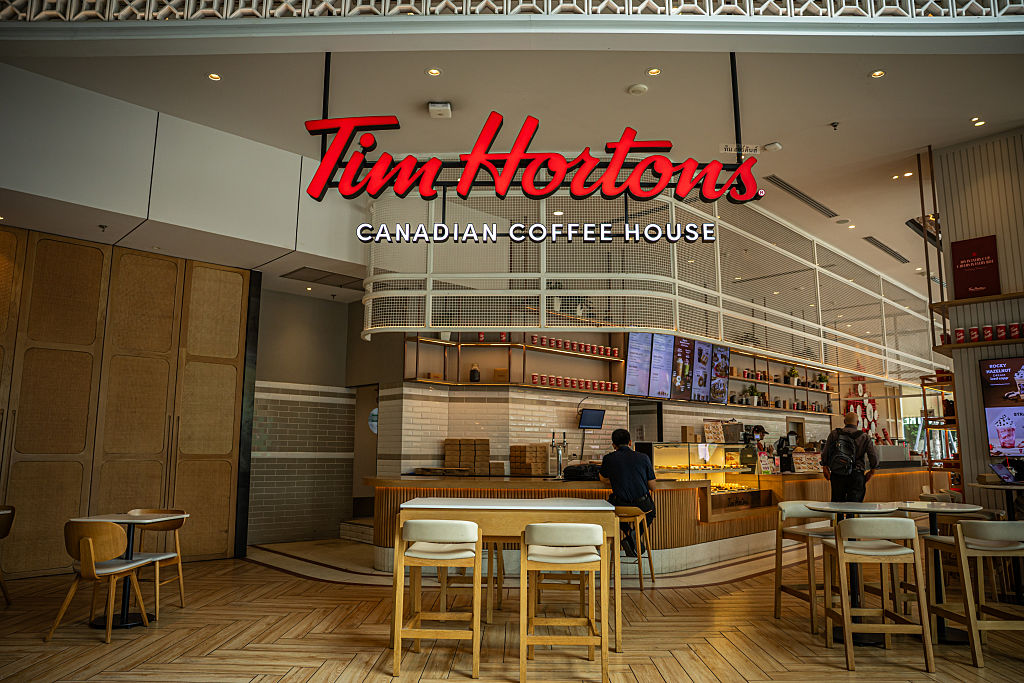
Tim Hortons, a Canadian coffee brand, has been operating in China under the name “Tims China” since 2019 but has yet to turn a profit. As of the end of June this year, the company has accumulated losses of approximately 3.31 billion yuan. In the second quarter, revenue decreased by 21.7% compared to the same period last year, with same-store sales down by 17.8%.
According to the financial report released on August 18 by “Tims China” (officially known as Tims Tianhao Coffee), the company’s revenue for the first half of this year was 530 million yuan, a decrease of 18.4% year-on-year. The net loss was 207 million yuan, expanding by about 53% compared to the same period last year.
In the second quarter, revenue was 273 million yuan, a 21.7% decrease from the previous year, with the net loss widening from 75.9 million yuan to 97.4 million yuan. The adjusted indicator used to measure the company’s operational performance, EBITDA, decreased from 2.2 million yuan to negative 21 million yuan.
As of the end of June, the company’s total assets were 1.028 billion yuan, total liabilities reached 2.434 billion yuan, and shareholder equity amounted to negative 1.407 billion yuan. The total cash, cash equivalents, and restricted cash only amounted to 121 million yuan.
In the second quarter, same-store sales at all “Tims China” stores decreased by 17.8%, with same-store sales at company-operated stores dropping by 17.3%.
The number of orders at company-operated stores decreased from 10.5 million to 8.3 million, a 20.7% decrease, and the average order value also declined by 0.9%. The contribution rate of company-operated stores decreased from 9.6% to 5.7% compared to the same period last year.
As of the end of June, “Tims China” had a total of 1,028 stores, a net decrease of 19 stores compared to the end of 2025, with company-operated stores reduced from 566 a year ago to 544.
“Tims China” focuses on “coffee + light meals” with prices mainly in the range of over twenty yuan. While brands like Luckin and CooTea have been competing for customers with low-price offers, this price point is also facing competition from Starbucks price reductions and brands like Manner and M Stand.
Lin Yue, an analyst in the food and beverage industry, previously told “Huaxia Times” that Tim Hortons faces competition not only from mid-range and affordable brands but also from high-end brands lowering prices and tea companies entering the market.
Wang Zhendong, Chairman of Shanghai Coffee Ventures, also expressed to “Jiemian News” that Tim Hortons operates more like a comprehensive restaurant selling light meals and coffee, leading to higher operating costs. In a situation of insufficient overall consumer demand, financial performance is more likely to face pressure.
Consumer growth in mainland China continues to slow down this year. Data from the National Bureau of Statistics of the Chinese Communist Party shows that in July, total retail sales of consumer goods increased by only 0.6% year-on-year, with a 1.2% growth in the first seven months of the year. In July, catering revenue increased by 1.4%, with catering revenue from large-scale units remaining flat compared to the same period last year; catering revenue in the first seven months of this year increased by 2.6%.