
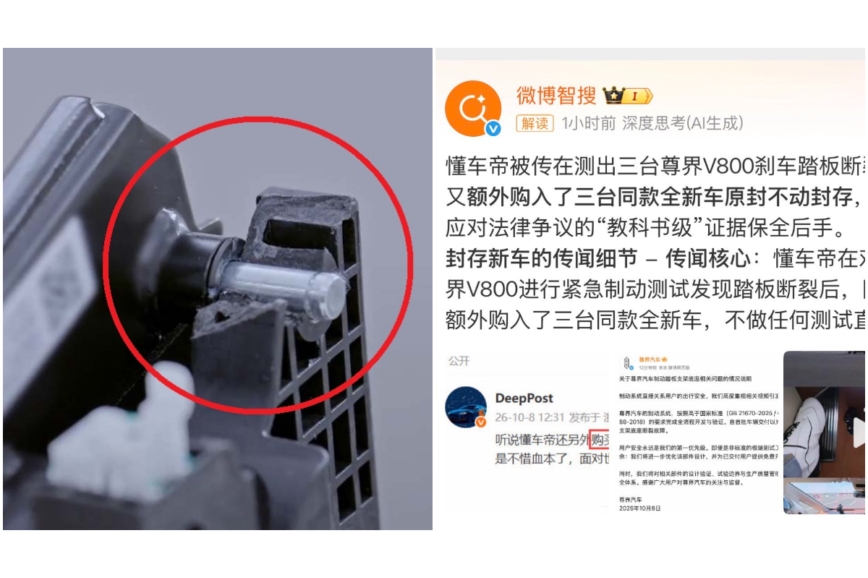
In recent news, the new cars of ZunJie V800 have caused a stir due to multiple incidents of brake pedal bracket failures during emergency braking tests by the car enthusiast platform “DongCheDi”. The controversy surrounding this issue continues to escalate, with even the Xinjiang government website questioning whether Huawei can “speak human language”. The People’s Daily previously linked the incident to “rush cars,” stating that ” ‘breakage’ should never occur while driving”! However, this assertion has been widely criticized. Moreover, the test videos have been taken down, and the reasons for the failures and corporate responsibilities are still unclear.
On October 11, the Chinese Communist Party’s official newspaper, People’s Daily, published an article titled “Four Departments Join Hands to Say No to ‘Rush Cars'”. The article describes China’s “rush cars” as those models launched to grab market share by compressing the research and development cycles excessively and reducing the real car verification process.
The article mentioned that public opinion is widely focused on the ZunJie V800 brake pedal bracket failure incident, with the main focus of discussion being the safety issues of cars, especially “rush” new energy vehicles. Although the event awaits an authoritative investigation conclusion, one thing is certain: a car’s brake pedal should never “break” while driving!
While the article emphasizes, “a ‘breakage’ should never occur while driving!” it does not directly address the specific issues with the ZunJie V800, but claims that the main focus of discussion is on the safety issues of “rush” new energy vehicles.
In fact, the focus of related public opinion is on questioning ZunJie V800’s manufacturer for consistently evading quality and design issues, and there is no indication of a conventional recall response or addressing these concerns.
Additionally, the test videos by DongCheDi have been successively removed from Weibo, Bilibili, and WeChat; Xinhua News Agency also deleted ZunJie’s response statement regarding the brake failure incident on the 9th. Furthermore, related topics no longer appear in the top fifty hot search rankings on Weibo. This authority’s actions have become a focal point of public opinion discussions.
Meanwhile, the Xinjiang government’s official WeChat public account, “Xinjiang Release,” released an article on the 10th with the title “In response to product safety issues, can you speak human language,” without naming Huawei, questioning, “[The public opinion] is asking if it is solid, and the answer is ‘I am compliant’,” “Speaking tactfully, answering everything except the question you asked.” However, the official Xinjiang article was also hidden within half a day.
Regarding the focus of the related public opinion, comments on X platform described that “DongCheDi has hit Huawei hard, and the authorities’ control of public opinion has not stopped Huawei’s momentum.”
Against the backdrop of this public opinion, the People’s Daily published an article on the “rush cars” statement from four departments; on the same afternoon, ZunJie Automobile’s customer service stated that the ZunJie V800 brake pedal bracket upgrade plan is expected to be confirmed by the end of October, with upgrades gradually starting from November. However, the customer service still did not address whether there are design issues or if defective cars will be recalled.
Regarding the People’s Daily article, comments on X platform pointed out, “Whenever public opinion is uncontrollable, it presents an urgent posture representing the people to put out the fire.”
In the comment section of Weibo, some people expressed concerns about a possible “reckoning after the autumn,” stating that “DongCheDi will also suffer delayed heavy losses,” and analyzing, “The problem with DongCheDi is that as a purely commercial media entity, it actually acquired the testing rights that were previously held by ministries, effectively punishing companies, causing Jianghuai’s market value to plummet by billions.”