
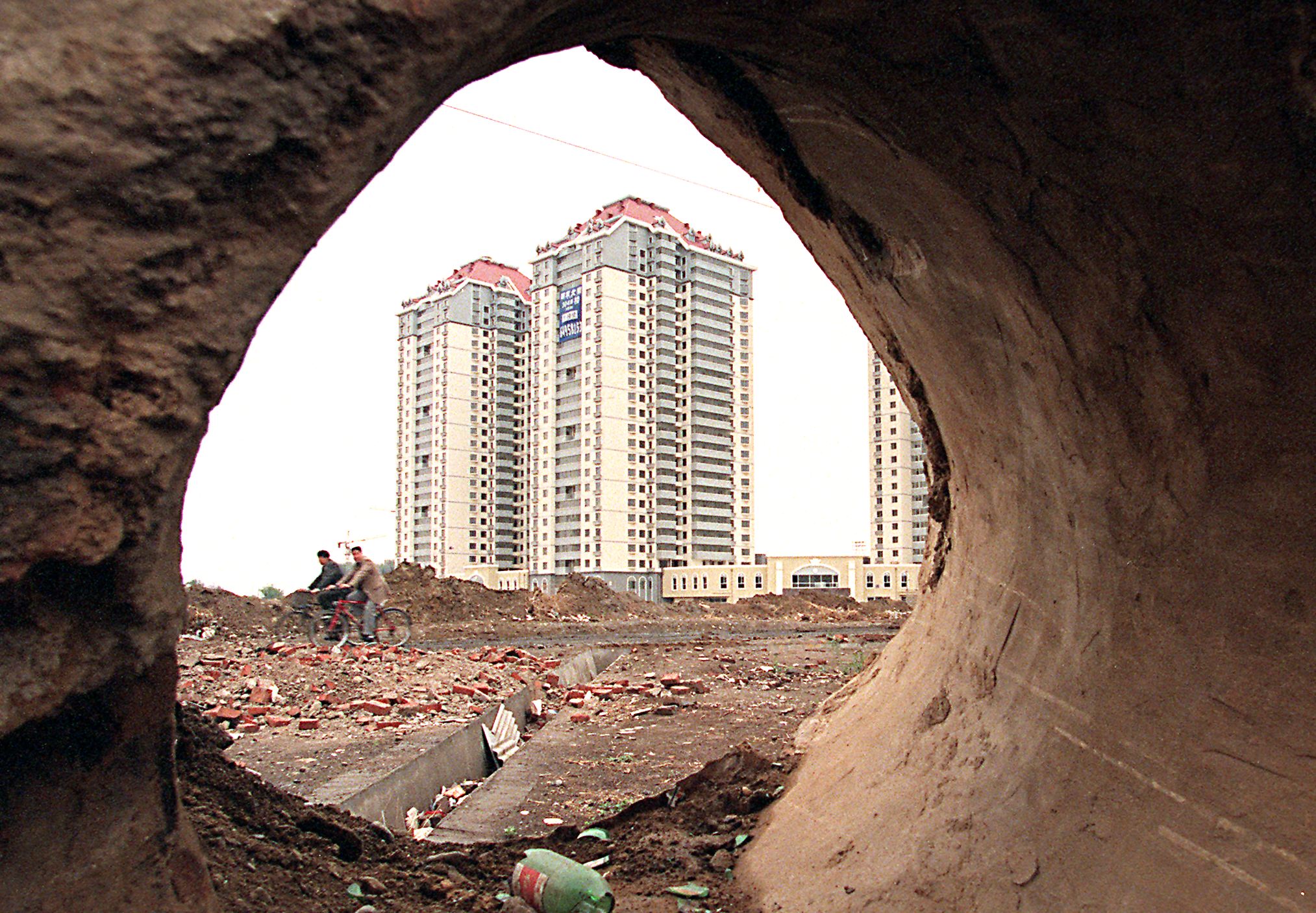
China’s real estate development total area is around 400 billion square meters, facing the issue of oversupply, while the proportion of second-hand housing in the overall housing market transactions is on the rise. Analysts believe that the Ministry of Housing and Urban-Rural Development of the Chinese Communist Party has stated that the real estate market has entered a stock era where new houses are not selling well, and it is a structural issue.
On September 18, the Ministry of Housing and Urban-Rural Development of the Chinese Communist Party held a press conference at the State Council Information Office. Zhang Xuetao, the director of the real estate market supervision department, stated that there have been two significant changes in the current real estate market. One is a major shift in the supply and demand relationship, and the other is the entry of the real estate market into a stock era, with the proportion of second-hand housing transactions increasing from 27% in 2020 to 46% in 2025. “In the first 8 months of this year, according to the data from the National Bureau of Statistics, the proportion of second-hand housing transactions has reached 52%, exceeding 50%, which signifies that the real estate market has entered the stock era.”
The National Bureau of Statistics of the Chinese Communist Party released the “Basic Situation of the National Real Estate Market from January to August 2026” on September 15, including data on second-hand housing transactions for the first time. From January to August, the national net signed area of second-hand housing transactions was 549.23 million square meters, an increase of 10.6% year-on-year. During the same period, the national sales area of new commercial housing was 498.80 million square meters, a decrease of 12.1% year-on-year. In addition, data shows that by the end of August, the national inventory of commercial housing was 750 million square meters.
Economist Ma Guangyuan wrote that the Ministry of Housing and Urban-Rural Development’s statement about the significant changes in the supply-demand relationship in real estate and the entry into the stock era indicate the end of the era of massive construction of houses in all cities nationwide. While the overall contradiction in quantity is decreasing, structural contradictions are becoming more prominent, with significant disparities in housing supply and demand between cities.
Political observer Xia Yan believes that the Ministry of Housing and Urban-Rural Development of the Chinese Communist Party’s concept of the real estate “stock era” is essentially due to developers defaulting on debts, leading to a loss of trust in presale homes, shrinking new home sales, and forcing property transactions to focus on second-hand homes. This signifies that over the past few decades, local governments have transferred the high cost of state-owned land through high-priced auctions to homebuyers. Now, with new homes not selling and land not being purchased, the land finance system is on the brink of collapse.
Industry insiders believe that the official labeling of this as entering the “stock era” makes it sound like a natural evolution of a mature market. However, removing the official jargon reveals that, in reality, new homes are not selling well, and it is a structural issue. Homebuyers are now more concerned about the inability to complete the transaction, lack of supporting facilities, and vacancy in the community, rather than just the high prices. Second-hand homes offer immediate occupancy, established facilities, and generally lower prices. Therefore, there is a significant shift in demand towards second-hand homes. New homes are struggling to attract buyers, making the denominator smaller, which gives the illusion of large sales figures. Furthermore, the properties that have real liquidity are those in good locations, with proximity to schools, and convenient commuting options; while old dilapidated homes in distant suburbs and large inventories of new homes are equally difficult to sell.
According to the “2026 China Housing Stock Report,” by the end of 2025, the total area of urban residential housing stock in China had reached 35.22 billion square meters (approximately 377 million units). Currently, the total construction area of properties under development by developers nationwide is 5.608 billion square meters, with the residential construction area accounting for 3.893 billion square meters. The combined total area of urban residential housing stock and residential construction under development is close to 400 billion square meters.
The report suggests that metropolitan areas and urban clusters, with a continuous influx of population, may still face housing shortages in the future. However, cities in the Northeast, Northwest, and non-metropolitan urban clusters have already encountered oversupply due to severe population outflows, and the degree of surplus is likely to deepen in the future.