
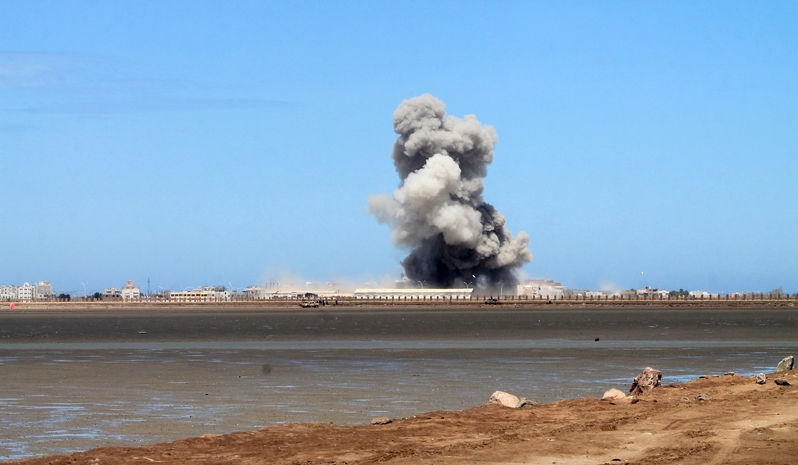
Saudi Arabia and the Houthi rebels in Yemen have recently launched attacks at each other, leading to the escalation of conflict spreading to the border regions of both Saudi Arabia and Yemen. Meanwhile, a large number of Yemeni civilians are fleeing their homes, with some even boarding small boats to cross the Red Sea and seek refuge in Djibouti, Africa.
According to a report by Reuters on September 17th, the Houthi-controlled television station claimed that the Saudi air force bombed areas near the Saudi border and along the Red Sea coast in Yemen’s Hajjah province and the southern Taiz region.
The Saudi Civil Defense Department stated that a Yemeni resident living in Saudi Arabia died near the western city of Taiz due to debris from a Houthi drone intercepted by Saudi forces. This marks the first civilian death due to a Houthi attack since the escalation of conflict last week, with over 80 people previously reported injured by the Saudi side.
The conflict is displacing Yemeni civilians towards the Red Sea. The International Organization for Migration (IOM) announced on September 18th that recent clashes have displaced at least 112,000 Yemenis internally, with nearly 3,000 individuals fleeing to Djibouti by boat. Many families, lacking food and other essentials, are boarding overcrowded vessels to cross the Bab el-Mandeb strait in search of safety.
Wahida Omer, a 50-year-old woman from the village of Dhubab on the Yemeni Red Sea coast, recounted fleeing to Djibouti by boat after her village was attacked. She expressed the harrowing and challenging nature of the sea crossing, with passengers crying throughout the journey and upon arrival, with scarce food supplies available.
The Houthi rebels have recently made rapid advances towards the Yemeni Red Sea coast, gaining control over more strategically important areas near the Bab el-Mandeb strait. This strait connects the Red Sea and the Gulf of Aden, serving as a crucial maritime passage between Asia and Europe. The expansion of Houthi influence in this region not only poses a greater risk to Saudi Arabia’s alternative Red Sea oil transport route, but also threatens global energy supply stability.
Currently, the shipping in the Hormuz Strait has been significantly affected by the conflict, forcing Saudi Arabia to rely more on the Red Sea direction for oil exports. Should the Red Sea and Bab el-Mandeb strait also come under conflict, the global energy supply will face even greater uncertainty.
However, market concerns over Saudi supply disruptions eased on September 18th, with Brent crude prices dropping for the third consecutive day but still remaining above $100 per barrel. Saudi Arabia is increasing crude oil transshipment through ship-to-ship transfer at the port of Sohar in Oman to alleviate the impact of blocked Red Sea exports.