
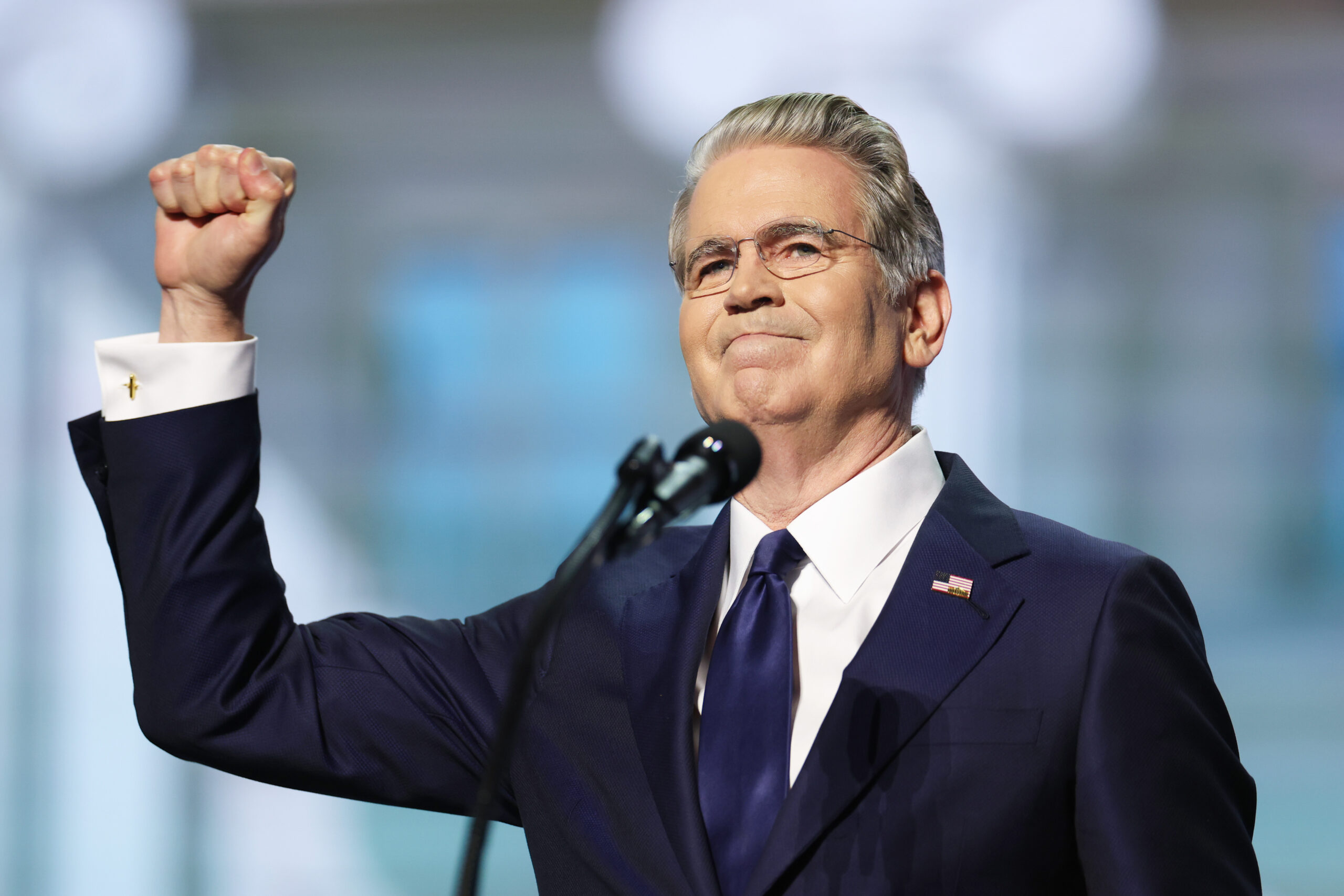
On Wednesday, September 9th, at the “State of the Economy” event hosted by the Breitbart News Network in Washington D.C., U.S. Treasury Secretary Scott Bessent unequivocally stated that the United States cannot afford to fall behind China in the field of AI. He emphasized that if China takes the lead in AI, it will offset any other existing advantages that the U.S. may have.
According to Bessent, allowing China to excel in AI would jeopardize America’s future. He emphasized that if China surpasses the U.S. in the AI realm, nothing else will carry significance.
In a joint statement released on the same day, the U.S. National Security Agency (NSA), Cybersecurity and Infrastructure Security Agency (CISA), and Federal Bureau of Investigation (FBI) accused six Chinese-based AI companies of engaging in widespread theft of cutting-edge AI models from the United States.
The six companies identified were DeepSeek, Moonshot AI, Alibaba, MiniMax, StepFun, and Z.AI. The statement alleged that these companies have been extracting billions of tokens by making millions of requests since at least late 2024, targeting advanced models including Claude, ChatGPT, Gemini, and Grok.
The NSA explicitly stated that these companies are systematically stealing U.S. AI capabilities to train their own AI models in China.
The statement outlined that these Chinese companies are utilizing “aggressive, malicious, and targeted” tactics to distill knowledge from U.S. advanced AI models, reducing the computational power, electricity, and fundamental research costs required in independently developing large AI models. This tactic aims to narrow the gap between Chinese and American AI technologies while enhancing their capabilities.
“Knowledge distillation” is a machine learning technique that uses the output of one model to train another. Although this technique has legitimate uses such as developing smaller or cost-effective models, in this context, it is being exploited for unfair advantages.
The statement highlighted that these companies are dispersing their “distillation” activities across different model providers, cloud platforms, and other infrastructure to evade detection. Some companies even utilize third-party services to access U.S. AI models, circumventing regional restrictions and other protective measures.
While the statement did not directly implicate the Chinese authorities in orchestrating these individual actions, the agencies evaluated that “China is likely knowledgeable”, given that the progress of Chinese AI models is crucial for expanding their military and cyber capabilities.
The statement called for U.S. AI companies and infrastructure providers to collectively enhance their detection capabilities of suspicious activities and strengthen coordination to counter China’s large-scale “distillation” operations.
In response, China refuted these accusations on the same day, with Foreign Ministry spokesperson Mao Ning claiming that China’s AI development is a result of “cooperation both domestically and internationally”.
Prior to the U.S. government’s statement, American AI companies had previously accused Chinese companies of utilizing “distillation” techniques to steal achievements from U.S. AI models.
In February, Anthropic company revealed that DeepSeek, Moonshot AI, and MiniMax had conducted over 16 million interactions with the Claude model through 24,000 fake accounts, executing large-scale “distillation” operations.
Anthropic stated that these accounts not only violated their terms of service and regional access restrictions but also allowed these entities to acquire development outcomes from other companies without incurring the corresponding costs through “distillation”.
Also in the same month, OpenAI informed the U.S. House Committee on China Issues that they observed DeepSeek continuously attempting to engage in “distillation” from OpenAI and other advanced U.S. AI models, employing increasingly covert methods to conceal illicit activities.
Bessent underscored the competition between the U.S. and China in AI during the event and connected it with the construction of data centers and other necessary AI infrastructure in the U.S.
He highlighted that while the U.S. holds a leading position due to its technology companies, advanced chips, financing, and startup ecosystem, the pace of development cannot pause. “Because China won’t stop progressing either”.
Bessent noted that technology companies have not adequately communicated with communities influenced by the construction of AI data centers, leading to certain contradictions. Consequently, he gave these companies a “D-” rating for their community outreach efforts, emphasizing the importance of explaining the role and potential benefits of such projects to residents.
He also mentioned that some opposition to data center development is influenced by Chinese political propaganda. However, Bessent did not provide specific examples to corroborate this claim.