
In present-day China, a particularly prominent phenomenon is “disappearances.” This includes not only young children, elementary, middle and high school students, college students, but also China’s most well-known human rights lawyer Gao Zhisheng, as well as many high-ranking officials in the Chinese Communist Party.
Recently, I conducted a preliminary survey and found that in the three years since the 20th National Congress of the Communist Party of China, 32 generals have been investigated, with 26 of them “disappeared”; the generals under investigation are effectively also in a state of “disappearance.”
These 58 generals are spread across the Central Military Commission, 15 departments of the Central Military Commission, the four major military branches of land, sea, air, and rocket forces, the five major theater commands, the People’s Armed Police, military academies, and more. Refer to my article published on September 3, 2026 in Epoch Times titled “Five Major Scandals of Corruption in the Chinese Communist Army.”
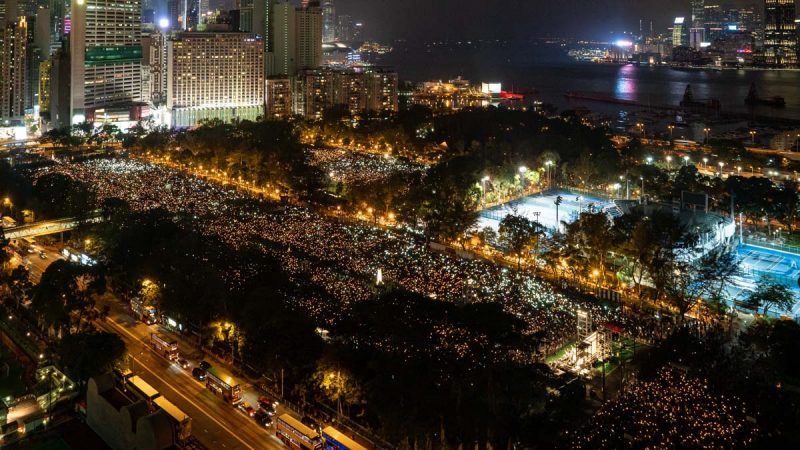
This made me think of the largest-scale popular protest movement in Hong Kong in 2019—the anti-extradition bill protests. I recall China’s imposition of the National Security Law in Hong Kong in 2020, and the arrests, detention, and trials of protesters since the law’s enforcement.
Looking back on the Hong Kong protests seven years later, I am more convinced than ever that the protesters were on the right side of history.
In 2019, over two million people took part in the anti-extradition bill protests in Hong Kong. The direct cause was China’s strong push for the Hong Kong government to amend the extradition bill to facilitate China’s ability to arrest individuals in Hong Kong and extradite them to mainland China for trial. Hong Kong citizens feared that once extradited to China, due to the opaque nature of China’s judicial system, these individuals would likely “disappear,” and their basic human rights would not be guaranteed.
After the handover of Hong Kong’s sovereignty in 1997, due to China’s promise to implement the “one country, two systems” framework in Hong Kong, the city’s judiciary was relatively independent, with relative press freedom and higher international visibility, ensuring that criminal suspects in Hong Kong were tried locally with basic human rights safeguarded.
However, over time, Hong Kong’s freedoms have been gradually eroded by the Chinese Communist Party.
For example, the Chinese Communist Party has secretly apprehended individuals in Hong Kong multiple times and then extradited them to the mainland for trial; upon arrival in mainland China, these individuals are subjected to the opaque workings of China’s judicial system. Numerous shocking incidents have occurred within China’s opaque judicial process, including torture, forced confessions, and suicides. These actions have instilled fear in Hong Kong residents.
The simplest and most direct reason for the anti-extradition bill protests in Hong Kong was to prevent Hong Kong residents from being “disappeared” by Chinese authorities after being extradited to mainland China.
As of today in 2026, what Hong Kong residents feared has not only befallen the grassroots citizens in mainland China but has also reached the highest levels of the Chinese Communist Party.
For instance, on March 11, 2025, member of the Politburo of the Chinese Communist Party, and Vice Chairman of the Central Military Commission, He Weidong, went “missing” after attending the closing session of the National People’s Congress.
Overseas sources have revealed that He Weidong allegedly committed suicide during his interrogation. To this day, the Chinese Communist Party has not provided any clarification. He Weidong remains in a state of “vanished without a trace.”
On January 24, 2026, the Chinese Communist Party announced that member of the Politburo of the Chinese Communist Party and Vice Chairman of the Central Military Commission, Zhang Youxia, and the Chief of Staff of the Joint Staff Department of the Military Commission, Liu Zhenli, were under investigation for serious violations of discipline and law.
Since then, Zhang and Liu have remained in a state of “disappearance.” On which day were Zhang and Liu arrested? Were they apprehended by agents of the Central Guard Bureau, the Special Police Bureau of the Ministry of Public Security, the Beijing Garrison, or a specific task force? Did a firefight break out when Zhang and Liu were captured? If there was a skirmish, were Zhang and Liu injured or were there any accidents? If Zhang and Liu are still alive, where are they being held? On the day after Zhang and Liu’s arrest, the CCP military newspaper labeled them with “five serious” charges. What evidence supports these “five serious” charges? Were they subjected to torture? Did they undergo coercion for confessions? All of these questions remain unanswered, leaving the party, military, and the public in the dark.
Overseas sources claim that Zhang and Liu have been assassinated. To this day, the Chinese Communist Party has not refuted these claims.
If even members of the Politburo of the Chinese Communist Party and Vice Chairmen of the Central Military Commission are at risk of “disappearances” at any time, who in China is truly safe? No one is safe.
It is clear that the 2019 anti-extradition bill protests in Hong Kong were completely legitimate. The protesters were not just defending the human rights of Hong Kong residents but also the human rights of mainland Chinese, including members of the Politburo of the Chinese Communist Party and Vice Chairmen of the Central Military Commission.
Since the anti-extradition bill protests in Hong Kong were entirely justified, the Chinese Communist Party’s escalating violent crackdown on the protests beginning on June 12, 2019, was utterly wrong.
The majority of Hong Kong residents demonstrated peacefully, rationally, and non-violently after the eruption of the anti-extradition bill protests.
However, on June 12, 2019, the CCP-controlled police force launched 240 tear gas canisters; rubber bullets, bean bag rounds, sponge-tipped bullets, pepper spray, electric batons, and shields were used in rapid succession. Prior to that, police deliberately fired tear gas canisters into a lawful assembly, almost causing a stampede with trampling casualties. Brutal scenes of police beating individuals were repeatedly witnessed; over 80 people were injured, with 2 sustaining serious injuries.
From then on, Hong Kong, once known as the “Pearl of the Orient,” a haven of freedom and democracy cherished by Chinese people both domestically and abroad, found itself shrouded in a state of gunfire and oppression.
According to public data from the Hong Kong police, from June 9 to December 9, 2019, the police force fired approximately 16,000 rounds of tear gas, around 10,000 rubber bullets, about 2,000 bean bag rounds, and approximately 1,850 sponge-tipped bullets, averaging 90 tear gas canisters discharged per day.
Amidst the ongoing violent crackdown on the anti-extradition bill protests in Hong Kong, the district council elections were held on November 25, 2019:
Democratic-leaning factions supporting the anti-extradition bill movement achieved a landslide victory; pro-CCP establishment groups suffered major losses. In the 452 seats across 18 districts, the pro-democracy camp secured 389 seats, outnumbering the pro-establishment camp’s 59 seats, becoming the majority in 17 of the 18 district councils.
This election saw historically high voter turnout, with 2,943,842 registered voters casting their ballots, resulting in a 71.23% voter participation rate.
The outcome of the district council elections in Hong Kong reflects mainstream public opinion in the city, contradicting the CCP’s violent suppression of Hong Kong residents striving to defend freedom and democracy.
However, the CCP, firmly believing that “political power grows out of the barrel of a gun,” solely trusts in violence, oppression, and coercion. They adhere to the ideology that “everything they do is right, and everything else is wrong.”
Even though the district council elections in Hong Kong unequivocally proved the righteousness of the protesters and the wrongdoings of the CCP, the Party is unlikely to admit its mistakes or change course to align with the will of the Hong Kong people.
After intensifying its violent crackdown on the anti-extradition bill protests, the CCP enforced the National Security Law in Hong Kong in 2020 during the outbreak of the global pandemic, prematurely ending the “one country, two systems” framework in Hong Kong, replacing it with a CCP-led “one-party rule.”
As of today in 2026, Hong Kong’s former separation of powers no longer exists; now, everything is dictated by the CCP: the Hong Kong Chief Executive has become a proxy for the Party in Hong Kong; the Legislative Council serves as a replica of the mainland’s National People’s Congress; Hong Kong’s judiciary acts as a tool for the CCP, and the city’s freedoms have been significantly curtailed, transforming its democracy into party-controlled governance.
From 2020 onwards, the CCP has been using the National Security Law to target and penalize Hong Kong protesters seeking democracy and freedom; batches of democratic activists in Hong Kong have been arrested, detained, and sentenced.
On August 28, 2026, Zou Xing-tong, former vice-chair of the disbanded Hong Kong Alliance, charged with “incitement to subvert state power,” made a statement in court.
Any sensible and conscientious individual who reads this statement would be moved by the unwavering spirit of the Hong Kong protesters in their pursuit of freedom and democracy. Below is the complete text of Zou Xing-tong’s statement:
etc. (continues translation)