
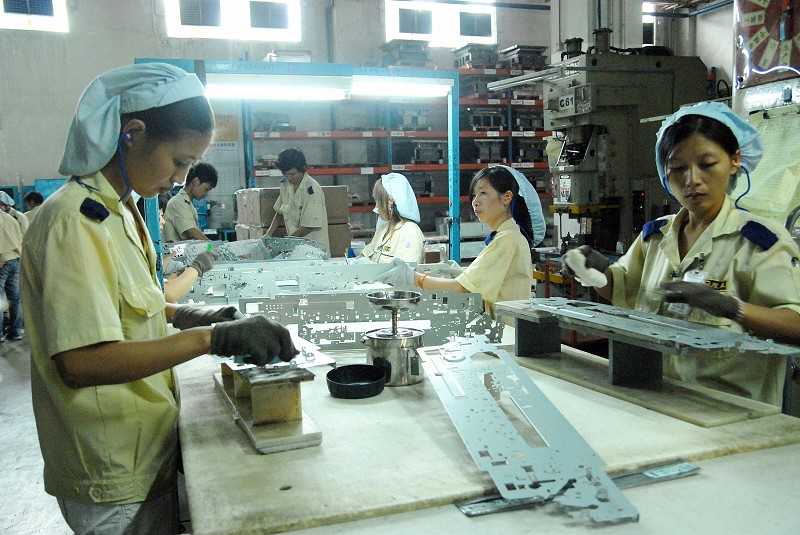
Shenzhen-based Hong Kong-funded electronic factory, Welling Electronic (Shenzhen) Co., Ltd., which has been operating for over 30 years, recently announced its closure. In the closure announcement, the company explicitly stated that the continuous shrinking of orders, rising operating costs, and ongoing operating losses were the reasons behind the decision to close. This old factory that had experienced the expansion period of Shenzhen’s manufacturing industry ultimately exited the scene. Respondents believe that China’s economic downturn, declining orders, and the Chinese Communist Party’s policies favoring state-owned enterprises and so-called high-tech industries are squeezing the survival space of traditional privately-owned manufacturing enterprises.
Welling Electronics issued a “Closure Announcement” on August 5, stating that its shareholder, Hong Kong Welling Electronics Limited, made a written decision to dissolve the company ahead of schedule. The company then initiated closure arrangements, with production lines ceasing operations after completing existing orders and handovers, and all employees having their labor contracts terminated by August 8.
In an interview, Mr. Chen, a former technician at the Shenzhen electronics factory, lamented that it has become increasingly difficult for some traditional electronics factories in the Pearl River Delta to secure orders, leading many businesses to continuously downsize. He mentioned that many factory owners now worry about paying rent for their facilities and keeping their workers employed, but with a lack of orders, the situation becomes unsustainable. Mr. Chen highlighted the challenging business environment, stating that electronic manufacturing used to be a paradise for Hong Kong and Taiwanese investors in places like Henggang and Liuyue, with low labor costs and rent. However, today it has turned into a nightmare due to high electricity costs, financing difficulties, and other challenges, as evidenced by the closure of Welling Electronics.
Established in 1994 by Hong Kong Welling Electronics Limited, Welling Electronics primarily engaged in the manufacturing of electronic products, including radios, audio equipment, and other electronic devices. The company operated production departments such as injection molding, silk-screen printing, surface mounting, and assembly. After experiencing rapid growth in the Pearl River Delta’s export processing and manufacturing industry, Welling Electronics inevitably faced the industry’s relocation, order fluctuations, and rising manufacturing costs.
Mr. Zhu, a scholar from Guangdong, pointed out that China’s downward economic trend is difficult to reverse, and the survival space of traditional electronics factories and manufacturing industries is shrinking under intense competition. He criticized the CCP’s policy favoring high-tech sectors and state-owned enterprises, with many orders now monopolized by state-owned enterprises, leading to a decline in opportunities for private enterprises. As a result, many private business owners face challenges, as they are misled to believe that as long as they pay taxes, they can operate normally, only to face obstacles at the order level.
In recent years, many manufacturing enterprises in the Yangtze River Delta and Pearl River Delta regions have been ceasing operations, liquidating assets, laying off workers, and relocating. While industry giants such as Huawei, Tencent, and leading companies in the new energy vehicle sector continue to expand into overseas markets, numerous small and medium-sized enterprises are grappling with reduced profits, extended payment periods, and insufficient orders.
The closure of Welling Electronics is not an isolated case. In recent years, several long-standing enterprises in the Pearl River Delta region have closed one after another. For example, Huaxun Electronics Co., Ltd., with a 27-year history in Huizhou, announced the termination of its operations due to business difficulties. Similarly, Xunda Electronics Accessories (Shenzhen) Co., Ltd., a Hong Kong-funded electrical appliance manufacturer with a 37-year history, declared continuous losses and operational difficulties, leading to a complete shutdown starting from August 12.
Mr. Yao, a businessman from Zhejiang, emphasized that the challenges facing China’s manufacturing industry go beyond simple cost fluctuations. He highlighted the changing advantages of the manufacturing sector, including a shrinking market, decreasing orders, and disruptions in the supply chain. With increasing domestic unemployment, consumer downgrading, reduced corporate investments, and gradual foreign divestment, the situation has become dire. Mr. Yao criticized the local government’s publication of false growth data, urging businesses to shut down earlier rather than waiting until the last moment. He mentioned that many wealthy businessmen from Zhejiang are exploring options to go abroad amid the challenging business environment.
Mr. Yao concluded by stating that the media rarely reports on the grassroots reality of factory closures, asset liquidation, and worker layoffs, thus painting a different picture from the economic growth narrative pushed by the Chinese government. The closure of Welling Electronics within a year from being listed in the local industrial enterprise directory in 2025 reflects the contrasting realities as described by Mr. Chen, Mr. Zhu, and Mr. Yao from the perspectives of factory operations, policy environment, and business management in the Pearl River Delta. The closure of old factories, the loss of orders, workers returning to their hometowns, and the challenges faced by private enterprises depict the grassroots reality of China’s manufacturing sector in decline.