
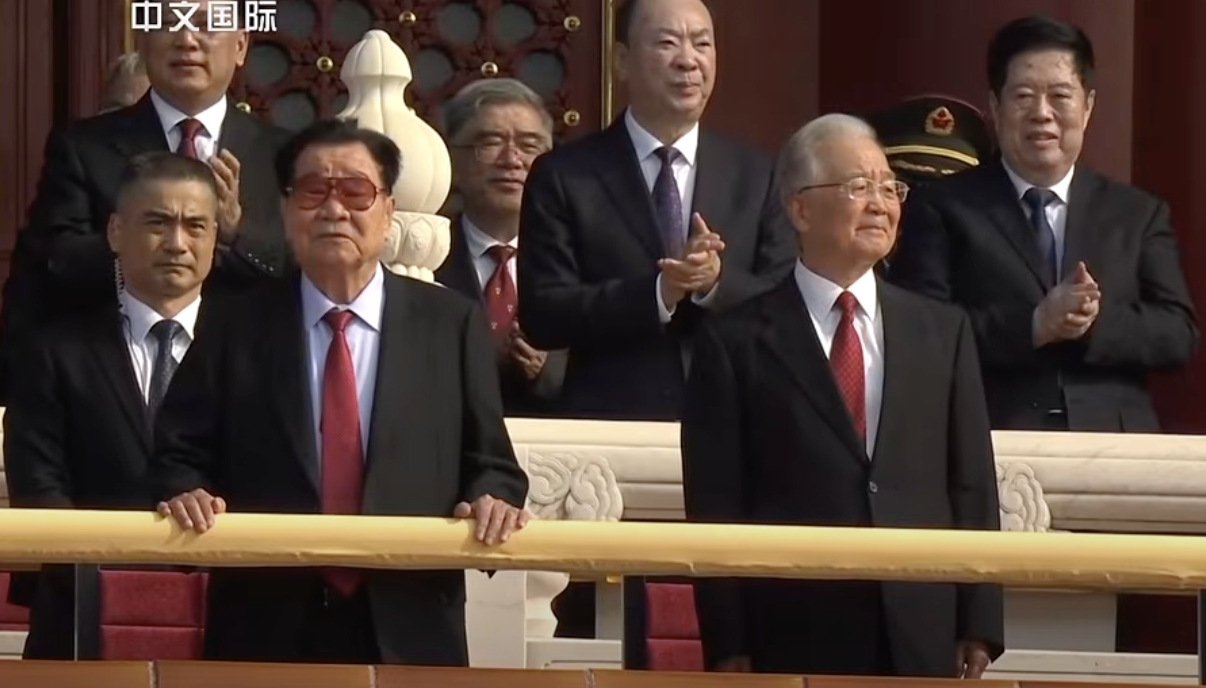
On August 18, 2026, the farewell ceremony for the body of former Chinese Premier Zhu Rongji was held in Beijing. Chinese Communist Party (CCP) elders including Hu Jintao, Wen Jiabao, and Li Ruihuan sent wreaths. Li Ruihuan, known as the “Jiang Slayer,” was notably absent from the CCP’s former leader Jiang Zemin’s memorial service the day before, causing public attention.
Zhu Rongji passed away in Beijing on August 12, 2026, at the age of 98. On August 18, his body was cremated at the Babaoshan Cemetery in Beijing.
According to the CCP’s official Xinhua News Agency, around 9:30 a.m. that day, CCP Politburo standing committee members and Vice President of the country, Han Zheng, were present to bid farewell and express condolences to Zhu Rongji’s family. Hu Jintao laid a wreath in mourning for Zhu Rongji.
Reports stated that during Zhu Rongji’s illness and following his passing, CCP standing committee members, Han Zheng, Hu Jintao, and others, “visited the hospital or expressed condolences through various means” to mourn Zhu Rongji’s death and comfort his relatives.
On the same night, CCTV’s “Xinwen Lianbo” broadcast showed scenes of former CCP elders including Wen Jiabao, Li Ruihuan, Wang Yang, Jia Qinglin, Zhang Dejiang, Yu Zhengsheng, and Li Zhanshu laying wreaths.
In recent years, when former CCP Prime Ministers like Li Peng, Li Keqiang, and former standing committee member Song Ping passed away, Hu Jintao laid wreaths in mourning but did not attend the body farewell ceremonies. State media reports only mentioned the CCP’s standing committee members, Vice Presidents, and Hu Jintao without naming other retired state-level officials. However, CCTV’s broadcast showed scenes of retired elders like Li Ruihuan and Wen Jiabao laying wreaths.
On August 17, 2026, the CCP held a centennial memorial service for former party leader Jiang Zemin. Xinhua News Agency and CCTV footage showed that out of the 17 retired state-level CCP officials, 13 attended the event, including Wen Jiabao, Jia Qinglin, Zhang Dejiang, Yu Zhengsheng, Li Zhanshu, Wang Yang, Li Lanqing, Zeng Qinghong, Li Changchun, He Guoqiang, Liu Yunshan, Wang Qishan, and Zhang Gaoli. However, Hu Jintao, Li Ruihuan, Wu Guanzheng, and Luo Gan were absent.
The absence of Li Ruihuan, known as the “Jiang Slayer,” sparked speculation. Commentator Cai Shenkun posted on August 17, 2026, that it was surprising that Li Ruihuan did not attend, as it was said he was in good health.
Apollo commentator Wang Duran analyzed that Li Ruihuan, who had been one of the few standing committee members to openly challenge Jiang, was dubbed the “Jiang Slayer.” Xi Jinping’s overt commemoration of Jiang Zemin this time around to court remaining Jiang faction members indicates that the deliberate exclusion of Li Ruihuan or his personal refusal to attend could be due to political reasons rather than solely age or health issues.
From 1991 to 2003, Zhu Rongji served as Vice Premier and then Premier of the State Council, engaging in power struggles and policy disputes with then CCP leader Jiang Zemin, garnering significant attention from the public. The intense power struggles and competition for succession between Zhu Rongji and Jiang Zemin, especially concerning the Far East case and the selection of the Premier’s successor, have been disclosed and brought to light over the past two decades.
Hong Kong media had previously revealed that during the 16th Party Congress, Li Ruihuan and Zhu Rongji pressured Jiang Zemin to retire. Li Ruihuan saw that Jiang Zemin was reluctant to give up his power position and publicly stated at the Beidaihe Conference before the 16th Congress: “The Yangtze River will carry on its mighty waves, we are already old, we need to let the younger generation take over. Among the standing committee members here, apart from Comrade Jintao, if no one steps down, I will be the first.” Li Ruihuan’s speech at the time embarrassed Jiang Zemin. Zhu Rongji, at another meeting, mentioned that he should retire entirely once he turns 70, as one should fulfill promises. Zhu Rongji referenced the incident in 1997 when Jiang Zemin forced NPC Chairman Qiao Shi to resign using age as an excuse.
According to the Taiwan-based “China Times” in September 2002, then-Premier Zhu Rongji did not support Jiang Zemin staying in power and had expressed his intention to retire at the 16th Congress, endorsing Wen Jiabao as his successor. Wen Jiabao was Li Ruihuan’s hometown friend from Tianjin.
After the 16th Congress, Hu Jintao and Wen Jiabao were marginalized by the Jiang faction, with Jiang Zemin exerting prolonged influence. Retired leaders like Zhu Rongji and Li Ruihuan provided crucial internal support for Hu Jintao and Wen Jiabao.
Before entering the central government, Zhu Rongji and Li Ruihuan had an extraordinary relationship during their terms as local leaders.
The book “Jiang Zemin: The Man” revealed that in 1985, with the recommendation of Shanghai Mayor Wang Daohan, Jiang Zemin, known for his cunning ways, was promoted from Minister of Electronic Industry to Mayor of Shanghai. Despite forming alliances to dominate Shanghai, during his two years as Mayor, the city’s residents faced numerous challenges. Many things in Shanghai required tickets for purchase in 1986; Jiang Zemin led the Shanghai people into a situation where they had to tackle issues such as food shortages.
In 1988, Deng Xiaoping had to urgently send Zhu Rongji to Shanghai as Mayor to clean up Jiang Zemin’s mess, allowing Jiang to become the Secretary of the Municipal Party Committee without having to handle practical matters. Zhu Rongji admitted that he was inspired by Li Ruihuan, who was then the Secretary of the Tianjin Municipal Party Committee and Mayor, in his approach to his work in Shanghai. Zhu Rongji mentioned seeking advice from Li Ruihuan twice before working in Shanghai, as he believed in the importance of identifying key breakthroughs.