
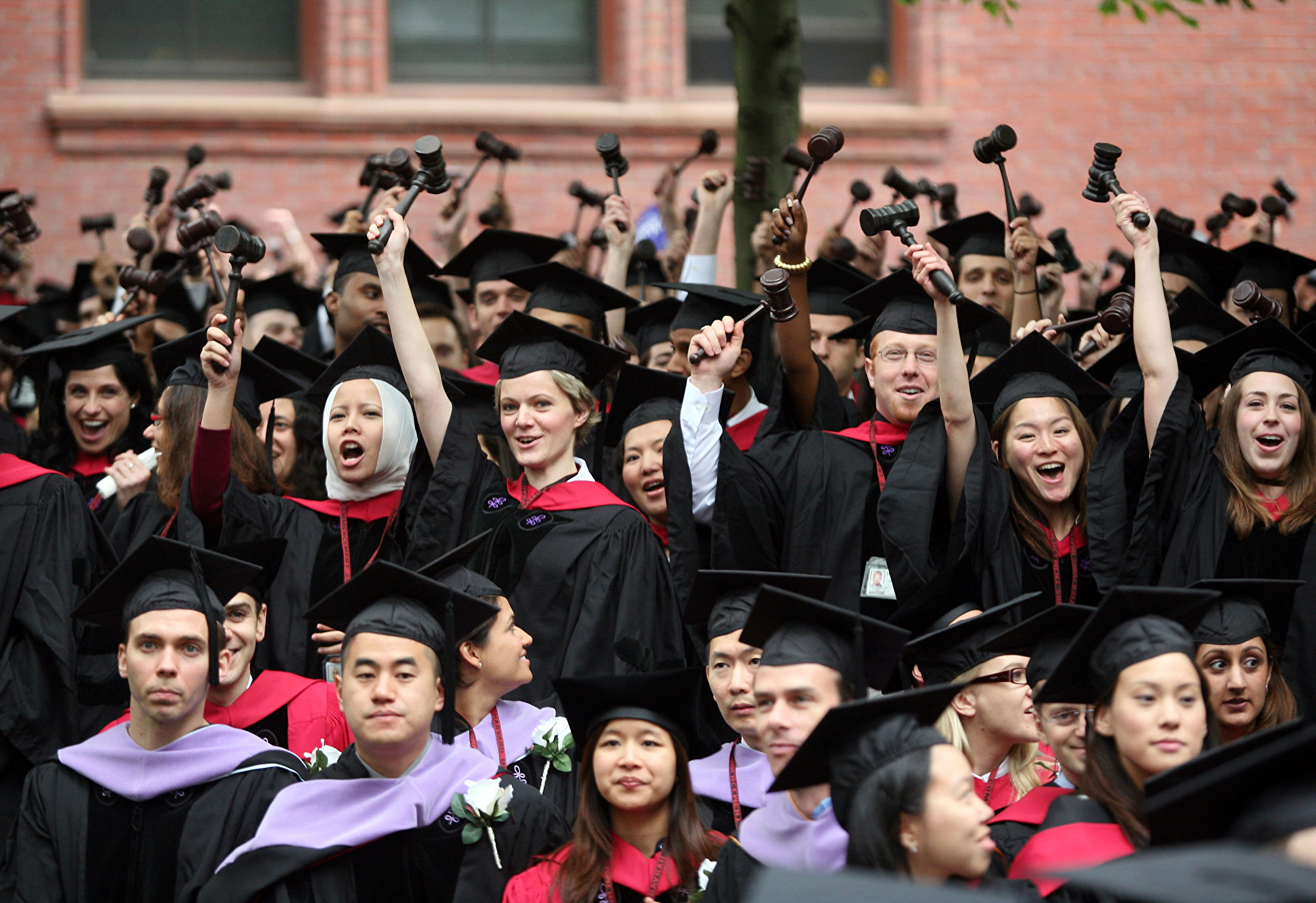
In the course of decades of openness and globalization, studying abroad was once a golden opportunity for countless Chinese families to move up the social ladder. Now, it is facing a historic structural reversal. Data shows a significant decrease in the number of students studying abroad, while the number of “sea turtles” returning to China has sharply increased.
Interviewed scholars analyze that due to the domestic economic slowdown, rising costs, reduced consumption, the fading effect of the “gilding” of educational qualifications, and the multiple impacts of geopolitical tensions, the former “study abroad premium” is rapidly collapsing. The dilemma faced by students studying abroad between internal and external pressures also signifies a deep crisis of China’s disconnection from the global talent network.
On August 6th, the UK’s “The Economist” cited official Chinese data stating that the number of Chinese studying abroad has decreased significantly, while the number of returning “sea turtles” has reached a new high, sparking discussions.
According to data released by the Chinese Ministry of Education, in 2025, the number of students studying abroad was 570,600, a steep drop from the peak in 2019 (703,500) by nearly 20%, returning to the level of 2016. On the other hand, the number of students returning to China was 535,600, showing an increase of 40,600 compared to 2024 and 120,000 compared to 2023. In total, from 1978 to 2025, there were 9.46 million Chinese students studying abroad, with 8.01 million completing their studies and 6.98 million returning to China.
Regarding the official media directly dividing the number of returnees in a year by the number of people leaving in the same year and claiming a “return rate of 94%” in 2025, Professor Xie Tian from the University of South Carolina pointed out to Epoch Times that this calculation is flawed: “Those leaving and those returning in the same year are completely different groups of people. You cannot use the number of returnees this year to indicate what percentage of people have returned.”
Professor Xie further explained that studying abroad has a lag effect, and when the number of students going abroad drastically decreases, the denominator shrinking can make the return rate figure artificially high, essentially “putting a coat of paint on for the Chinese Communist Party, which is actually applying gold to itself.”
Addressing the public opinion that top Chinese universities like Peking University ranking 13th and Tsinghua University ranking 14th globally do not require studying abroad, Professor Xie countered that the rise in the rankings of individual Chinese universities does not represent an overall improvement in higher education. There still exists a systematic gap in academic structure and freedom atmosphere compared to the West.
Sun Guoxiang stated that the high return rate reflects deteriorating investment returns and political risks simultaneously.
In reality, the costs of studying abroad have soared. According to the “2026 Report on the Development of Chinese Students Studying Abroad” by New Oriental, the average study abroad budget this year has reached 605,000 RMB, a 20% increase from 2023 and a 12-year high. The high costs coincide with the domestic economic slowdown as shown by the first decline in domestic consumption expenditure in May 2026 due to the epidemic, leading middle-class families to doubt their investment in education.
Contrasting the high tuition fees is the low starting salary for “sea turtles.” According to a 2025 report on the employment of Chinese returnees by Zhaopin, the average starting salary for returnees is only 12,800 RMB per month, with a premium of only 20% compared to domestic graduates (10,700 RMB). Except for high-skill positions like AI and semiconductor with a starting salary of 17,000 RMB, most ordinary professions offer only a few thousand RMB per month.
In March of this year, Tencent News reported a case of a graduate student from Newcastle University in the UK resigning from a job with a net monthly salary of over 2,000 pounds to a monthly salary of only 7,000 RMB upon returning to China, which dropped even further during the probation period to less than 4,000 RMB.
The era where overseas diplomas guaranteed high salaries is coming to an end. In a repost on Sohu Blog on July 7, 2023, Professor Zhu Hong from Nanjing University highlighted that the return on investment for studying abroad is decreasing. She cited an example of a secretary who graduated from a “985” university in China, spent over 1.5 million RMB to pursue a master’s degree in the UK, and upon returning to China, could only earn slightly over 5,000 RMB per month.
When interviewed by Epoch Times, Professor Sun Guoxiang from Nanhua University in Taiwan stated that this reflects the diminishing “gilding effect of overseas education qualifications.” Returnees face three challenges including youth employment, degree inflation, and salary disparities, which may turn the wave of returnees into “not necessarily a talent dividend, but potentially transform into new employment internal pressure.”
In addition to factors of push and pull in the domestic economy, geopolitical tensions are crucial in accelerating the closure of the study abroad channel. Since the freezing of China-US relations in 2019, the West has been tightening security measures against China step by step.
In July 2026, the US Department of Homeland Security (DHS) issued new regulations to limit F-1 and J-1 visa validity to 4 years, profoundly affecting STEM doctoral students. In February, the UK announced a 15% reduction in the approval rate of student visas for Chinese nationals, while Canada also restricted quotas for all international students.
This barrier built due to political security concerns is directly reflected in visa data. According to the “Open Doors 2025” report by the Institute of International Education in the US, the number of Chinese nationals studying in the US dropped for five consecutive academic years from the peak of 372,500 in 2019-2020 to 266,000, a decrease of 28.6%.
Moreover, data from the Center for Immigration Studies (CIS) in the US also shows that the issuance of F-1 visas to Chinese citizens from May to August 2025 was only 40,340, half of the average over the past seven years. In the summer of that year, the issuance of F-1 visas fell by about 34%, with only 17,000 issued in June and July, a staggering 56% decline year-on-year.
Xu Zhen, a senior figure in the Chinese financial industry, pointed out that compared to the 1980s when the world embraced China, the West is now turning toward confrontation, prevention, decoupling. The core of this shift lies in the weaponization by the Chinese Communist Party of some overseas students, using them as the main force for “plagiarizing Western technology,” “exporting communist ideology,” and even acting as “intelligence agents.”
Xu Zhen described it as “a few mouse droppings spoiling a pot of soup,” where the misconduct of a few individuals has tarnished the reputation of all overseas students, leading to widespread suspicion in the West.
Professor Xie Tian criticized that due to the Chinese Communist Party’s long-standing “technology theft” and bribery of Western academic talents, countries like the US have erected defenses, severely restricting Chinese students from entry into sensitive areas like national defense, STEM, artificial intelligence, and semiconductors, and raising the threshold for employment.
Xu Zhen pointed out that overseas students have become the “most direct victims of the malicious actions of the Chinese Communist Party,” facing a dilemma where they “not only fail to gain the trust of Europe and America but are also not favored by the Chinese Communist Party, with low returns after graduation.”
After restrictions on STEM, the proportion of Chinese students studying humanities, social sciences, law, and business abroad has increased. However, Professor Xie noted that these disciplines are now becoming controlled “forbidden zones” under the current Chinese system.
He analyzed, “You study humanities, social sciences, politics, and management here, but in China, they neither allow you to use nor disseminate this knowledge.” Students undergo logic training and academic freedom abroad, washing away political indoctrination, and find it challenging to integrate into an authoritarian system upon their return, facing prevention and exclusion instead.
Furthermore, Professor Xie observed that many students studying abroad carry strong “pro-China, anti-US sentiments,” loudly proclaiming that “China is strong, and the US is not that great.” This mentality is inseparable from the long-standing extreme nationalist brainwashing by the Chinese Communist Party, leading them to be closed off in a free society.
Professor Xie admitted that students with such attitudes have weak competitiveness, fail to achieve success upon returning, and “damage the reputation of returnees,” causing employers to develop biases like “studying abroad holds no value,” further worsening their job prospects.
In recent years, the Chinese government has actively promoted Sino-foreign cooperation in education. According to the Ministry of Education’s data, nearly 300 cooperative projects at or above the undergraduate level were approved in 2025, attempting to establish a “domestic study abroad” system. However, there are doubts externally whether this can replace open international exchanges.
Professor Sun Guoxiang observed that the rise of Sino-foreign education cooperation is a microcosm of the disconnection between China and Western talent mobility. The West has strengthened security checks, reducing its attractiveness, while China, although restricting the outflow of talent and capital, paid a heavier price: “In reality, they lose a crucial channel to absorb Western knowledge, institutional experience, and international networks.”
At the same time, China’s attractiveness to foreign professional talents has plummeted. Citing data from the China Immigration Administration, the “South China Morning Post” on August 9 reported that the number of residence permits issued to foreigners in 2023 was 711,000, 85% of 2019’s figures, with only 237,000 for employment, indicating a growing resistance to entering China by foreign talents.
Scholars warn that returnees were once the bridge for communication between China and the world. However, under the political control by the Chinese Communist Party restricting academic exchanges and closing off student thinking ideologically, this channel is deteriorating.
Xu Zhen pointed out sharply that the decline of the study abroad trend and the predicament faced by returnees “indicate the end of an era and signal the retreat of the Communist regime,” with the decline of the study abroad trend signifying the “world abandoning the Chinese Communist Party.”
He urged the entire society to rethink the systemic roots of this crisis: “Only by truly recognizing and abandoning the Chinese Communist Party from the heart can the country have hope, and every individual – including students studying abroad – can have a future.”