
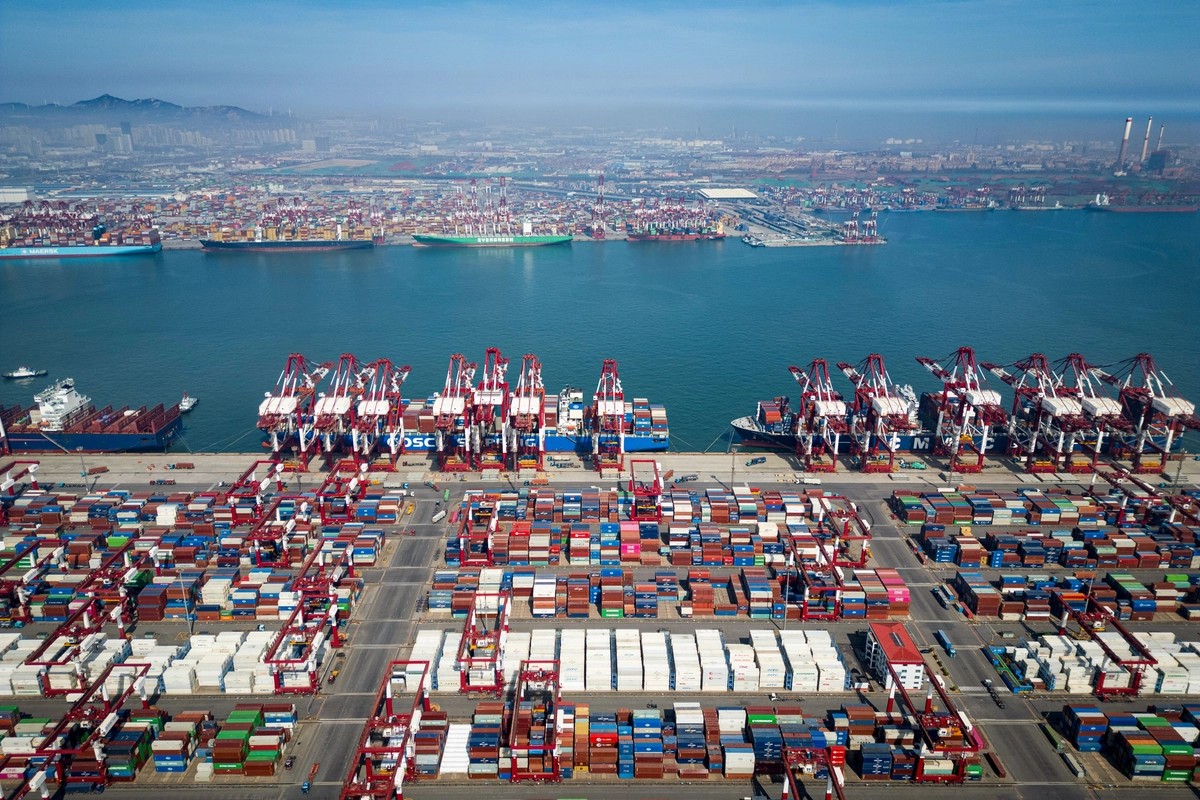
China’s official data shows that in the first seven months of 2026, the country’s import and export increased by 17.3% year-on-year, with exports growing by 14% and imports rising by 22%. The export growth is particularly fueled by high-tech products such as AI, chips, and servers, while there is also a significant increase in the import of related high-end equipment and components.
Analysts point out that while China’s foreign trade appears robust on the surface, domestic consumption and investment remain weak, deepening the country’s reliance on external demand, showing a “two ends abroad” characteristic. The “China Impact 2.0” is triggering caution among relevant economies, indicating a potential escalation in trade frictions and raising the risk of economic imbalances in China.
According to the data released by the General Administration of Customs of China on August 7, the total value of China’s trade import and export in the first seven months of 2026 reached 30.13 trillion yuan, a 17.3% increase compared to the same period last year. Of this, exports were 17.44 trillion yuan, up by 14%, and imports were 12.69 trillion yuan, up by 22%.
In terms of trade methods, general trade import and export in China grew by 10.2% in the first seven months, processing trade import and export increased by 26.3%, and bonded logistics import and export surged by 40.8%.
Looking at key products, China’s export of electromechanical products increased by 21.2% in the first seven months, while the import of electromechanical products rose by 29.7%.
Data from the General Administration of Customs of China shows that China’s export of integrated circuits in the first seven months reached $216.02 billion, a 99.5% year-on-year increase.
According to reports from media outlets like Reuters, in July, China’s exports grew by 23.9%, with semiconductor exports nearly doubling and high-tech product exports increasing by 40.7%. AI servers, data centers, chips, and related electronic components have become the new growth engines for China’s exports.
In the first seven months of 2026, China’s exports have gradually shifted towards high-tech fields such as integrated circuits, semiconductors, and AI-related products, moving away from traditional labor-intensive products.
Simultaneously, China is importing a large quantity of related high-tech goods. In the first seven months of 2026, imports of automatic data processing equipment and its components grew by 93.2%, and the import of integrated circuits increased by 58.3%.
Chinese expert Mike Li stated that as China exports more AI products, it also significantly imports high-end chips, memory, semiconductor equipment, and other products that it cannot yet produce domestically.
Li highlighted the phenomenon of “two ends abroad,” where certain key equipment, components, and technologies in China still rely on foreign sources, while a considerable portion of the products needs overseas markets to absorb.
Li explained that this dual reliance on international markets for both raw materials and sales is a model of economic development, indicating the need for China to balance its dependence on external supplies and global markets, which could be impacted by shifts in global supply chains, geopolitics, and trade policies.
Li noted that China’s economic growth is not solely driven by domestic demand but rather supported by external demand, given the pressure on domestic consumption and investment. This deepens China’s reliance on foreign trade for economic growth.
In the first seven months of 2026, general trade in China increased by 10.2%, processing trade surged by 26.3%, and bonded logistics experienced a substantial increase of 40.8%.
Li emphasized that the slower growth rate of general trade compared to processing trade and bonded logistics indicates the strengthening linkage between Chinese manufacturing and cross-border supply chains, with some enterprises adjusting production and logistics layouts based on tariffs, costs, and changes in global supply chains.
Li believes that while China aims to adjust its export product structure through manufacturing upgrades, there are still deficiencies in core technologies, particularly in areas like artificial intelligence, high-end chips, memory, and semiconductor equipment, requiring continued imports.
Therefore, while China has established a relatively complete industrial chain in its manufacturing sector, certain high-tech industries still exhibit characteristics of relying on imported key components and depending on overseas markets for product sales.
In the first seven months of 2026, China’s trade volume with ASEAN countries increased by 20%, with trade with the EU growing by 9.5%, trade with countries of the Belt and Road Initiative up by 15.5%, and trade with the United States declining by 1.6%.
Since 2025, with the implementation of new tariffs by the United States reshaping the global economic trade landscape, China’s exports to the U.S. have been significantly impacted, prompting a shift towards ASEAN and African markets.
Central Banks in Europe noted that following the imposition of tariffs on Chinese goods by the U.S., China’s exports have notably shifted towards ASEAN, Africa, and other markets.
European Central Bank research found that while China’s trade expansion with ASEAN countries may not be substantial, it represents an adjustment in China’s trade path to ultimately flow goods into the U.S. through transit trade.
Moreover, the European Central Bank’s research suggested that China’s recent surge in trade volume cannot be solely attributed to new demand but is also influenced by factors like tariff expectations, advance shipments, and trade diversion.
According to The Wall Street Journal, China’s GDP growth rate in the second quarter has slowed from 5% in the first quarter to 4.3%, with fixed asset investment, real estate investment, and consumption still under pressure. Despite the significant increase in import and export, domestic consumption, real estate, and investment in China remain weak.
The People’s Bank of China recently issued a currency policy report acknowledging the persistence of domestic supply-demand imbalances and the need to further expand domestic demand.
Li noted that from January to July 2026, China’s imports grew by 22%, surpassing the 14% growth rate of exports. The increase in imports is related to the growth in AI, electronic equipment, manufacturing equipment, and intermediate goods, but it does not indicate a comprehensive recovery of domestic demand within China.
China’s economy currently exhibits a stark contrast: continuous surges in foreign trade while domestic consumption remains weak.
The Wall Street Journal highlighted that present-day China is no longer confined to producing low-value consumer goods but has shifted towards exporting chips, precision machinery, robots, as well as electric vehicles, batteries, and green energy products, emerging as the “factory of the factories.” This export transformation is termed “China Impact 2.0,” which is challenging high-end manufacturing economies like the EU, Japan, and South Korea.
Reuters also mentioned on August 9 that China is trying to confront its domestic economic slowdown through exports, a development that many Western countries view as a second wave of the China Impact.
The report noted that China’s exports grew by 23.9% in July, with a trade surplus reaching $113 billion, while China’s second-quarter GDP growth rate was only 4.3%, signaling continued weak domestic demand.
Presently, China’s economy presents a noticeable dichotomy: soaring foreign trade alongside stagnant domestic consumption and investment.
Analysts anticipate that Chinese companies are exporting electric vehicles, batteries, green energy, and AI hardware to global markets, potentially leading other countries to see this as “China Impact 2.0” and respond with tariffs, industrial policies, and trade restrictions.
Li pointed out that China’s surplus in certain industries, merely expanding exports to absorb excess production capacity, has triggered retaliatory measures from foreign countries through anti-dumping inquiries, tariff increases, and more.
China’s trade volume with Belt and Road Initiative countries increased by 15.5% in the first seven months of 2026, accounting for about half of the total import and export trade. Li mentioned that this pattern reflects China’s strategy to export excess production capacity and alleviate domestic economic pressure amidst Western countermeasures.
If China’s domestic consumption fails to significantly recover while manufacturing capacity continues to expand, businesses will increasingly rely on overseas markets to absorb the additional capacity. This could lead to short-term strength in China’s foreign trade but may also escalate frictions with major trading partners.
Therefore, the 2026 Chinese trade data does not simply indicate “export prosperity” but rather a scenario where China’s manufacturing competitiveness has grown alongside weak domestic demand. This structure of “strong manufacturing, weak domestic demand, increased export reliance, and deep integration into the global supply chain” may become a critical issue in China’s future economy and global trade relations.