
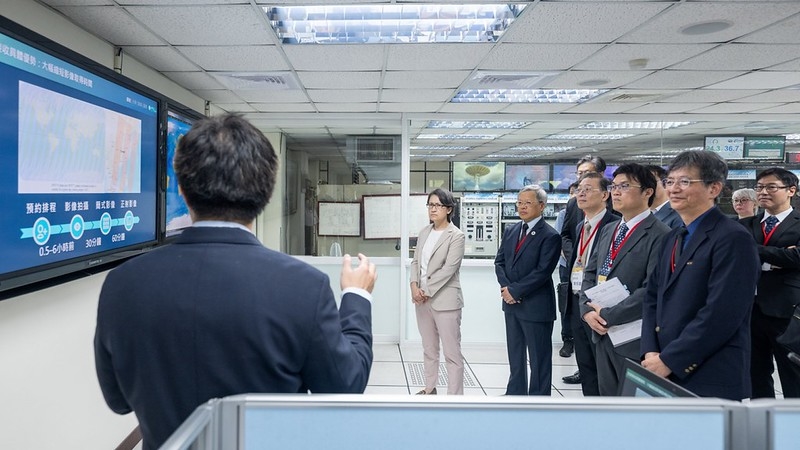
Taiwan’s Vice President, Lai Ching-te, visited Central University today (August 14) and emphasized the importance of integrating defense, industry, scientific research, and talent cultivation to jointly promote the country’s space development in the face of rapid global space industry and technological advancements. The government aims to continue strengthening Taiwan’s space technology and talent foundation while seizing international cooperation opportunities.
In a press release from the Office of the President of Taiwan, Vice President Lai Ching-te first visited the Space and Remote Sensing Research Center, where she observed the resource satellite receiving station’s rooftop antenna and satellite assembly and integration testing room to understand the satellite data reception, development, and remote sensing applications. She then received briefings on space talent cultivation, research, industry applications, national security, and environmental monitoring from Central University’s research team and engaged in discussions on talent development and international space cooperation.
During her speech, Vice President Lai Ching-te expressed her keen interest in space-related issues and her gratitude for the opportunity to visit Central University for the first time. President Lai Ching-te has instructed the government to establish a cross-agency Space Development Committee under the National Security Council framework to promote national space development by integrating defense, industry, scientific research, and talent cultivation.
Vice President Lai Ching-te, not an expert in the field of space, expressed her desire to gain more insights into related topics. Central University is a crucial talent development hub for the nation, and she viewed this visit as a valuable learning opportunity to gain a comprehensive understanding of many important issues.
Regarding Taiwan’s space development, Vice President Lai Ching-te noted that Taiwan entered the space arena relatively late compared to other countries, but given the rapid global space industry and technological advancements, Taiwan cannot afford to lag behind. During a recent meeting with Dr. Kjell Lindgren from NASA, Dr. Lindgren emphasized the emergence of new international cooperation opportunities, including the U.S. promoting relevant space cooperation legislation and the international collaboration driven by the Artemis program. Although Taiwan was not previously a signatory to relevant agreements, the U.S. has actively engaged Taiwan in discussions to seek suitable areas for collaboration with other countries.
Vice President Lai Ching-te highlighted the importance of space technology as a support pillar for various fields such as remote sensing, communication, and national defense in the overall development of the nation. She believed Central University’s role in the future would be increasingly crucial and an indispensable part of the country’s overall space strategy.
In conclusion, Vice President Lai Ching-te thanked the faculty and students of Central University for their insights and exchanges, while also expressing hope for continued support from the Ministry of Education in relevant resources. She emphasized the need for concerted efforts among the government, academia, and research sectors to strengthen Taiwan’s space technology and talent foundation, creating more opportunities for the country’s future development.
Following this, Vice President Lai Ching-te visited the High-Temperature High-Pressure Rock Mechanics Research Laboratory to observe related research facilities and receive a briefing on enhancing national disaster resilience through scientific research, understanding earthquake mechanisms, monitoring warnings, and disaster prevention applications.