
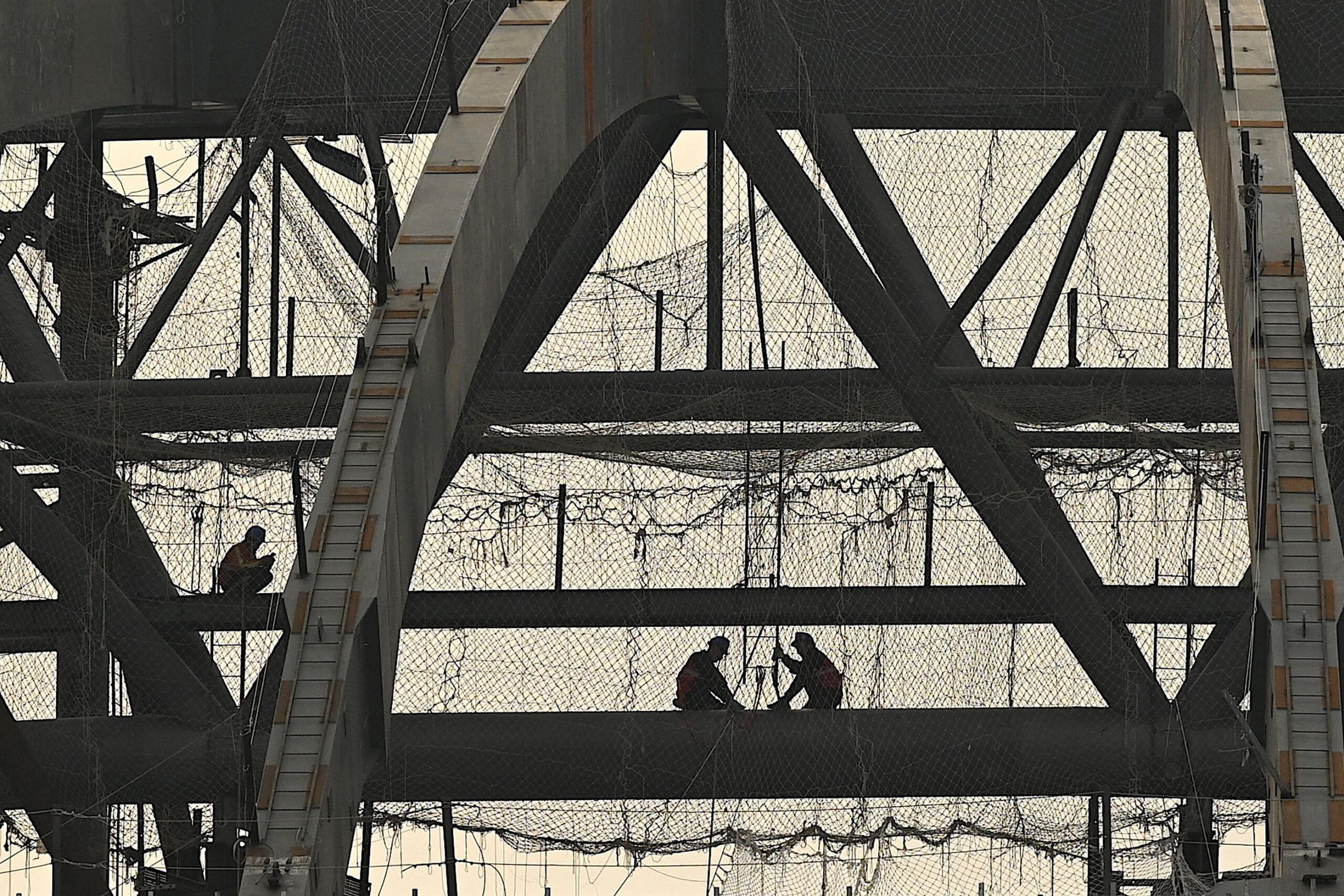
In recent years, the Chinese Communist Party (CCP) has been vocal about real estate issues, but has shown minimal concern for the downturn in the real estate industry as a whole, with many media reports indicating “overcapacity in certain industries” and emphasizing the need for transformation and upgrading. However, the reality reveals that the real estate industry is facing a crisis, threatening the livelihoods of 70 million people.
The real estate industry in China has a long industrial chain, involving more than 50 related industries such as steel, cement, home appliances, furniture, building materials, decoration, finance, and logistics. Official data and reports from mainland media show that during the peak period, the real estate and construction industry accounted for a significant portion of GDP, around 13% in total by 2024, driving employment for over 70 million people.
Starting from the second half of 2021, the Chinese real estate market began to slump and has been in a downturn ever since.
According to data from the National Bureau of Statistics of the CCP, from January to June this year, real estate development investment nationwide dropped by 18.0% year-on-year, housing construction area decreased by 12.5%, new construction area fell by 23.4%, completed area dropped by 23.7%. In addition, sales area of new commercial housing decreased by 11.6% year-on-year, sales revenue of new commercial housing dropped by 13.6%, and in-place funds of real estate development enterprises decreased by 20.2% year-on-year.
Housing wealth accounts for 60% to 70% of the total family wealth of Chinese residents. The continuous downturn in the real estate sector has led to a sharp decline in demand for home furnishings, resulting in a shrinking market and business closures.
A designer specializing in whole-house customization in Guangzhou, Guangdong, Mr. Yang, revealed to reporters that the market in this industry has shrunk by 50%, and although he still has orders from past clients, the prices have dropped by around 5%.
He said, “There are no new commercial housing projects now, only the sales of existing ones. Next year is expected to be even worse. I believe that about 30% of industry peers and factories will be eliminated. Closing early may result in less loss.”
A renovation shop owner in Foshan, Guangdong, Mr. Da Peng (pseudonym), stated that both the construction industry and related industries are struggling, with many building material shops closing down.
Foshan is a major hub for the kitchen and bathroom industry in China. According to data from the Foshan Sanitary Ware Industry Association, the Foshan production area once housed over 2,000 sanitary ware manufacturing enterprises. However, currently, a large number of small and medium enterprises are either silently ceasing production or switching to other industries.
Qiming (pseudonym), a renovator in Kunming, Yunnan, revealed that the largest Huayang Home Furnishing Plaza in the Southwest region, covering an area of 160,000 square meters, which used to generate over 100 million yuan in peak rental income, now has vacant areas in the sanitary ware, electrical appliances, and doors and windows sections. About half of the hundreds of shops in the mall have closed down.
The parent company of the high-end home furnishing brand Meike Meijia, Meike Home Furnishing, announced the suspension of operations at its core production base in Tianjin starting from January 1, 2026, due to years of substantial losses and a broken financial chain. This decision has led to widespread employee unpaid salaries, closures, and controversies related to “paying employees with goods”.
Many people who have purchased houses are now refraining from renovation, leading to a significant reduction in demand for glass. Data from the National Bureau of Statistics of the CCP shows that in 2025, China’s flat glass output reached 976 million weight cases, a decrease of 3.0% year-on-year.
The leading construction company in Shaanxi, Shaanxi Construction Group Co., Ltd., recorded a 92% year-on-year decline in net profit attributable to the parent company in 2025. After deducting non-recurring gains and losses, the net loss attributable to the parent company even reached 600 million yuan, a decrease of 126.6% year-on-year.
According to a report from “China Real Estate News,” risks in the real estate industry continue to spread, with local projects facing payment obstacles, fully exposing the survival crisis faced by local construction leaders deeply tied to the real estate chain.
Architectural design institutes are also experiencing unprecedented impacts. According to mainland media reports, the number of various design institutes in China was at 23,700 in 2019, reached its peak in 2023 at 29,000, and in 2024 alone, about 12,000 design institutes closed down. Industry estimates suggest that between 10,000 and 15,000 design institutes may be eliminated in 2025, potentially leaving only a few thousand in the entire industry.
As the new construction area in the real estate sector significantly decreases, the demand for cement has been on a continuous decline. In 2023, the national cement capacity utilization rate was about 59%, dropping below 50% in the second half of 2024. This indicates that half of the cement production lines in the country are in a state of normal kiln shutdowns or staggered production halts.
On July 27, an industry insider revealed that the cement industry is undergoing “kiln dismantling,” where structures built 10 years ago for 300 million yuan are being torn down and sold for scrap today. In the first half of 2026, the entire industry is losing money, with profits dropping nearly 90% from the peak, resulting in one ton of excess cement produced for every three tons, leading to continuous losses if the kilns are not stopped and debts not repaid, making it not a choice between option A or B but rather a dead end irrespective of the choice made.
In the first half of 2026, the nationwide cement price index hit a new 10-year low, with the ex-factory price of P.O42.5 bulk cement falling below 150 yuan per ton in some regions. It has become a common situation for cement companies to sell one ton at a loss for every ton produced. Many enterprises in various regions are caught in the dilemma of “losing money on production, exiting the market when production is stopped.”
Mr. Lan, a cement industry distributor in Hejiang County, Luzhou City, Sichuan, lamented to the Epoch Times, saying, “The domestic (cement industry) is a mess, with widespread losses and closures. No business without lowering prices means waiting to fail. Lowering prices without profits also leads to failure. There is no way out.”
The continuous shrinkage in demand for construction steel has led to a downturn in the industry. Profit warnings by Chinese steel-listed companies for the first half of 2026 have been successively disclosed recently, with nearly 75% of the 20 listed steel companies reporting losses. Enterprises like Linggang shares, Xining Special Steel, and Chongqing Iron and Steel have recorded continuously expanding losses.
On June 9, 2026, due to insolvency, Hongda Steel Plant in Anyang City, Henan Province, declared bankruptcy liquidation.
With the collapse of the real estate sector, over 70 million upstream and downstream industry practitioners are facing unemployment.
A 36-year-old first-class construction engineer, after losing his job, turned to self-media. In a video, he mentioned contacting some former colleagues, with some resorting to street vending and others choosing to idle away. He expressed, “After the industry downturn, the construction industry shrinking or disappearing has become the norm; we can never return to the vibrant era of the past.”
A report released by the China Construction Industry Association shows that in 2025, the average number of individuals directly engaged in production and operation activities in the construction industry was 51.15 million, a net decrease of 7.62 million compared to 2024, representing a 12.97% decline.
A reduction of over 7.6 million people in a year is equivalent to the total population of a large city. This scale of labor force exit is unprecedented in the history of the construction industry. The core reason for the mass departure of personnel is “lack of work.”
An indoor painter found that fellow craftsmen are facing similarly arduous situations. He expressed in a video, “In previous years, I had two or three jobs lined up, but this year, every call I make says to wait. After a month of rest, I panicked. I have a mortgage to pay, and my parents need medical care. Later, I read the comments section; many brothers are like me. It turns out, I am not alone in this difficult situation.”
In July this year, Wanhe Electric, a longstanding kitchen and bathroom enterprise in Guangdong, sent a letter to all employees, stating that the company is facing the “most severe survival crisis in its history” and will lay off non-core redundant positions.
Cement plants serve as economic pillars and essential labor absorbers in many regions. During production halts, factories only provide the minimum living expenses according to local standards. Many frontline workers are being forced to “voluntarily resign,” with these individuals not being counted as “laid-off unemployed” in official statistics.
The closure of a cement plant also impacts surrounding dependency positions: heavy trucks and logistics drivers have “no goods to transport,” auto loan supply disruptions, effectively leading to informal unemployment.
As cement demand shrinks, the precast concrete production in many regions plummeted by over 22% in 2024, with the capacity utilization rate plunging to as low as 18.4%. Subsequently, sand and gravel plants and concrete mixing stations have followed suit in closures, resulting in tens of thousands of mixer truck drivers, testers, and dispatchers losing their jobs.
Additionally, cement factories usually outsource packaging, cleaning, and equipment maintenance. When factory efficiency declines, outsourced personnel are the first to be cut, leading to these migrant workers directly “returning home” after the factory shutdown, becoming a hidden unemployed group not included in urban unemployment rates.
Data from an economic survey in China shows a significant reduction in the number of employees engaged in the real estate development industry from the end of 2018 to the end of 2023. Many workers have been forced to switch to self-media, food delivery, or ride-hailing to make a living. Experts point out that this trend reflects a deep crisis brought about by rising unemployment rates and industry contraction.