
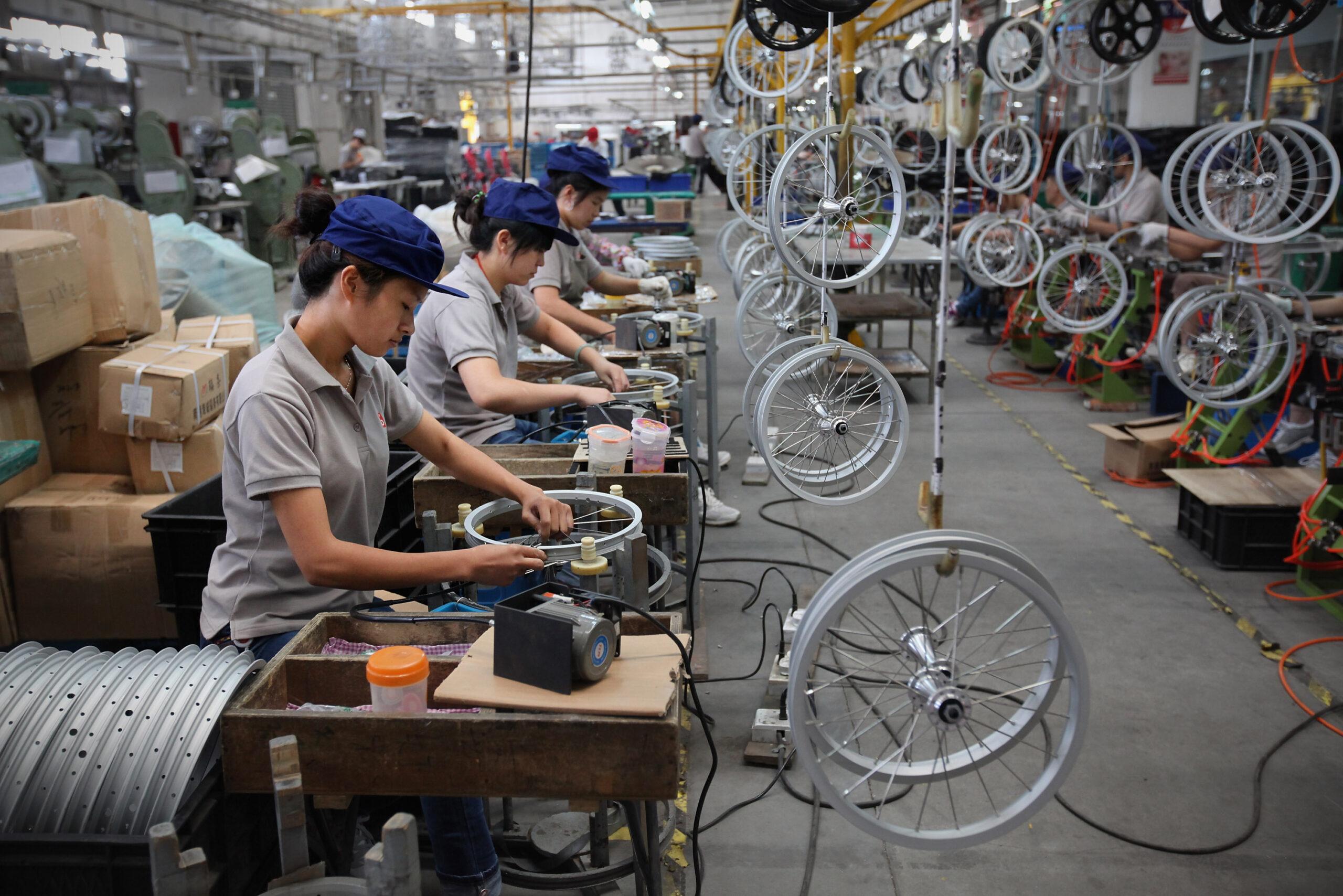
Recent reports from Chinese manufacturing sectors reveal a continuing decline in the country’s real economy. Manufacturing operators in Zhejiang and Jiangsu provinces have expressed concerns beyond dwindling orders. They are also facing pressures from competitors lowering prices, customers delaying payments, declining profits, increased tax inspections, and halting expansion plans. While some factories are still in operation, many operators are contemplating how long they can sustain their businesses.
The coastal manufacturing industry in China is rapidly shrinking, as mentioned by Mr. Chen in Yuyao, Zhejiang, engaged in hardware manufacturing. He highlighted two major challenges of reduced orders and tax audits: “Foreign trade orders have significantly decreased, and the domestic consumption market is weak, forcing us to shift to exports. Currently, only export business is profitable, but the shift from domestic to foreign sales has intensified unhealthy competition. Recently, over 90% of companies in Zhejiang were audited by the tax authorities, with penalties for violations.”
Mr. Chen noted that his hardware and building materials products have been impacted by the real estate market, prompting him to nearly abandon the domestic market since last year. He mentioned that many companies are selling products at low prices, shifting toward foreign exports, harming the domestic market and causing numerous businesses to operate at a loss. He predicts that most factories in Zhejiang may only last for about a year.
On July 31st, the official data released by the National Bureau of Statistics of China reported a decrease in the official manufacturing Purchasing Managers’ Index (PMI) from 50.3 in June to 49.2 in July, below market expectations. Non-manufacturing business activity index dropped to 49.0, construction industry index decreased to 47.0, and the manufacturing new orders and production indexes also returned to contraction territory. Official figures also indicated a manufacturing production index of 49.9 and a new orders index of 48.5.
Mr. Zhang Yao, a businessman in Lianyungang, Jiangsu, involved in machinery parts trading, disclosed that the domestic market situation is worse than expected. The more products exported, the more it signifies a contraction in the domestic market: “Currently, the most troublesome issue is customers renegotiating prices every three months, with payment delays extending up to two to three months, some even up to four months. Cash flow is tight, and tax authorities are scrutinizing accounts relentlessly to meet their targets. They claim that enterprises used to evade taxes; now that the country lacks funds, it’s time to contribute. What kind of logic is that?”
According to the data released by the National Bureau of Statistics, China’s economy in the second quarter grew by 4.3% year-on-year, marking the lowest level in over three years. Mr. Zhang mentioned that in his over thirty years in the manufacturing industry, he has never encountered such challenging circumstances: “Apart from the tech industries supported by the Communist Party receiving subsidies, no other industry is genuinely profitable. Some small factories in Jiangsu have reduced night shifts, and some have switched employees from fixed wages to piece-rate pay. Many are considering retiring to Thailand, as continuing is resulting in greater losses.”
Ms. Liu, working as an accountant in an enterprise in Kunshan, Jiangsu, shared that many businesses are under intense scrutiny from the fire department and tax authorities: “Currently, enterprises have no means to evade taxes; the audits are solely aimed at penalizing them, even if no irregularities are found. The industry and commerce sector require the purchase of their designated fire safety products; refusal leads to claims of non-compliance and subsequent fines and shutdowns.”
Ms. Liu mentioned that her employer informed her: “Enterprises are now primarily concerned with how long their cash reserves can last and what procedures are required for deregistration. If enterprises fail to pay, they are not allowed to deregister.”
Scholar Xu Dong from Zhejiang pointed out that China’s economy is still reliant on exports, governmental investments, and supported high-tech industries, while traditional manufacturing, small and medium-sized enterprises, real estate sectors, and local service industries continue to decline. The authorities in Beijing lack the capacity to introduce substantial economic stimulus measures, leading to a significant disparity between the official growth figures and the experiences of business operators in Jiangsu and Zhejiang, who are witnessing reduced orders, delayed payments, tax inspections, and production halts.
Xu Dong believes that the Communist Party channeling resources into a few favored industries leaves numerous traditional manufacturing enterprises without orders, funding, or market support. When local finances are strained, the government resorts to taxing, imposing fines, and administrative inspections on private enterprises to raise funds. To grasp the true state of China’s economy, one must not only rely on the official figures but also consider how long private businesses can keep operating and how many are seeking an exit strategy.