
In recent times, Japan and Taiwan have been deepening their political, economic, trade, and security exchanges, expanding their cooperation from semiconductors and artificial intelligence to drone technology and supply chain development. Analysts point out that in the face of military pressure from the Chinese Communist Party and changing Taiwan Strait situations, Japan-Taiwan cooperation is not only crucial for industrial development but also for regional security, economic resilience, and crisis response capabilities.
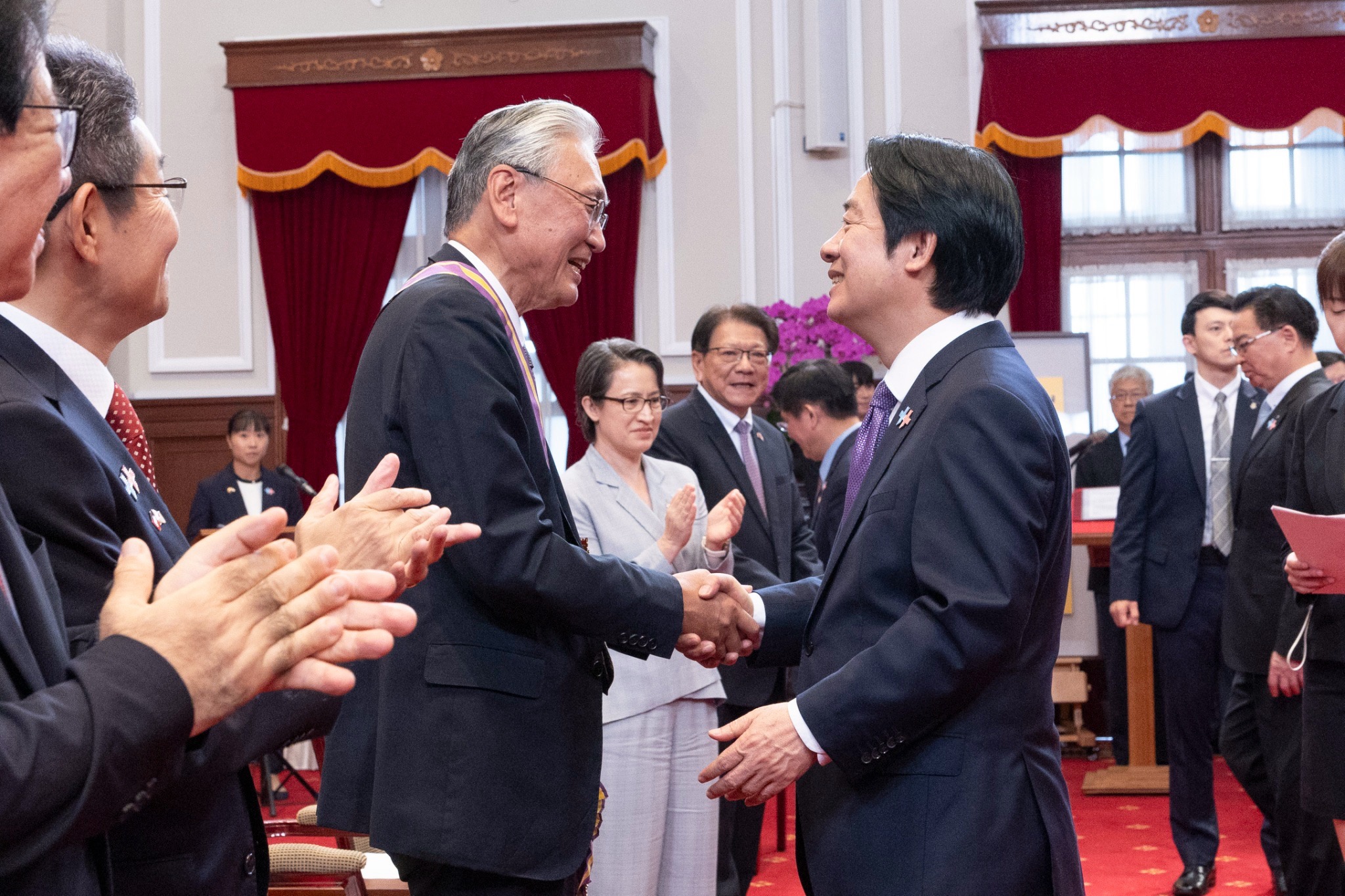
According to a report by Japan’s Nikkei News, on October 10, Taiwanese President Tsai Ing-wen met with a delegation from the Japan-Taiwan Friendship Parliamentarians’ League who were in attendance for Taiwan’s National Day celebrations.
The league’s president, Keiji Furuya, stated on October 11 to the media that Japan and Taiwan should accelerate cooperation in Taiwan’s advantageous industries such as semiconductors, robotics, and drones.
Furuya mentioned during a press conference that the “17 important strategic areas” proposed by the Sanae Takaichi Cabinet in Japan have “extremely high compatibility” with Taiwan’s technology in semiconductors, artificial intelligence, robotics, and more. He emphasized, “This will help drive new industrial cluster cooperation between Japan and Taiwan.”
Also reported by the Central News Agency, Furuya mentioned at the press conference the need for further discussions on defense cooperation between Japan and Taiwan, especially in expediting cooperation in drone technology. Furuya indicated that while there have been various defense-related collaborations at the private sector level between Japan and Taiwan, discussions are still needed at the government level for cooperation direction.
The report mentioned that the parliamentarians’ league has established a defense cooperation task force and believes that both sides should leverage their respective strengths to advance cooperation in drone technology.
During the meeting with President Tsai Ing-wen, the Japanese delegation also expressed gratitude for the donation of approximately 300 million New Taiwan Dollars (about 1.5 billion Japanese Yen) by Taiwanese citizens for disaster relief following the Kumamoto earthquake.
The Japan-Taiwan Friendship Parliamentarians’ League delegation also visited the Taiwan High-Speed Rail Yan Chao Maintenance Depot to understand the maintenance of new Japanese-made vehicles, demonstrating that transportation infrastructure and industrial exchanges remain crucial parts of bilateral cooperation.
On October 9, the Taiwan Ministry of Foreign Affairs announced on its official website the visit of a 34-member delegation from the Japan-Taiwan Friendship Parliamentarians’ League and introduced that the group officially renamed itself as the “Japan-Taiwan Friendship Parliamentarians’ League” in June 2026, marking the first large-scale visit to Taiwan after the renaming.
The warming of Japan-Taiwan relations are closely related to Chinese military activities, economic pressures, and the impact of Taiwan Strait situations on regional security.
The 2026 Diplomatic Bluebook by the Japanese Ministry of Foreign Affairs positions Taiwan as an extremely important partner and precious friend to Japan, noting that peace and stability in the Taiwan Strait are crucial for overall stability in the international community. Japan also emphasizes that Japan-Taiwan relations are maintained at the practical level outside government channels.
A report by the Center for Strategic and International Studies (CSIS) highlights the necessary strengthening of defense, base protection, force mobility and transportation capabilities in Japan’s southwest islands, as well as unmanned systems in air, sea, and underwater. It also mentions the possibility of conflicts in the Taiwan Strait making U.S. military bases in Japan significant military support locations.
The CSIS report indicates that in the face of Chinese military pressure, economic coercion, and grey zone actions, the United States, Japan, and Australia must enhance crisis coordination, strategic communication, and security cooperation.
The report further analyzes that a Taiwan Strait crisis could involve Japan’s U.S. military facilities and potentially trigger a new crisis around the Senkaku Islands. Both the northern part of the Philippines and the Bashi Channel hold strategic importance as well.
Experts from the Brookings Institution point out the close relationship between a Taiwan Strait crisis and Japan’s security. With important U.S. military bases located in Japan, a military conflict in the Taiwan Strait would greatly affect Japan. Due to the lack of formal diplomatic and military communication channels between Japan and Taiwan, the authors suggest improving policy coordination and crisis response capabilities through trilateral cooperation between the U.S., Japan, and Taiwan.
A report published on September 23, 2026, by the Taiwan Institute for Democracy, Society, and Emerging Technologies (DSET) notes that the institutionalization of Japan-Taiwan cooperation is gradually taking shape. DSET statistics show that there have been at least 20 publicly available memorandums of understanding on drone-related cooperation between Taiwanese and Japanese government agencies, industry associations, companies, and research institutions, with approximately half signed in 2025.
The report indicates that the scope of Japan-Taiwan cooperation is expanding. The memorandums of understanding on drone cooperation cover technology exchange, market development, application development, and supply chain cooperation, illustrating a progression from individual company contacts to the establishment of an industrial cooperation network.
The report suggests that the complementary nature of the Japan-Taiwan drone industry warrants further development: Taiwan has advantages in drone manufacturing and production capacity expansion, while Japan is increasing defense procurement, strengthening domestic manufacturing capabilities, and seeking more reliable supply chains.
DSET also recommends that Japan consider purchasing drones manufactured in Taiwan and deepen cooperation through joint production. This is a policy recommendation from the think tank and not a finalized government procurement decision.
In a report dated February 5, 2026, by the Central News Agency, when TSMC Chairman and CEO Mark Liu met with Japanese Prime Minister Sanae Takaichi, he mentioned the evaluation of transitioning the second wafer plant in Kumamoto to produce 3-nanometer chips to meet the demands in AI technology.
Japanese Minister of Economy, Trade, and Industry Akazawa Ryo stated that the conversion of the Kumamoto second plant to mass-produce 3-nanometer advanced semiconductors will make significant contributions to Japan’s industrial development and economic security.
The Investment Review Division of the Taiwanese Ministry of Economic Affairs approved a change in the investment plan of TSMC’s Japanese subsidiary JASM, adjusting the process to 3 nanometers with a planned monthly capacity of 15,000 12-inch wafers, with equipment installation and production expected to start in 2028.
An article by the Institute of Developing Economies (IDE) in Japan believes that TSMC producing 3-nanometer advanced semiconductors in Kumamoto will introduce cutting-edge semiconductor front-end processing into Japan, marking a significant advancement in enhancing its influence in the global semiconductor supply chain.
The Center for Strategic and International Studies (CSIS) notes that the Japanese government is promoting semiconductor manufacturing reshoring and industry rebuilding through subsidies and cooperation with companies like TSMC, Sony, and Renesas. This marks a shift in Japan’s policy from solely pursuing semiconductor self-sufficiency to rebuilding domestic manufacturing capabilities and strengthening supply chain resilience through international cooperation.
In May 2026, when Tsai Ing-wen met with Japan-Taiwan Exchange Association Chairman Norio Maruyama, they discussed cooperation between Japan and Taiwan in semiconductors, AI, information and communication technology (ICT) fields, expressing a desire to deepen economic and trade exchanges in other areas. The Japanese side also noted that exchanges and cooperation between the two sides are becoming increasingly frequent.
With Taiwan’s geographical proximity to Japan, the report from the Center for Strategic and International Studies (CSIS) in December 2025 suggests that Japan needs to prepare for security situations like a possible Chinese invasion or blockage of Taiwan and strengthen coordination between central and local governments, crisis information management, and citizen protection.
The Japanese government has planned for the evacuation of residents and visitors to the Senkaku Islands in emergency situations, aiming to evacuate around 120,000 residents and tourists to Kyushu, Yamaguchi, and other areas within approximately six days.
In the event of a military conflict in the Taiwan Strait, Japan may face challenges in maritime and airspace security, disruption in maritime traffic and energy transportation, and the utilization of U.S. military bases. Therefore, Japan and Taiwan need to strengthen cooperation in crisis information exchange, maritime security, citizen protection, and disaster response under appropriate legal and diplomatic frameworks.
Furthermore, Japan-Taiwan cooperation can maintain maritime traffic and energy supply, strengthen semiconductor and key technology supply chains, enhance regional deterrence and crisis response capabilities, among other benefits.
Studies from organizations like the Japan Institute of International Affairs (JIIA) indicate that the Taiwan Strait situation is crucial for Japan’s security, underscoring the need for Japan and Taiwan to enhance crisis information exchange, maritime security and disaster response cooperation within the appropriate legal and diplomatic frameworks.
The Economic Security Research Center of Dentsu Inc. in Japan (DCER) points out that Taiwan is an important trade partner for Japan, with Taiwan accounting for 58.8% of Japan’s imports of integrated circuits in 2024. Changes in Taiwan’s advanced semiconductor industry directly impact the competitive environment and economic security of Japanese enterprises.
+