
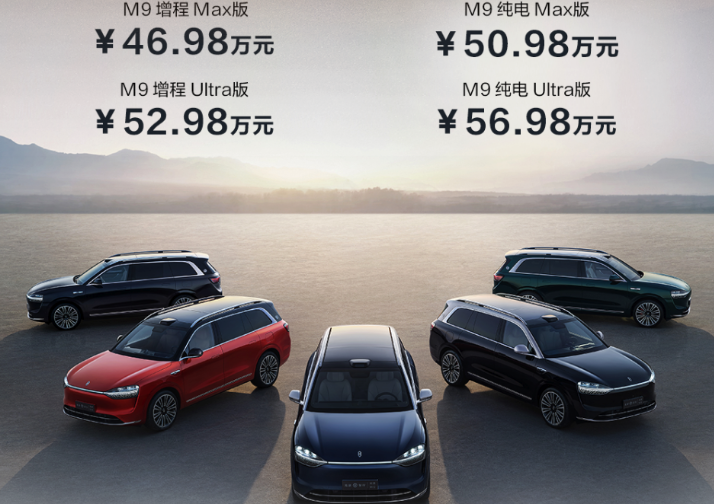
Recently, Chinese luxury electric vehicle brand, Wenjie M9, has been facing complaints from car owners, sparking discussions on the internet. From October 11th to 12th, “Wenjie M9 car owners complain about quality” became a hot topic on Weibo.
A circulated screenshot from a social media post by the blogger “Xia Hao” revealed that he ordered the first batch of Wenjie M9 in June 2023 and received the car in January 2024. The vehicles are produced by Siles located in the Longxing New City of Liangjiang New Area in Chongqing, with the factory being completed in October 2023.
The issues listed by this car owner include rust on the car body frame, mm-wave radar detachment, internal fogging in headlights, stuck lift screen, unsynchronized car clock, detached in-car refrigerator, and insufficient brightness in the projection headlights. He also questioned whether the short duration from factory completion to the delivery of the first batch of vehicles in about 3 months indicated compressed production or verification processes.
There are also doubts circulating on the internet regarding whether Wenjie M9 is AI-generated and involves false information dissemination. The blogger mentioned that legal action has been taken, but no official response has been provided yet.
Public data from Car Quality Network shows recent complaints from Wenjie M9 car owners about vehicle issues.
One complaint registered on September 29th involves the 2024 Ultra version, citing paint peeling in various parts of the new car, interior damages, and abnormal noises. Another complaint registered on September 30th involving the 2024 Ultra version mentioned that the right rear door handle cannot pop out. Additionally, complaints about suspension lift malfunction, tire wear, and driver assistance failure are listed on the platform.
Another circulated insurance policy screenshot on the internet sparked discussions among netizens about the operating cost of using Wenjie M9. The poster mentioned purchasing the 2024 Ultra Extended Edition for nearly 600,000 RMB with an annual insurance premium of around 4,000 RMB and a third-party liability coverage of 3 million RMB.
As Wenjie M9 stirred up discussions, the public’s attention turned to the issue of “quick-made cars.”
On October 10th, the Chinese Ministry of Industry and Information Technology, the Ministry of Public Security, the Ministry of Ecology and Environment, and the State Administration for Market Regulation jointly issued a notice seeking opinions on further strengthening the management of innovative design and R&D testing and verification of automotive products, aiming to address the issue of “quick-made cars.”
“Quick-made cars” refer to models introduced by compressing the R&D cycle and eliminating real vehicle verification processes excessively to seize market share. Some car companies have compressed the traditional car-making period of over 40 months to 18-20 months, skipping major real-world testing processes like high-temperature and durability tests, overly relying on virtual simulations, turning consumers into “testers.”
Some media outlets and industry insiders have linked this regulatory trend with the issue of “quick-made cars,” criticizing some car companies for accelerating new car launches by cutting back on R&D testing.
Meanwhile, another high-end vehicle model of Hongmeng Zhihang, the Zunjie V800, experienced a brake pedal fracture incident, triggering trust concerns across different models.
On October 8th, Dongchedi released a test video showing three Zunjie S800 experiencing brake pedal bracket fractures during emergency braking tests from 100 km/h to 0 km/h.
Dongchedi stated that the fracture locations of the three cars were close, and regarding the circulated pedal force value of “4589N,” the platform clarified the actual peak value was 1612N. Zunjie later declared they would further optimize related component designs and offer free upgrades for delivered users.
These consecutive events have fueled discussions and increased public attention on how high-end electric vehicles strike a balance between rapid iterations and safety verification.