
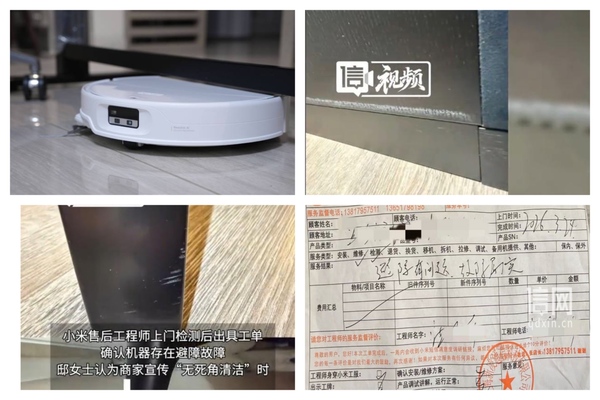
Recently, a woman named Di from Shanghai claimed that the Xiaomi Robot Vacuum 5Pro had obstacle avoidance malfunctions, causing damage worth a million yuan to her imported furniture, with repair quotes reaching as high as 375,000 yuan, sparking attention on the internet.
Di told Signal News on August 20th that she has a house in Shanghai where she meticulously selected high-end furniture, mostly imported from Europe, including B&B Italia dining chairs, Buben&Zörweg safe, FENDI coffee table, LAGO master bed cabinet, Tonin Casa bedside table, and more, totaling over a million yuan in original purchase price.
In February this year, Di purchased a Xiaomi Robot Vacuum 5Pro from the Xiaomi flagship store on an e-commerce platform. After using it for a while, she noticed significant scratches on her furniture. Upon closer inspection, she discovered that these scratches were caused by the Xiaomi robot vacuum.
Videos taken by Di show that the robot vacuum would clean by hugging the edges closely, almost touching the furniture. When entering tight corners where furniture blocked its path, the robot would repeatedly collide, trying to clean the area.
On March 24th, Xiaomi’s after-sales engineer visited and issued a work order after detecting an obstacle avoidance malfunction. Meanwhile, the e-commerce platform offered a 500 yuan compensation plan, which Di didn’t accept.
After Di complained to the customer service, the e-commerce platform proposed a 500 yuan compensation plan. Di expressed that most of her furniture is imported, with some already discontinued, and official repair quotes from furniture suppliers amounted to 375,000 yuan.
Currently, Di has sued Xiaomi and the e-commerce platform. The case has been filed in the Jing’an District Court in Shanghai and is scheduled for trial on September 15th.
On August 20th, the news labeled “Xiaomi Robot Vacuum Damages Million-Worth Furniture” trended on hot search.
Netizens commented that the “intelligence” of smart home appliances should not only focus on cleaning efficiency but also on safeguarding users’ property.
“A robot vacuum advertised for its obstacle avoidance capability should not shift responsibility onto users and furniture. The most glaring issue lies here. Since the after-sales department has confirmed the machine’s obstacle avoidance malfunction, compensation should not stop at a symbolic figure like 500 yuan. Whether the 375,000 yuan repair quote is reasonable can be further evaluated, but losses caused by product defects should not be lightly dismissed with a statement on usage risks. Particularly when emphasizing cleaning ability in promotions, the boundary risks, collision probabilities, and protection tips for valuable furniture should have been clearly communicated.”
Internet technology influencer “Constantine” posted, “A machine priced at 3,999 yuan damaged over a million yuan in imported furniture. While the after-sales work order clearly stated an obstacle avoidance malfunction, the merchant only offered 500 yuan in compensation. This is not just a disparity in compensation amount but a rupture of responsibility between the ‘no dead angles’ promotion of intelligent appliances and extreme financial losses.
“When a brand promises an all-encompassing cleaning experience with algorithms but remains silent on scratch risks in product descriptions, do users truly bear an infinite prevention duty of setting up virtual walls? In commercial logic, any cheap undercutting of physical sense will eventually be paid for at a certain price; and in the era of intelligence, this price could be several million in repair costs.”