
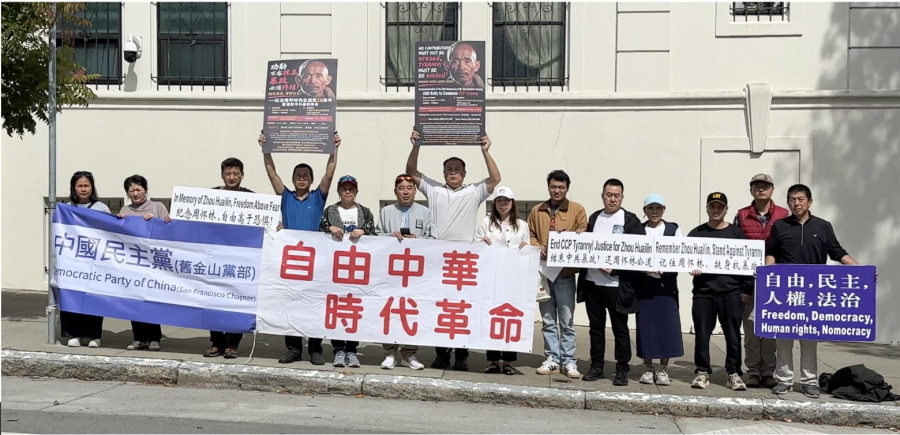
“Merits should not be erased, tyranny must come to an end!” “Remember history, safeguard justice!” On August 16, the China Democracy Party San Francisco Branch and the China Democracy Education Foundation held a gathering in front of the Chinese Consulate General in San Francisco to commemorate the 28th anniversary of the passing of Zhou Huailin, a farmer from Fengcheng, Jiangxi, and to review the Fengcheng Incident and the heavy tax burden long endured by Chinese peasants.
The event was organized by Zhou Xiaojun and Kang Jiaming. Zhou Xiaojun’s hometown is near the town of Baitu where Zhou Huailin lived, and they share the same surname Zhou. When the incident occurred years ago, Zhou Xiaojun was just a teenager. As a fellow clansman, he felt a responsibility to seek justice for Zhou Huailin.
On that day, several participants shared their own or their families’ rural experiences from the 1990s, recounting memories of farmers having to “contribute grain,” bear the burden of the “three deliveries and five guarantees,” and various levies of that time.
For them, this was not a distant history but rather a life they, their parents, grandparents, and even they themselves had experienced firsthand.
On August 16, 1998, a large-scale mass conflict erupted in Fengcheng, Jiangxi, due to farmer’s burden issues, known as the “Fengcheng 8·16 Incident.” (Note: Online records usually mention 1999 or even 2000, but according to records kept by the elderly farmers living in the area, the incident occurred in 1998.)
In the late 1990s, in addition to agricultural taxes, Chinese rural areas also faced the “three deliveries and five guarantees” policy and various local levies, funds, and levies. The actual costs borne by farmers in some regions far exceeded the burden limits set by the policies at that time.
According to historical records, Fengcheng’s Baitu town farmer Zhou Huailin raised objections to the excessive and opaque fees in the area. He collected and transcribed policy documents aimed at easing the burden on farmers, explained the policies to villagers, recorded grain production and delivery data, and demanded transparency in the fees and deductions.
Zhou Huailin was subsequently taken away by the township authorities on charges of “misleading the people and disrupting administration,” sent to a study class, and died under non-normal circumstances two days later. When his family approached to question, they were driven away. Upon hearing the news, villagers from surrounding towns gathered in support, and the conflict quickly escalated, eventually turning into a large-scale confrontation besieging the township government.
During the conflict, the emotionally charged “rebels” destroyed the township government office, throwing the township leader and a cadre from the second floor to their deaths, burying them alive. The director of the township police station and a police officer were beaten to death, with the director’s body hanging from a tree in public display, while only the township party secretary managed to escape to the county on a borrowed motorcycle.
This incident shook the higher echelons of the Communist Party of China. Jiangxi later became an important pilot region for agricultural tax reform. Starting from January 1, 2006, China comprehensively abolished agricultural taxes.
However, to the participants at the event today, the resistance of Zhou Huailin and countless ordinary farmers still remains an unforgettable chapter in this history.
The event’s host Zhou Xiaojun said that many people today, when looking back at the cancellation of agricultural taxes, easily interpret it as “the country becoming wealthy, so the government reduced the burden on farmers.”
But in his view, history should not be limited to a single official narrative.
He stated that Zhou Huailin collected policy documents from the central government aimed at reducing the burden on farmers, explained to the farmers which expenses were according to policy and which burdens were problematic. He believed that what Zhou Huailin did initially was hoping to solve problems according to policies and reason.
“Why do we still commemorate Zhou Huailin today?” Zhou Xiaojun said, “Because Zhou Huailin’s tragedy is not just one person’s tragedy.”
Zhou Xiaojun recalled that at the time the government stipulated a mandatory annual agricultural tax of 300 yuan per person. His family of five had to pay 1,500 yuan in agricultural taxes annually. With only five mu of land, they harvested approximately 6000 jin of grain in two seasons a year, calculated based on the price of grain at 30 yuan for 100 jin at that time. After paying the 1500 yuan agricultural tax, they were left with only 300 yuan. This was the miserable life of Chinese farmers.
He said that the grain grown through the hard work of the farmers in a year, after completing various deliveries, was hardly enough for a family’s living expenses.
Zhou Xiaojun pointed out that even after the cancellation of agricultural taxes, many problems in Chinese rural areas have not disappeared. When an ordinary person encounters land, property, or other rights issues but lacks effective channels for appeal, judicial processes, and oversight, social conflicts may still accumulate.
“We oppose violence, but we must also question why some ordinary people have lost hope of fair treatment through peaceful means due to what kind of system,” he said.
Guo Jinsheng, born in the 1970s from a rural area in Jiangsu, spoke about his family’s experiences in the 1990s.
He said that in his family of five, with three laborers, they were allocated over five mu of land.
“My family had to hand over 3,600 jin of grain to the state every year,” he said.
At that time, the price of grain was relatively low, so the family had to first keep enough food for daily needs, and the rest of the grain had to be used to meet the delivery task. Despite this, they sometimes couldn’t fulfill the task and had to purchase additional grain to compensate.
In addition to the grain burden, Guo Jinsheng also remembered the “town coordination, village retention” policy of that time and various voluntary work obligations.
“Every person over 18 years old had to perform 25 days of volunteer work for the government, and sometimes even more,” he said. His family, with three laborers, had to complete at least 75 days of volunteer work per year; if they couldn’t complete the work, they had to pay a fee for each day missed, ranging from 3 to 5 yuan. What kind of logic is this? Forcing farmers to become volunteers, and being fined if unable to attend, is the policy of the Communist Party!
He said that if peasant families failed to meet various delivery obligations and fees on time, sometimes they would incur debts and interest. By the year-end, some grassroots officials would go door-to-door to collect debts, and there were cases of confiscating grain and livestock.
He also mentioned the plight of his neighbor Liu Jianguo’s family.
Liu’s family of six members, because of the long-term burden of various taxes and fees, faced extremely difficult living conditions. Guo Jinsheng recalled that around 1994 or 1995, when government personnel visited Liu’s home for collections, they took away most of the rice in the house, leaving only a small amount for the family to survive.
Feeling desperate and powerless, Liu Jianguo secretly went two miles away from home to commit suicide by jumping into a pond alone.
A few days later, someone found a pile of clothes by the pond, and poor Liu Jianguo had left the world walking away naked!
Villagers speculated that maybe he had already planned it out before his death, taking off his clothes before jumping into the pond because the family was poor, hoping that if discovered, at least he could have clean clothes for the funeral to avoid burdening his family further… a heartbreaking and cruel reality that brings tears to one’s eyes…
“This is what I witnessed in the rural areas during that time,” Guo Jinsheng said.
Xiong Chaofeng from Hunan, being a farmer’s daughter, felt particularly touched by Zhou Huailin’s story.
She recalled that her parents used to support the family by farming, and most of the rice grown through hard work in a year had to be used to fulfill agricultural taxes and other burdens.
“What can we eat if we sell the rice?” she said. The parents had to resort to planting sweet potatoes, radishes, and cabbage in barren lands. Sometimes when the family had no grain, they had to borrow from neighbors or relatives, but since everyone was a farmer, nobody was well off.
She still remembers a small incident.
One time, her younger brother returned from their grandmother’s house, and her mother wanted to fry him an egg. However, her mother scraped the oil jar for a long time but couldn’t find even a bit of lard.
“For many people, a single egg may seem insignificant, but at that time, it was a luxury for us,” she said.
Xiong Chaofeng said, “Since childhood, I have believed that a government truly serving the people should not allow its citizens to live in such hardship.”
Activist Zhao Ming recounted the memories of the farmers from the previous generation.
In an era without agricultural vehicles and muddy roads, paying grain taxes every year was the most physically and mentally burdensome task for Zhao Ming’s grandfather.
Before dawn, his grandfather would tie a rope around his shoulders and pull a wooden cart filled with grain ten kilometers to the grain station.
There, they had to wait in line. The grains had to undergo inspections, and any issues with moisture content, impurities, or other factors could lead to rejection.
“The best grain was taken away, leaving hungry the workers who were toiling on the fields.”
Zhao Ming said, the remaining grain at home could only be mixed with sweet potatoes, corn flour, sorghum flour to make into mixed grain bread. Rarely did they have oil, with meat only being consumed during the festivals.
“A barrel of pickled vegetables for a year.”
Besides the public grain deliveries and the “three deliveries and five guarantees,” there were road constructions, fundraising for schools, family planning costs, and various other fees. If they couldn’t pay up, there were sometimes door-to-door collections.
“Farmers in that era, working hard on the fields, but not necessarily being able to eat the fine-grain they grew,” he said.
Gao Zhibin from a rural area in Shandong said he was also a witness to that era.
“In the 1990s, many rural families faced difficult living conditions. I witnessed grassroots officials going door-to-door to collect grain, fees, and various taxes.”
He said that for people today, terms like “contribute grain,” “agricultural tax,” and the “three deliveries and five guarantees” might just be historical terms. However, for the farmers back then, those were “a family’s food, children’s school fees, and the hope of life.”
“Today, commemorating Zhou Huailin is not about nurturing hatred or praising violence,” he said.
Zhou Xiaojun said: “We hope that China will not see another Zhou Huailin, that there won’t be one after another ordinary person pushed to the brink.”
“What can truly end violence is not greater violence, but justice; and what can bring stability is not repression but making people trust the law.”
28 years have passed, the Fengcheng incident of that year has become history.
But on August 16 in San Francisco, people still look back through the stories of ordinary farmers to revisit those not so distant years.
These stories may not have been included in grand historical narratives, but they constitute the most authentic historical memories of rural China. ◇