
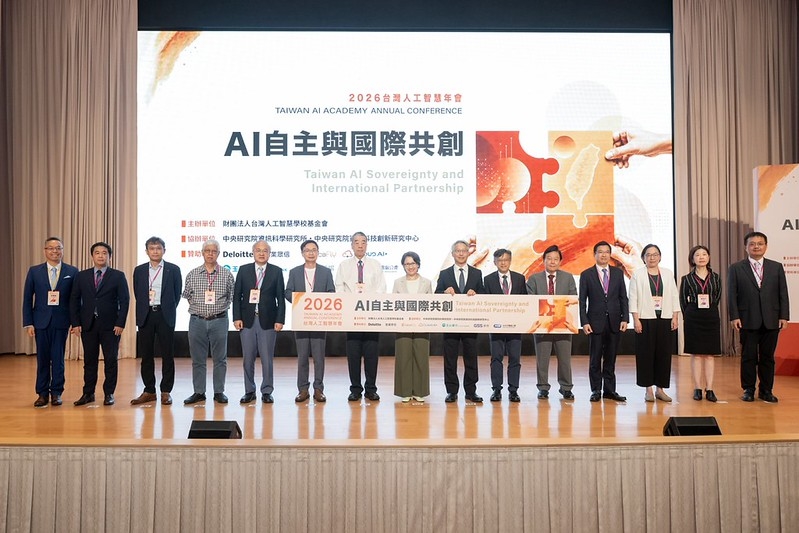
Taiwan Vice President Xiao Meiqin attended the opening ceremony of the “2026 Taiwan Artificial Intelligence Annual Conference” today and delivered a speech emphasizing the importance of strengthening Taiwan’s autonomous AI applications and data governance in the face of the rapid development of AI. She also called for active participation in international co-creation and global AI governance, while balancing technological innovation, security resilience, and human-centered values.
In her address this morning, Vice President Xiao expressed her delight at being invited for the third time to the opening of the “Taiwan Artificial Intelligence Annual Conference.” She noted the rapid development of AI in recent years, with many new breakthroughs in the application and development of related technologies. She reflected on the significant progress made in artificial intelligence within just 8 years from the establishment of the “Taiwan Artificial Intelligence School.”
The theme of this year’s conference, as pointed out by Vice President Xiao, is “AI Autonomy and International Co-creation.” Both the President of Academia Sinica, Chen Chien-jen, and the Chairman of the Taiwan Artificial Intelligence School Foundation, Liao Chun-chih, highlighted the importance of establishing Taiwan’s autonomous AI applications. Xiao emphasized the need to ensure Taiwan’s autonomy in AI applications as AI becomes smarter with tighter iteration cycles.
Stressing Taiwan’s unique advantages, Xiao pointed out that Taiwan possesses the world’s most advanced semiconductor manufacturing capabilities, serving as an indispensable core engine driving global AI computing. Beyond hardware and computing power, she highlighted the importance of data governance and cultural values in ensuring Taiwan’s genuine autonomy.
The government’s recent initiative, the “New Ten AI Constructions,” aims to provide computing power, enhance data governance, nurture talent, establish an innovation ecosystem, develop cutting-edge technologies including quantum computing, silicon photonics, and intelligent robots, and promote applications across various industries. These efforts underscore the interconnectedness and indispensability of AI autonomy for comprehensive development.
Xiao underscored the importance of data governance, noting that any model lacking sufficient data will encounter operational challenges. To address this, the Executive Yuan has established the “Sovereign AI and Data Governance Task Force,” led by the Vice Premier with deputy ministers serving as “Data Chiefs,” forming the “Data Chiefs Alliance.”
The government’s approach involves starting with non-personally identifiable data, actively inventorying and releasing “AI-Ready Data” in line with Taiwan’s values to provide ample language resources for Taiwan’s sovereign AI training. Additionally, relevant regulations will be updated to ensure that Taiwan’s execution of sovereign AI is based on robust data governance.
By promoting data governance, the government aims to facilitate the introduction of AI into governance processes while providing sufficient data and an open framework. This initiative is crucial for technological development, humanistic research, administrative procedures, healthcare, and other fields to have a solid governance foundation for AI development.
In discussing “International Co-creation,” Xiao pointed out that autonomy and co-creation are not mutually exclusive, and autonomy does not equate to isolation. Taiwan must engage in developing core technologies and participate in establishing global AI governance standards through international open-source communities. Taiwan’s absence in the global AI ecosystem would leave a significant gap without its semiconductor capabilities.
Therefore, Xiao stressed that Taiwan must not only serve as a provider of chips but also emerge as a core player in governance and international co-creation. Through the combination of hardware and software, Taiwan can make irreplaceable contributions in chip production, cybersecurity, resilient system design, cross-industry applications, and leveraging the experience accumulated in Taiwan’s democratic practices, thus positioning Taiwan as an indispensable player in the global AI landscape.
While acknowledging the great convenience brought by AI, Xiao also emphasized the need to address the risks and challenges it presents. Countries must have the capacity to counter challenges such as mass production of fake news by AI, deepfake technology, cognitive warfare, and cyberattacks on critical infrastructure, which could undermine societal trust and democratic systems.
President Lai Ching-te particularly emphasizes the concept of “Societal Resilience Defense,” encompassing resilience in information communication and basic infrastructure. The implementation of the “Artificial Intelligence Basic Law” by the government this year underscores a dual-engine framework that balances innovation and security, aiming to export globally trusted AI systems based on human-centered and rights-ensuring principles, solidifying Taiwan’s legal governance and cybersecurity defenses as globally trusted foundations.
Furthermore, while focusing on enhancing technology, governance, and defensive resilience, the government also places great importance on the balanced development of various industries. Given Taiwan’s rapid technological advancements, efforts to ensure that the benefits of technological innovations are shared across different sectors are crucial. The conference agenda for today includes discussions on “Enterprise Applications and Governance” and “Humanities Applications and Reflections,” aiming to address various ethical and societal impacts, emphasizing the importance of integrating technology with humanistic concerns to prevent the rapid development of AI from straying away from its human-centric direction.
In conclusion, Vice President Xiao expressed her gratitude to the Taiwan Artificial Intelligence School, attending experts, scholars, and private sector partners. She highlighted Taiwan not only as an island known for its chips and hardware but also as a republic of AI innovation and values. She expressed hope that the discussions and collaborations arising from today’s agenda would inspire greater dialogue and cooperation for the future, while wishing the conference a successful conclusion and looking forward to experts leading Taiwan with AI to greater heights.