
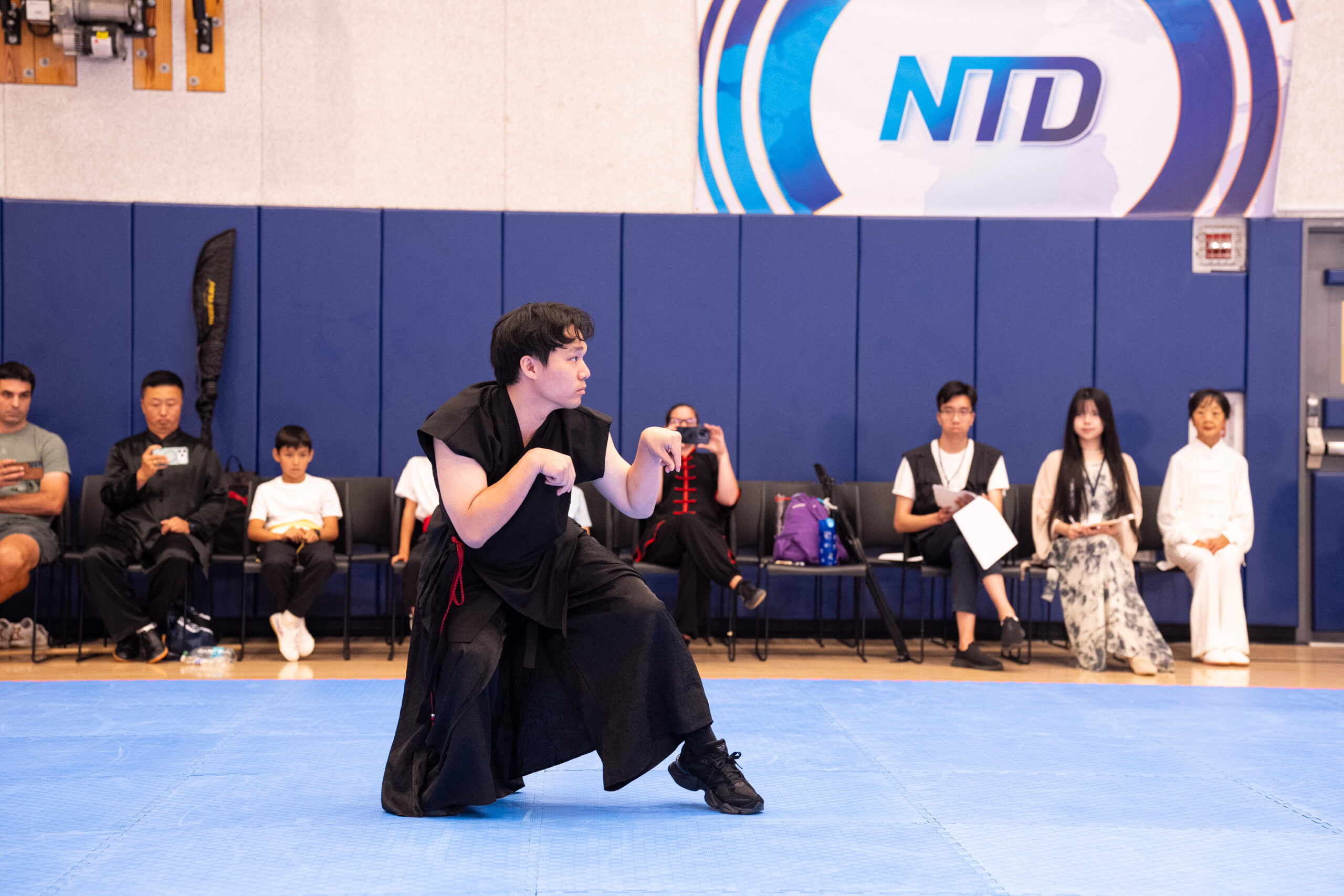
The 9th NTD World Chinese Traditional Martial Arts Competition resumed in Manhattan, New York, on August 14th. Lin Jingyao from Taiwan advanced to the semi-finals and finals with a set of Bengbuquan. Having practiced martial arts for many years, Lin believes that the rewards of martial arts go beyond just the techniques, but also encompass a journey of physical training, mental cultivation, and the pursuit of martial virtue.
When it comes to Seven Star Praying Mantis Fist, Lin Jingyao explained that this form emphasizes agility in movements, swift actions, and clean overall style with quick strikes from the mantis hands.
However, he points out that people may have different understandings of martial arts at different stages of life. “In the past, it was about hard training, so I felt that it toughened one’s resilience,” he said. Early martial arts training was more about building willpower and cultivating a spirit of perseverance. As his skills improved, he began to realize that what needed enhancement was not just the techniques but also his moral character.
Discussing the understanding of martial virtue, he said, “Kung Fu is used to cultivate oneself, not to attack others; this is what we call martial virtue.”
Later on, he developed a deeper understanding of martial arts. “Martial arts are a tool for ‘cultivating oneself through martial arts’.”
Lin Jingyao emphasized that nowadays, when practicing martial arts, he values the state of being in harmony between body and mind. “When I am practicing martial arts, I can feel that my body and mind are in sync. I even enjoy practicing in nature, feeling the oneness with the natural surroundings.”
He mentioned that focusing on each move helps clear his mind. “There are many worries in life because there are too many distracting thoughts in the mind. When I am practicing martial arts, my mind is almost blank, free from distractions and worries.”
He believes that although the body appears to be in motion during training, it is actually a process of “movement nourishing stillness”. “Even though the body is moving, the mind is still, achieving a state of tranquility.” Sometimes after training, things that seemed important or troubling before suddenly become clear, and “the thoughts that were once considered very crucial or indispensable gradually fade away.”
He admitted that the greatest reward from practicing martial arts is not just the skills themselves but the continuous self-discovery throughout the process. “The more I practice martial arts, the more surprises and rewards I find in life.”
Speaking of the biggest change in his martial arts practice over the years, Lin Jingyao mentioned that besides technical improvement, learning to accept his body has been more crucial.
“In the past, I could perform certain movements, but now there are some that I can’t do anymore.” He admitted that he was once troubled by changes in his body, but now he realizes that it is essential to accept oneself in the present moment.
“Accepting the changes in my body, accepting the facts themselves,” he said, and this realization has led him to understand martial arts from a different perspective.
“With the current state of my body, how can I practice martial arts? Because of this, I increasingly feel the improvement in character, not just physical understanding, so I think the levels are moving upwards.”
In his view, there is not a single way to perform a set of techniques. “If I can’t strike with strong force, then I can add a bit of softness; what used to be shorter and faster force might now include longer and softer forces.”
He believes that a person should constantly adjust themselves with different stages of life. “In life, one should continuously feel changes within themselves; I believe this is a process of self-understanding.”
Regarding the NTD Martial Arts Competition advocating traditional martial arts and emphasizing martial virtue, Lin Jingyao fully agrees.
He believes that true martial virtue does not stem from having martial skills and becoming proud but is an internal tranquility and self-confidence. “You know that you are great, but it is not arrogance or aggression, it is a kind of calmness and joy.”
He said that once the inner self is truly stable, a person is less susceptible to external influences. “When someone attacks you, you will not be easily affected. Like ripples, they come and go, without lingering in your mind.”
It is for this reason that he hopes to pass on these principles to more students in the future. “I used to practice martial arts with more emphasis on hardship, and there was an inner resistance. Now, I hope that students can enjoy the process of practicing martial arts because it is a beautiful thing.”
As for the significance of NTD organizing the martial arts competition, he believes that the main purpose is to reintroduce traditional martial arts to more people. “Practicing martial arts involves combat, but it is not just about fighting; it also involves nurturing virtues, martial ethics, and spiritual cultivation.”
He stated that he has gained numerous benefits from martial arts and hopes to promote this traditional culture to a wider audience. “Let everyone understand the true essence of martial arts more and more.”