
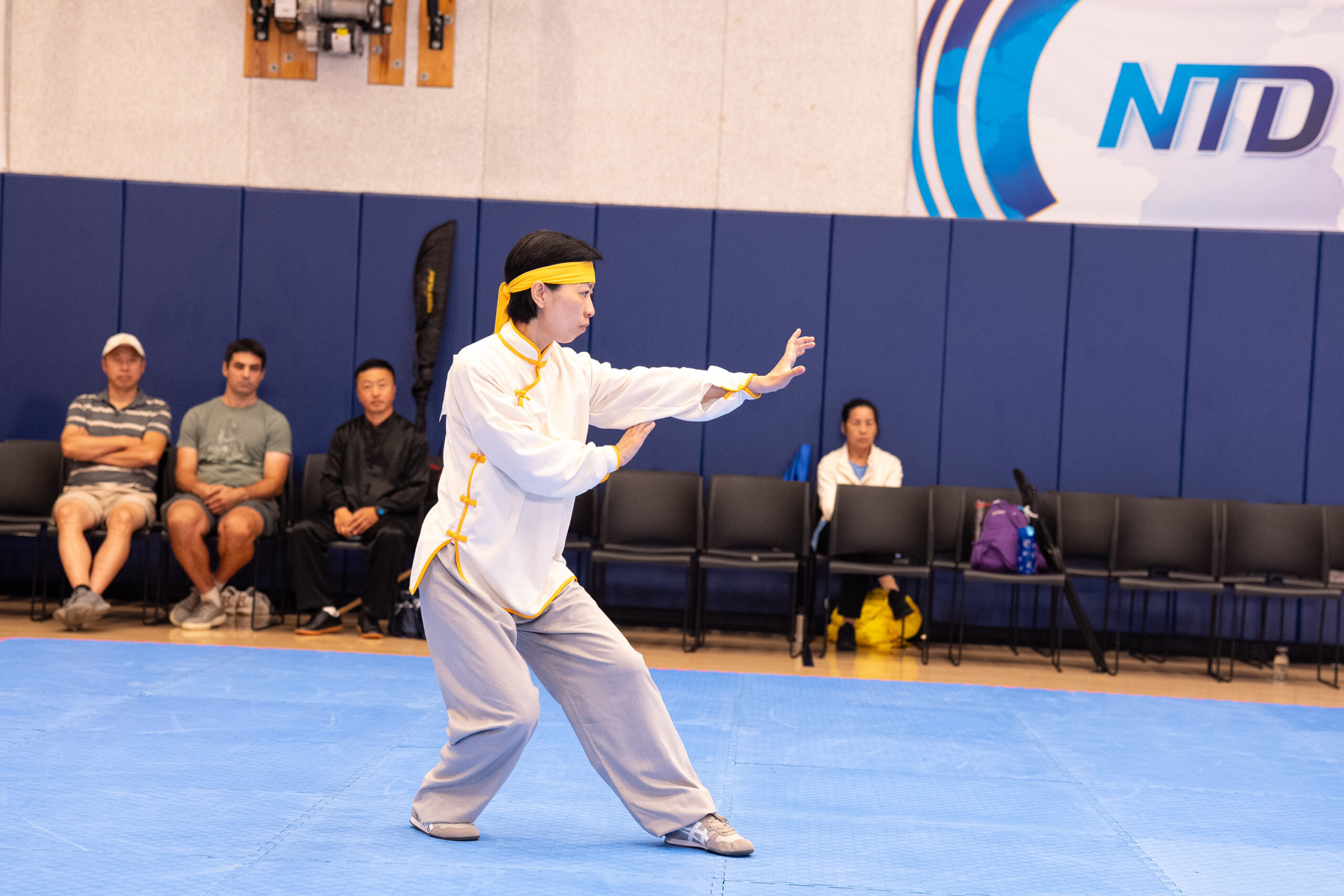
In recent news from Epoch Times on August 15, 2026, it was reported that Wu Jiaying participated in the New Tang Dynasty Worldwide Traditional Chinese Martial Arts Competition for the second time, advancing to the semi-finals with a set of Xingyi Quan. Looking back on her years of martial arts practice, her greatest takeaway was not just becoming more skilled in routines, but gaining a whole new understanding of traditional martial arts and Chinese culture. Previously, she viewed martial arts as portrayed in martial arts films, cool and flashy, but through actual practice, she came to realize the importance of “martial virtue.”
Discussing her technical breakthroughs, Wu Jiaying highlighted a phrase her teacher often said: “Relax.” At the start of her martial arts journey, she believed that punching required exerting force. However, her teacher repeatedly reminded her that it’s not about using arm strength, but the power from the waist while staying relaxed.
“It took me about a year to truly comprehend the meaning of ‘relax,’” she said. Understanding that real power doesn’t come from brute force but from a relaxed yet controlled movement akin to stretching a rubber band. It was only then that she started to grasp the essence of power generation in traditional martial arts.
Compared to her technical advancements, she believed that her most significant changes stemmed from within herself. Wu Jiaying expressed that before practicing martial arts, her impression of Chinese martial arts was limited to the fight scenes in martial arts films, which she thought were “cool.” However, diving into traditional martial arts, she discovered that it emphasized “martial virtue,” prompting her to actively delve into Chinese history and traditional culture.
“I gradually realized that traditional Chinese culture is all about morality. Martial arts focus on martial virtue, business has its own ethics, every aspect has its own cultural significance.”
She believed that “genuine traditional martial arts are not just about practicing forms but also about improving one’s morality and cultivation. As one improves as a person, their martial skills naturally advance.” In her view, “balancing internal and external training is crucial for understanding the essence of martial arts.” Such understanding gradually influenced her mindset.
Wu Jiaying stated, “Previously, I used to do things with specific goals in mind, but now I have become more simple-minded and considerate of others.” She attributed this change to the natural progression of learning martial virtue and traditional culture.
Witnessing classmates helping each other also reinforced her belief in the phrase often uttered by teachers, “Return to the basics and stay true to oneself,” understanding that “people in the past were kind-hearted.”
Recalling the initial stages of basic training, where she experienced discomfort in her knees from practicing standing stances, she once doubted her suitability for martial arts. However, with encouragement from teachers and classmates, she persisted, valuing this martial arts learning journey even more.
Li Liping has been learning traditional martial arts for three years. During her first participation in the New Tang Dynasty Traditional Martial Arts Competition, she had only practiced for a year. Now, returning to the competition arena, she advanced to the semi-finals with a set of Four Gates Saber. When asked about the secret to her progress, she emphasized the importance of perseverance, stating that there are no shortcuts.
She explained that she attends classes for three to four hours weekly, and her teacher encourages home practice, leading her to practice almost every day. Despite juggling work and personal life, she doesn’t perceive martial arts as a time-consuming activity. “If you don’t practice martial arts, you would still engage in physical activities; many people go running or to the gym, which also takes a considerable amount of time.”
What keeps her going is witnessing her progress with each practice session.
“Every day practicing a set of forms, ensuring each movement is executed correctly, gives a different feeling. Teachers always correct us, and when you get it right, you feel a sense of accomplishment.” She believes that “martial arts embody beauty, and to truly appreciate it, one must strive for precision and elegance in each movement.”
After three years of practice, she noticed significant changes in her physical condition. “My endurance has improved a lot.” She shared that when she arrived at the competition venue on the seventh floor, she and her peers effortlessly climbed the stairs without feeling out of breath. She reiterated that although martial arts may seem like basic stances and movements, they quickly induce sweating, enhancing overall physical fitness and stress resilience.
When asked why she perseveres, she responded straightforwardly, “Because with practice comes visible progress.” During each class, teachers require students to demonstrate their progress, and as she observes her classmates improving daily, she wonders if she’s progressing as well. This continuous process of improvement serves as her primary motivation to persist in martial arts.
Li Liping encourages everyone to explore traditional martial arts. “Traditional martial arts suit all age groups, catering to different forms suitable for each age group.” She noted that seeing competitors in their sixties and seventies perform stably and powerfully during the competition reinforced her belief in the longevity of traditional martial arts as a sustainable form of exercise.