
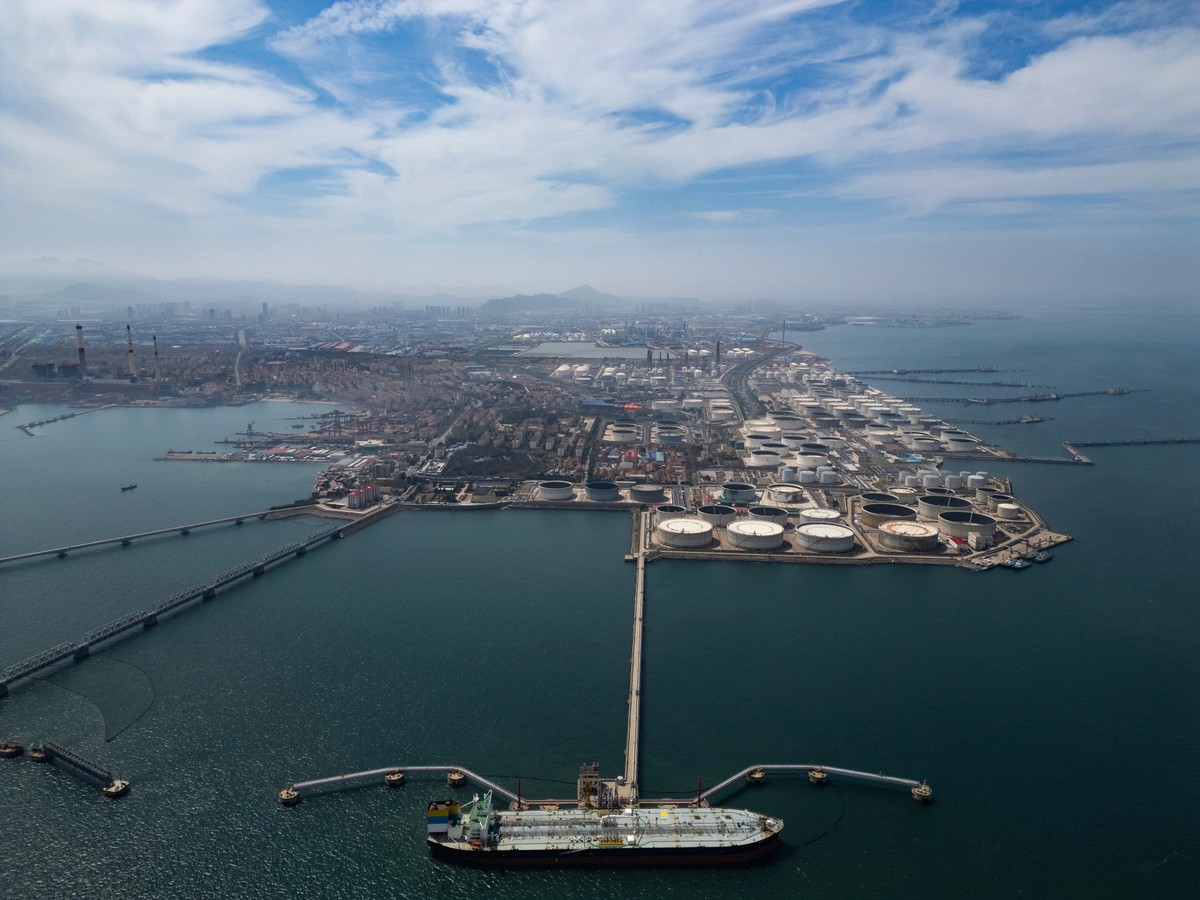
Iran announced on July 31 that it had sunk two ships and forced another four ships to retreat. The Islamic Revolutionary Guard Corps (IRGC) of Iran claimed that the sunken ships were accompanied by US military air support at the time, as if that could justify the attack. However, ships associated with China, Russia, and some other countries usually receive special treatment from Iran.
Beijing has close ties with Tehran, and Tehran’s attacks on shipping lanes have interrupted navigation in the Persian Gulf. Beijing also has good relations with the Houthi proxies in Yemen, who have blocked shipping to Saudi Arabia and disrupted navigation in other regions.
It is alleged that China has provided military supplies to Iran, including 400 sets of shoulder-fired surface-to-air missile launchers about to be delivered. In exchange, Chinese ships are usually spared from attacks by Iran and its proxies.
The IRGC of Iran attacks non-Chinese ships trying to escape the Persian Gulf via the Strait of Hormuz, while the Houthi proxies control the Bab al-Mandeb Strait to block the Red Sea. Both the IRGC of Iran and the Houthi proxies are designated as terrorist organizations.
The IRGC of Iran publicly seeks “insurance” compensation, while the Houthi proxies are reportedly considering imposing “fees” on shipping in the region. Some Houthi members believe that the closure of the Strait of Hormuz has quadrupled the value of the Bab al-Mandeb Strait.
Iran is said to be providing fee advice to the Houthi proxies, while China has reached agreements with both organizations allowing passage of its ships. This not only rewards terrorism but also boosts China’s already thriving international shipping industry. If Tehran and Beijing’s plans succeed, the ultimate victims will be the United States, our allies, and the entire democratic system.
During the War in Afghanistan (2001-2021), China likely reached a similar agreement with Taliban terrorists to pay protection fees in exchange for mining rights. This has undermined US interests and helped expand Chinese influence in business and politics in Afghanistan.
The collusion between the Chinese regime and Tehran and their proxies has escalated the scale of war. This exponential growth of the war’s global impact far exceeds the effects of rising oil prices.
Iran’s attacks on Israel, including those carried out through proxies like Hamas, have triggered this war. Tehran has used retaliatory actions by the US and Israel to justify expanding the conflict to multiple Arab countries, which are now beginning to strike back against Iran.
Tehran’s retaliatory actions have also affected European shipping, potentially even impacting US water systems. Dozens of water departments across at least seven states have reported being targeted in cyber attacks, likely originating from Iran. With Europe relying on the Suez Canal connecting the Mediterranean and Red Seas, its shipping is under threat. On July 29, a US natural gas tanker was attacked by drones near the Egyptian port of Damietta in the Mediterranean, leading to a fire spreading to a Greek natural gas tanker.
The Damietta attack clearly indicates that Egypt is no longer safe. All goods shipped through Egypt to Europe, including through the Suez Canal and the Suez-Mediterranean oil pipeline, are at risk.
The Damietta attack could be retaliation by Iran and its proxies against Europe for a July 25 attack on an Iranian ship in the Caspian Sea by Ukraine. (Iran has long provided military drones to Russia, and the ship was reportedly transporting military supplies between the two countries at the time.) Alternatively, it could be a carefully orchestrated plot to charge passage fees to ships passing through the Strait of Hormuz, Bab al-Mandeb Strait, and even the Suez Canal. This would not only enable Iran and its proxies to control the Persian Gulf but also both sides of the Red Sea.
Before the Damietta attack, Iranian-backed militia groups in Iraq had carried out dozens of attacks on Saudi Arabia. Recent other Iranian attacks also targeted countries like Jordan, Kuwait, and Bahrain, including US military facilities in these regions. In response to some of the attacks, the US and Saudi Arabia conducted joint airstrikes on Iranian-supported militia groups inside Iraq on July 28.
Iran and its proxy groups are attempting to control and levy taxes on Middle Eastern shipping by controlling the Strait of Hormuz and Bab al-Mandeb Strait. These straits can be used to control the Persian Gulf and Red Sea, effectively taxing oil exports from most Arab countries.
The Red Sea is connected to the Mediterranean through Egypt’s Suez Canal. Controlling the Bab al-Mandeb Strait also provides the Houthi proxies the opportunity to levy passage fees on Eurasian trade passing through the Suez Canal.
On July 29, the US sanctioned two Iranian entities providing “insurance” against Iranian attacks. As highlighted by the US Treasury Department, these risks are created by Iran, with these entities accepting cryptocurrency as payment method. This is akin to piracy. To curb such criminal activity, the US has imposed sanctions on over 100 ships associated with the Iranian shadow fleet, including many transporting energy to China.
On July 23, two Chinese super tankers filled with Saudi oil sailed out of the Red Sea through the Bab al-Mandeb Strait. The strait is currently blocked by Iran-backed Houthi proxies, imposing a maritime blockade on Saudi Arabia and launching recent attacks on oil tankers. These two super tankers clearly benefited from the China-Houthi agreement. It is alleged that Russia is also providing satellite targeting intelligence to Iran and the Houthi proxies.
Since March, global shipping has faced numerous challenges, including price hikes, prompting shippers not included in China’s agreements on the Strait of Hormuz and Bab al-Mandeb to seek alternative routes to mitigate risks, such as through Egypt’s Suez Canal. While shipping through the Suez Canal remains safer, cargo must be lightened to pass through. Some goods can be transported overland through Turkey, but at higher costs than shipping.
Another mitigation strategy is to engage in forward warehousing near key markets, but building such facilities could take a decade and incur high costs. Iran’s attempts to levy passage fees on global shipping routes through the Middle East are dragging down the global economy, akin to “taxation without representation.”
Some ships evade Iran’s detection by disabling their transponders to pass through the Strait of Hormuz. Ship-to-ship transfers also aid in the transportation of oil through the strait. Global shadow fleets that previously transported sanctioned Russian and Iranian oil to Chinese and Indian markets have now disabled their transponders, shifting to carrying unsanctioned oil. Cheaper vessels reduce their risk exposure.
The wars erupting simultaneously in Ukraine and the Middle East, along with the tension in US-China relations, are negatively impacting oil and natural gas transportation through the Persian Gulf, Red Sea, Black Sea, Sea of Azov, Baltic Sea, Caspian Sea, and now the Mediterranean. Conflicts over energy transportation are driving up global energy prices, putting pressure on global economic growth.
Meanwhile, the US is trying to force China out of the Panama Canal project, while China is pressuring Panama in return. The difference between US pressure and pressure from dictators and terrorists is that US pressure aims to maintain freedom of navigation in the long run and ultimately promote global democracy.
If only Chinese ships and shadow fleets can pass through the straits, Iran, China, Russia, and criminal syndicates will prevail. Iran’s attempt to tax Middle Eastern waterways and support militia groups in multiple countries indicates its regional hegemonic ambitions. These ambitions align with its partners Russia and China, which respectively have regional and global hegemonic ambitions. With the US caught in a costly new quagmire of war in the Middle East, Russia and China will ultimately emerge victorious. The international system led by the US since World War II has crumbled.
Some Arab countries support various proposals to improve Middle Eastern shipping, including joint control of the Strait of Hormuz by Iran and Oman, and the maritime defense alliance announced by Saudi Arabia on July 30. Saudi Arabia hopes to lead the alliance and establish its headquarters. The former proposal would reward Tehran’s terrorism by institutionalizing its increasing control, even if not entirely Tehran’s will. Tehran could leverage this for greater gains in the future. While the Saudi alliance may alleviate pressure on the US, it also entrenches an authoritarian regime and wrests control of global freedom of navigation from democratic nations.
Another option is for the US and its democratic allies to take stronger measures against Iranian and Chinese (as well as Russian) shipping. One way to secure both economic benefits for the US and achieve this goal is to levy American tolls, escort fees, or insurance fees on ships passing through Middle Eastern straits, rather than allowing this revenue to flow to dictators and terrorists.
The US has long advocated for democracy, human rights, and maritime freedom globally, making this approach ultimately align with these goals. Arguments that US international shipping fees violate international law are counterproductive for democratic nations, as dictators and terrorists repeatedly violate international law with minimal consequences, thereby bolstering their relative strength compared to democratic nations.
In conclusion, there is no reason to hand over maritime freedom to those seeking to subvert it. Whichever entity first controls global shipping revenue gains not only financial improvements but also enhances their geopolitical influence. We must ensure that this entity can support peace and democracy in the long term.