
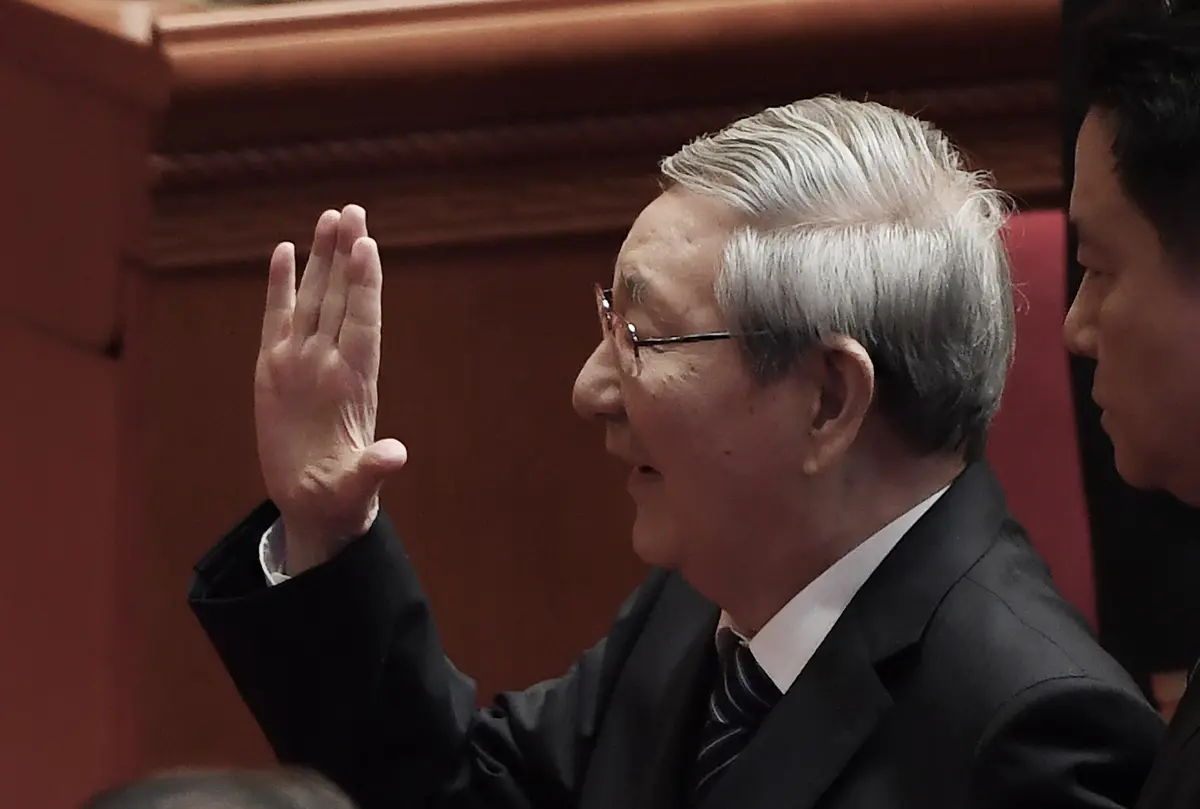
Former Chinese Premier Zhu Rongji passed away in Beijing on August 12, 2026. People spontaneously visited his ancestral home in Changsha, Hunan to offer flowers and pay their respects, with on-site crowd control measures in place. Online posts mourning Zhu Rongji have been subject to censorship.
Veteran mainland Chinese media figure Gao Yu has been prohibited by the Chinese authorities from publishing posts related to Zhu Rongji. There are indications that the Chinese Communist Party is on high alert, concerned that the public may utilize the occasion of mourning Zhu Rongji to express dissatisfaction with the current reality.
Videos and photos circulating on social media platforms show that barriers have been erected at the entrance of Zhu Rongji’s ancestral home since August 13, with flower bearers required to hand their bouquets to staff members for placement in front of the ancestral house.
The Zhu family has long resided in Tangpo, Ansha Township, Changsha, Hunan, where the ancestral home “Tianyuan” is situated, and where Zhu Rongji spent his childhood. On August 13, numerous netizens on Chinese social media platforms posted pictures of flowers, candles, and other tributes commemorating Zhu Rongji.
However, many internet users have reported that tributes and related content have been restricted on various platforms. Posts containing full names or elegiac couplets have either been blocked or limited from circulation, leading users to share tactics in the comments section to evade censorship, such as “avoiding writing out the full name.”
Professor at Peking University and former president of Capital Medical University, Rao Yi, penned a memorial on WeChat on August 13, 2026, reflecting on the generation to which Zhu Rongji belonged by stating, “they faced the opportunity for reform, they grasped the pace of reform, they were the backbone of China’s economic reforms.” Rao Yi did not explicitly mention Zhu Rongji in his post.
On August 14, 2026, Gao Yu, a senior media figure in Beijing, disclosed on a platform that after working hours, two state security personnel visited her, explicitly requesting her to cease posting content related to Zhu Rongji and referring to her previous writings on Zhu Rongji’s “rightist” experiences. In order to avoid trouble, Gao Yu agreed not to publish any further posts about Zhu Rongji. Before leaving, the security personnel emphasized, “If you post anything, we will come in the middle of the night.”
Gao Yu mentioned that a certain article about “Zhu Rongji and his introducer to the party Guo Daohui” can now only be saved in a folder for an undetermined period.
Following Zhu Rongji’s passing, Gao Yu shared a post on a platform on August 12, 2026, highlighting one of Zhu Rongji’s distinctive traits as the only senior Chinese leader since the establishment of the Communist Party with a “rightist” background. However, this aspect was omitted in the official obituary issued by Xinhua News Agency.
Gao Yu is a well-known independent journalist and senior media figure in China who has been detained and subjected to long-term “stability maintenance” by the Chinese authorities on multiple occasions due to her public statements and reporting of truths.
Zhu Rongji served as Vice Premier and Premier of the State Council of the People’s Republic of China from 1991 to 2003. The death of former General Secretary of the Communist Party Hu Yaobang had sparked waves of mourning and protests in the past. Following the sudden passing of Li Keqiang in 2023, large-scale grassroots mourning events took place on social media and in his hometown in Anhui Province.
On the day of Zhu Rongji’s death, insiders within the Chinese Communist system relayed to Epoch Times that Zhu Rongji had been under constant surveillance in his later years. Currently, high-ranking Chinese Communist officials are concerned that the public may utilize the mourning of Zhu Rongji as an avenue to express dissatisfaction with the reality, potentially giving rise to broader societal discontent.
Insiders mentioned that the Chinese Communist Party has always been opposed to spontaneous grassroots activities, regardless of alignment with official goals, remaining vigilant due to fears of potential loss of control and escalation into anti-party movements. The authorities have intensified their grip on monitoring. In light of Zhu Rongji’s passing, they are expected to be highly vigilant regarding public sentiments. If signs of spreading or escalating mourning activities are detected, relevant information is likely to be swiftly reported to the highest centers of power.