
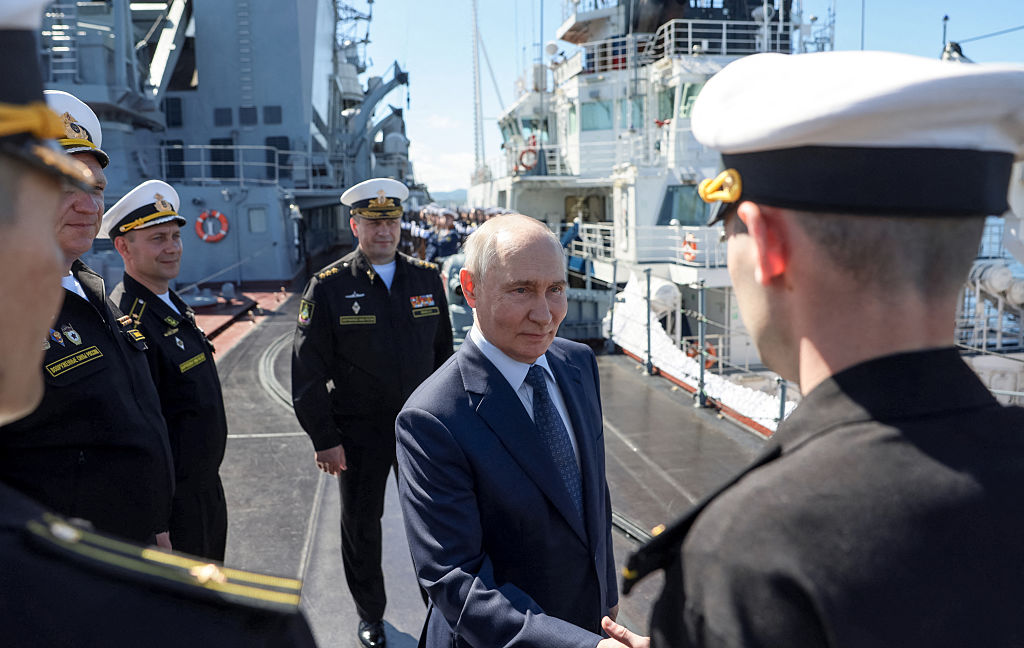
On Thursday, Russian President Putin made his first visit to one of the disputed southern Kuril Islands (known as the Northern Territories in Japan), Iturup Island (known as Etorofu Island in Japan). This action sparked strong protests from the Japanese government, with the Ministry of Foreign Affairs summoning the Russian ambassador in Japan, and Prime Minister Takanosae also condemning the visit. The visit coincided with North Korea launching ballistic missiles into the Sea of Japan for the second time in six days, raising regional security concerns.
According to the Russian official media TASS, Putin visited a fish processing plant on Iturup Island after inspecting naval exercises in Russia’s Far East region. He tasted locally produced caviar and met with some residents on the island.
Television footage showed Putin in a dark suit standing in a room, looking at large tunas and halibuts on the table, while two officials explained the local fishing situation to him.
On that day, Japanese Foreign Minister Toshimitsu Motegi issued a statement on social media platform X, reiterating Japan’s sovereignty claim over the Kuril Islands.
In the statement, he said, “The Northern Territories, including Etorofu Island, are Japan’s inherent territory from both a historical and international law perspective. The Japanese government strongly protests against Putin’s visit.”
Prime Minister Takanosae also expressed at the Prime Minister’s Office, “Putin’s visit to Etorofu Island as the current Russian President contradicts Japan’s position on the Northern Territories issue, and this damages the sentiments of the Japanese people and is absolutely unacceptable.” Takanosae added that he hopes Russia will take this matter seriously.
Of note, just a day before Putin’s visit to the southern Kuril Islands on August 12, North Korea launched a ballistic missile from the Wonsan area towards the eastern waters (Sea of Japan direction), flying approximately 700 kilometers.
According to reports from the Japanese Kyodo News agency, this missile launched by North Korea landed outside of Japan’s exclusive economic zone (EEZ) approximately 10 minutes after flight. This was the second missile launch into the Sea of Japan by North Korea within six days.
Since the end of World War II, Moscow and Tokyo have never signed a formal peace treaty, mainly due to the unresolved territorial dispute over these islands near Japan’s Hokkaido – the southern Kuril Islands (Northern Territories).
In early August 1945, during Operation August Storm, Soviet forces defeated the Japanese Kwantung Army and occupied the southern Kuril Islands (Northern Territories). Subsequently, the Soviet Union expelled about 17,000 Japanese residents from the island, and now approximately 20,000 Russian citizens live on these islands.
Russia believes that based on the San Francisco Peace Treaty, Japan has renounced sovereignty over the entire Kuril Islands including the southern Kuril Islands; while Japan argues that the term “Kuril Islands” in the treaty does not include the southern Kuril Islands, asserting that they are still Japanese territory and demanding their return.
Over the years, progress has been minimal in resolving this territorial dispute between Japan and Russia. Following Russia’s full-scale invasion of Ukraine in 2022, Japan imposed sanctions against Russia, further deteriorating relations between the two countries.