
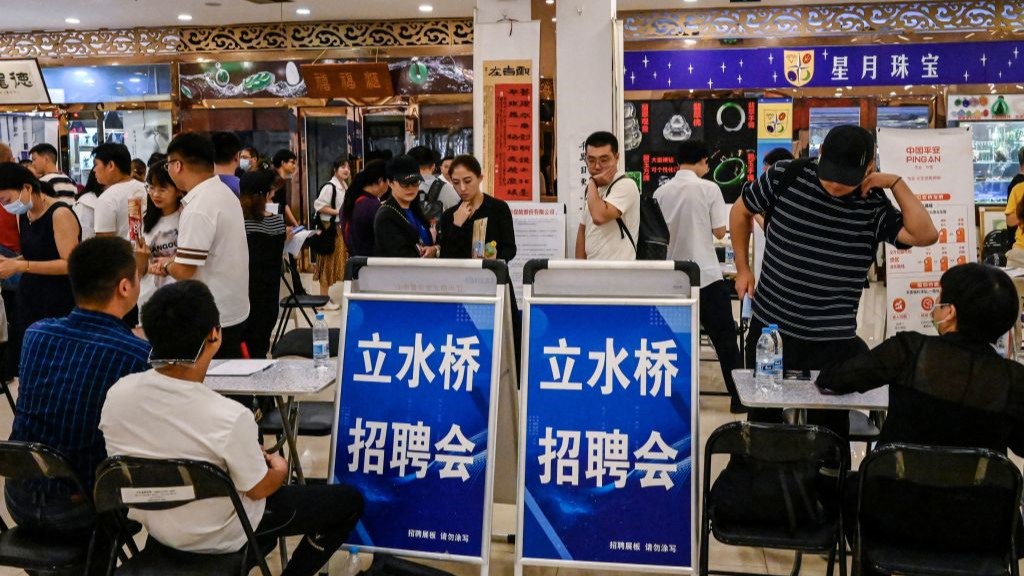
In September 17, 2026, according to Epoch Times report, the youth unemployment rate in China rose to 18.9% in August, reaching a new high in the past year. Some scholars analyze that the real employment issue in China cannot be fully captured by the unemployment rate figures.
According to data released by the National Bureau of Statistics of the Chinese Communist Party on September 17, the unemployment rate for the 16-24 age group in urban areas across the country, excluding students, reached 18.9% in August, up by 1 percentage point from July’s 17.9%, returning to the high level of August 2025. At that time, the youth unemployment rate was also 18.9%. Subsequently, the authorities stopped publishing this statistic, adjusted the statistical criteria, and then reissued it, leading to a significant decrease in the official youth unemployment rate.
Additionally, in August, the unemployment rate for the 25-29 age group in urban areas across the country was 7.5%, exceeding July’s 7.2%; the unemployment rate for the 30-59 age group in urban areas was 3.9%, remaining unchanged from July.
The unemployment rate reported by the Chinese Communist Party is widely believed to be much lower than the actual unemployment figures in China. Based on the officially released figures, the youth unemployment rate is much higher compared to other age groups. According to data from the Chinese Communist Party’s Ministry of Education, there are 12.7 million fresh graduates this year, an increase of 480,000 compared to last year, setting a new historical peak. Coupled with previous graduates who are still unemployed entering the job market, the unemployment situation becomes even more severe.
Taiwanese financial expert Huang Shicong previously expressed to New Tang Dynasty Television that aside from seasonal factors during graduation season, the continuous economic slowdown, coupled with weak domestic demand and severe “internal competition” within companies, are all squeezing the employment opportunities for young people.
Huang Shicong mentioned, “Including real estate or the catering industry, and the entire retail sector is declining, unable to support the biggest pillar of the Chinese economy. In addition, industries like export manufacturing are also facing price competition now.”
Chinese capital market veteran Xu Zhen also stated that the official figures do not fully reflect the real employment plight of young people in China. “Due to the adjustment in the Chinese Communist Party’s statistical criteria, the youth unemployment rate only covers actively job-seeking labor in urban areas. Underemployment, low wages, insecure jobs are also counted as employment, while a large number of youth who choose to ‘lie flat,’ rely on their parents, or continue studying for postgraduate exams are not counted as unemployed, and invisible rural labor force is also not included in the statistics. By increasing the denominator and reducing the numerator, they beautify the youth unemployment rate.”
The National Bureau of Statistics of the Chinese Communist Party announced on September 15 that the surveyed urban unemployment rate in August was 5.3%, an increase of 0.1 percentage points from July. The main reason given for the rise in the unemployment rate in August was the seasonal impact of new graduates entering the labor market.
However, an analytical article by Zhu Tian, deputy dean and economics professor at the China Europe International Business School, believes that the real employment issue in China today is not reflected in the unemployment rate figures.
Although the nationwide surveyed urban unemployment rate and the youth unemployment rate for the 16-24 age group did not show much change over the past three years based on official figures, Zhu Tian believes that this does not align with the actual experiences of many. The Central Bank’s urban household survey index on employment perception decreased from 43.9 in the first quarter of 2021 to 35.1 in the first quarter of 2024, and further dropped to 29.2 in the fourth quarter of 2025. Now, companies are becoming more cautious in recruitment, making it increasingly difficult for university graduates to find jobs, leading many previously stable workers to resort to jobs like driving for ride-hailing services, delivering food, or engaging in other so-called flexible employment opportunities.
The article emphasizes that the pressure in the Chinese job market can be seen from the number of people receiving unemployment benefits. The number of people receiving unemployment benefits has doubled from 2.59 million in 2021 to 5.57 million in 2025 over four years, but the number of people insured for unemployment benefits has only increased by 8.5%. Moreover, only a small portion of the total unemployed population qualifies for receiving unemployment benefits. “In a context where there is a continuous shift towards flexible employment, the doubling of the number of people receiving unemployment benefits is worth paying attention to.”
He pointed out that if the current employment situation is judged solely based on changes in the official surveyed unemployment rate, it may underestimate the severity of the current overall insufficient demand and the necessary intensity of macroeconomic policies needed. The rising employment pressure is not an isolated issue but a concentrated manifestation of overall insufficient demand in the Chinese economy since 2022.
Industry insiders suggest that 2022 marked a significant downturn in the Chinese economy. From a data perspective, the GDP deflator, reflecting price changes, showed negative growth for three consecutive years from 2023 to 2025. Real estate started significant adjustments in the second half of 2021, with substantial decreases in real estate investment, sales, and new construction continuing from 2022 to the present. Noticeable changes in the number of people receiving unemployment benefits and those engaged in flexible employment occurred around 2022.