
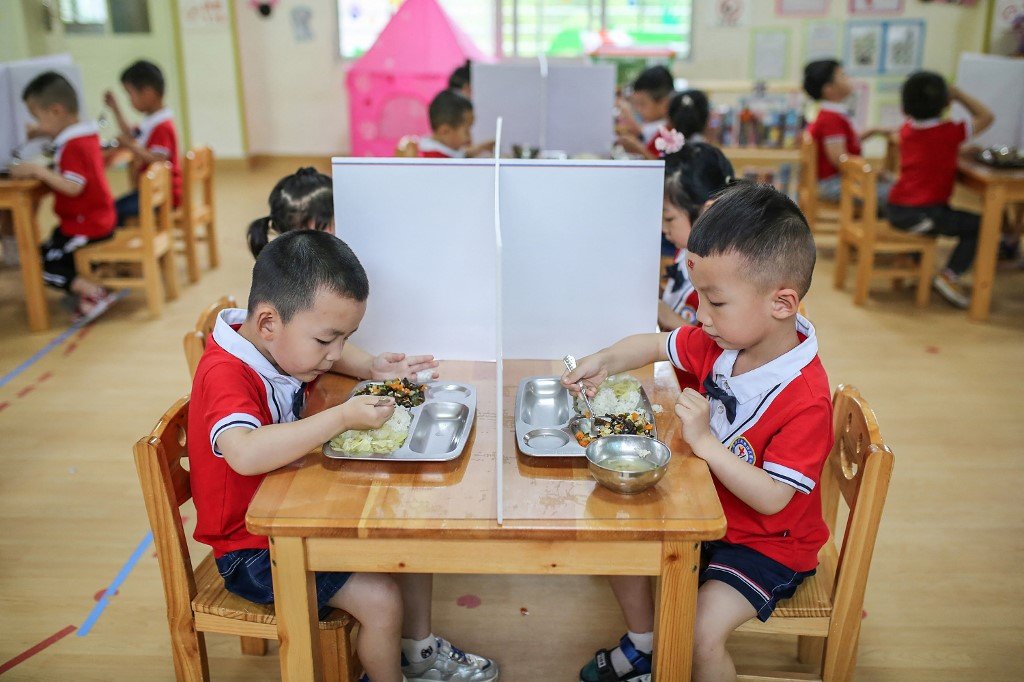
China’s declining birth rate is causing a ripple effect across the “birth-raising-education” chain, impacting various sectors from hospitals stopping delivery services to nurseries experiencing reduced enrollments to schools having to dismiss teachers due to a lack of students.
According to a report by “Caixin” on September 14th, the sharp decrease in the birth rate is affecting the education system and teaching positions, spreading from medium-sized cities to major cities. As the new school year begins in September, Zhang Yue, a contract teacher at a primary school in the Huangpu district of Guangzhou, did not receive a notification to return to work. Despite his contract not yet expiring, he was dismissed by the school due to a decrease in student enrollment.
Zhang Yue’s situation is not an isolated case. Since July this year, several contract teachers from districts in Guangzhou such as Huangpu, Haizhu, Panyu, and Huadu have shared their experiences of being dismissed by schools on social media.
With the declining birth rate, the number of new students entering primary schools in Guangzhou peaked in 2023 and has been decreasing annually since.
In recent years, teacher recruitment plans in various regions across the country have been shrinking. In Hubei Province, for example, the public recruitment of primary and secondary school teachers this year decreased by about 52.8% to 2740 positions from 5799 in 2025. In Jiangxi Province, there were 1190 open positions for primary and secondary school teachers in 2026, down from 7821 in 2023.
Nurseries were among the first to be impacted.
According to data from the Ministry of Education of the Chinese Communist Party (CCP), in 2025, there were around 231,900 nurseries nationwide, with 32.2552 million children in preschool education and 2.6126 million full-time nursery teachers.
The number of nurseries decreased by 21.34% from its peak in 2021 (294,800 nurseries), resulting in a total reduction of 62,900 nurseries over four years.
In 2022, the number of nursery children enrolled in preschool education across the country dropped from 481.826 million in 2020 to 480.521 million in 2021 (a decrease of 130,600 children, or 0.27%, the first decline in years), further falling to 462.755 million in 2022. By 2025, the number had dropped to 322.552 million, marking a decrease of over 30% in five years.
The number of full-time nursery teachers also decreased from 3.2442 million in 2022 to 2.6126 million in 2025, a reduction of 631,600 teachers in three years.
The impacts of the declining birth rate have also reached obstetrics and maternal and child health services.
In recent years, cases of hospitals discontinuing delivery services, merging obstetrics departments, or reorganizing medical resources have been reported in various regions. Some areas have even cited the declining birth rate as a reason for these adjustments.
In January 2026, the Jiangxi Fengcheng Mining Bureau General Hospital announced the temporary suspension of inpatient delivery services for expectant mothers starting on January 19th in response to the “new population development situation with fluctuating declining birth rates.” The Tangyin County Hospital of Integrated Traditional Chinese and Western Medicine in Henan stopped all inpatient delivery services in obstetrics starting from January 4th. Local health authorities stated that these actions were taken to “actively respond to changes in the county’s population structure” and avoid redundant construction of medical resources.
Guangdong Wengyuan also announced in January this year the cessation of inpatient gynecology and obstetrics services in the hospital ward starting from February 1, while retaining the outpatient obstetrics and gynecology services. Likewise, the Dongtai Anfeng Central Health Center in Jiangsu stopped midwifery services from April 1, ceasing birth deliveries, cesarean sections, and issuing birth medical certificates.
Data from the National Bureau of Statistics of the CCP shows that in 2025, there were 79.2 million births in China compared to 113.1 million deaths, resulting in a natural population growth rate of -2.41‰ for the whole year. By the end of the year, the total population of China decreased by 3.39 million to 1.40489 billion people from the previous year.
China’s negative population growth has persisted for many years, with changes in the education population lagging behind.
The situation in Guangzhou is particularly noteworthy.
Official data shows that in 2025, Guangzhou had a registered population of 19.101 million people, an increase of 123,000 from the previous year. The registered population was 10.914 million people, with 108,000 births recorded throughout the year, maintaining a natural growth in the population.
Even if the permanent population of a city continues to increase, as long as the birth rate continues to decline, the number of children entering nurseries and primary schools may decrease in the coming years. This is the key difference between a declining birth rate and general population movement.
Currently, nurseries and primary schools are the most visibly affected, but this is not the end. If the trend of population change persists, the issues faced by contract primary school teachers in Guangzhou today may gradually appear in more school levels in the future.