
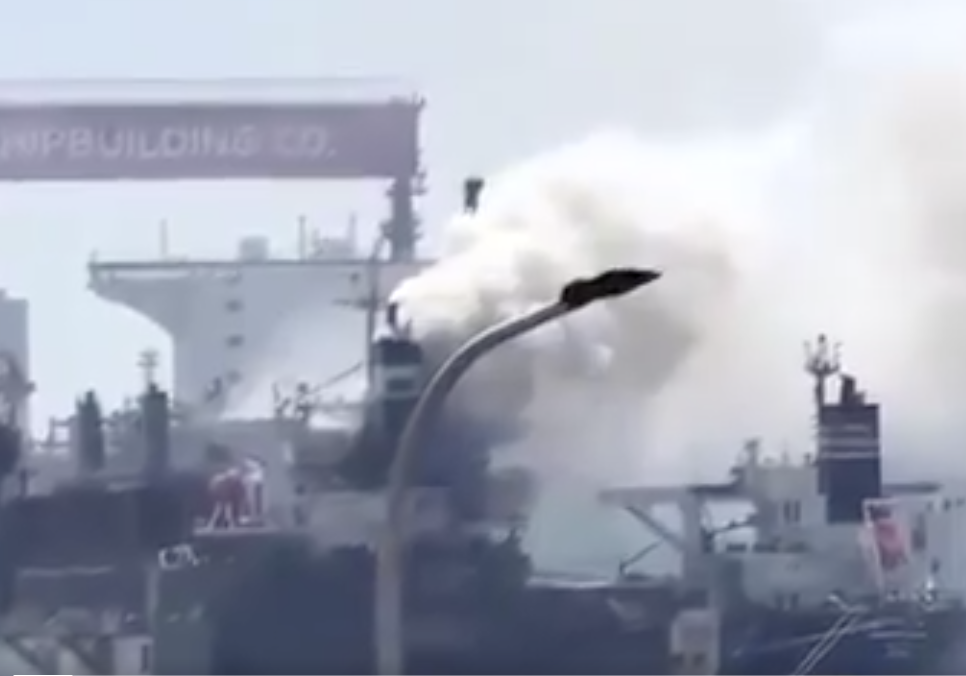
On September 10, a foreign cargo ship caught fire at a shipyard in Qingdao, Shandong Province, China, resulting in 25 deaths and 5 injuries, according to official reports. Chinese Communist Party leader Xi Jinping issued instructions following the incident. A special investigation team led by the State Council of the People’s Republic of China has been set up by the Ministry of Emergency Management to probe into this major fire accident. The cause of the accident remains unclear, with speculations arising due to the involvement of Chinese companies in ship owning and operating.
According to reports from Xinhua News Agency, the State Council accident investigation team held its first full meeting on the afternoon of September 14. Members of the State Council investigation team, along with officials from the Communist Party of China Central Commission for Discipline Inspection, the National Supervisory Commission, and the Supreme People’s Procuratorate, attended the meeting.
The investigation team is led by the Ministry of Emergency Management, with the participation of other departments including the Ministry of Foreign Affairs, the Ministry of Industry and Information Technology, the Ministry of Public Security, the Ministry of Transportation, the State-owned Assets Supervision and Administration Commission of the State Council, the All-China Federation of Trade Unions, the National Fire and Rescue Bureau, and the Shandong Provincial Government. The meeting aimed to swiftly determine the cause of the accident, thoroughly investigate the responsibilities of the company, industry regulators, and local authorities, and hold those responsible accountable.
On or around 11:15 a.m. on September 10, a foreign cargo ship at the Qingdao Beihai Shipyard of China State Shipbuilding Corporation caught fire while docking for repairs. The news of the incident was made public at the same time Xi Jinping issued instructions. The authorities later released official casualty figures, stating that 25 people died and 5 were injured.
The involved cargo ship was named “Ocean Melody,” a 20-year-old bulk carrier flying the flag of Liberia with a deadweight tonnage of 55,742 tons.
On September 13, a shipbuilding industry insider named Li Ming (pseudonym) from Anhui revealed to a reporter of Epoch Times that among the 25 victims, 5 were foreign nationals, 1 was hired directly by the shipowner, and the remaining 19 were laborers.
Li Ming mentioned that the cargo on the Ocean Melody included flammable gas and oil, although this information could not be independently verified by Epoch Times. Official details regarding the nationalities and identities of the deceased, the materials onboard, and the cause of the fire have not been disclosed yet.
According to a report by Nikkei Asia citing ship tracking data from the London Stock Exchange Group (LSEG), the vessel was managed by Shanghai Yu Yang Kunpeng Ship Management Co., Ltd., with the registered shipowner being Hui Li Shipping Co., Ltd., both Chinese companies. However, the authorities only referred to it as a foreign cargo ship, avoiding mention of the Chinese shipowner.
On an overseas platform, a commentator named Finding expressed that the State Council of China’s decision to escalate the investigation into the fire appeared unusual. Speculations arose regarding the cargo or individuals onboard not being ordinary, suggesting deeper underlying stories implicating a potential involvement beyond foreign elements.
Netizens speculated with remarks such as, “Could it be true that there were weapons on board as rumored?” “It seems so, unmanned aerial vehicles, military-grade chips.” “It might be weapons destined for Iran.” “It could also be destined for Russia.” “The impact of China’s involvement is significant, indicating certain challenges in managing some issues due to limited resources.”
Furthermore, claims surfaced on the X platform alleging that the official disclosure of detailed information regarding the disaster was incomplete, hinting at the possibility that the ship belonged to China’s “shadow fleet”: vessels that transport sanctioned oil for countries like Venezuela and Iran, typically employing aged ships with opaque ownership and lacking top-tier insurance to evade international sanctions.
Multiple instances in which Chinese shipowners were reportedly involved in operating vessels within these “shadow fleets” were reported, with suspected oil tankers linked to the Russian “shadow fleet” being captured by France and Sweden last year and this year, all manned by Chinese captains.