
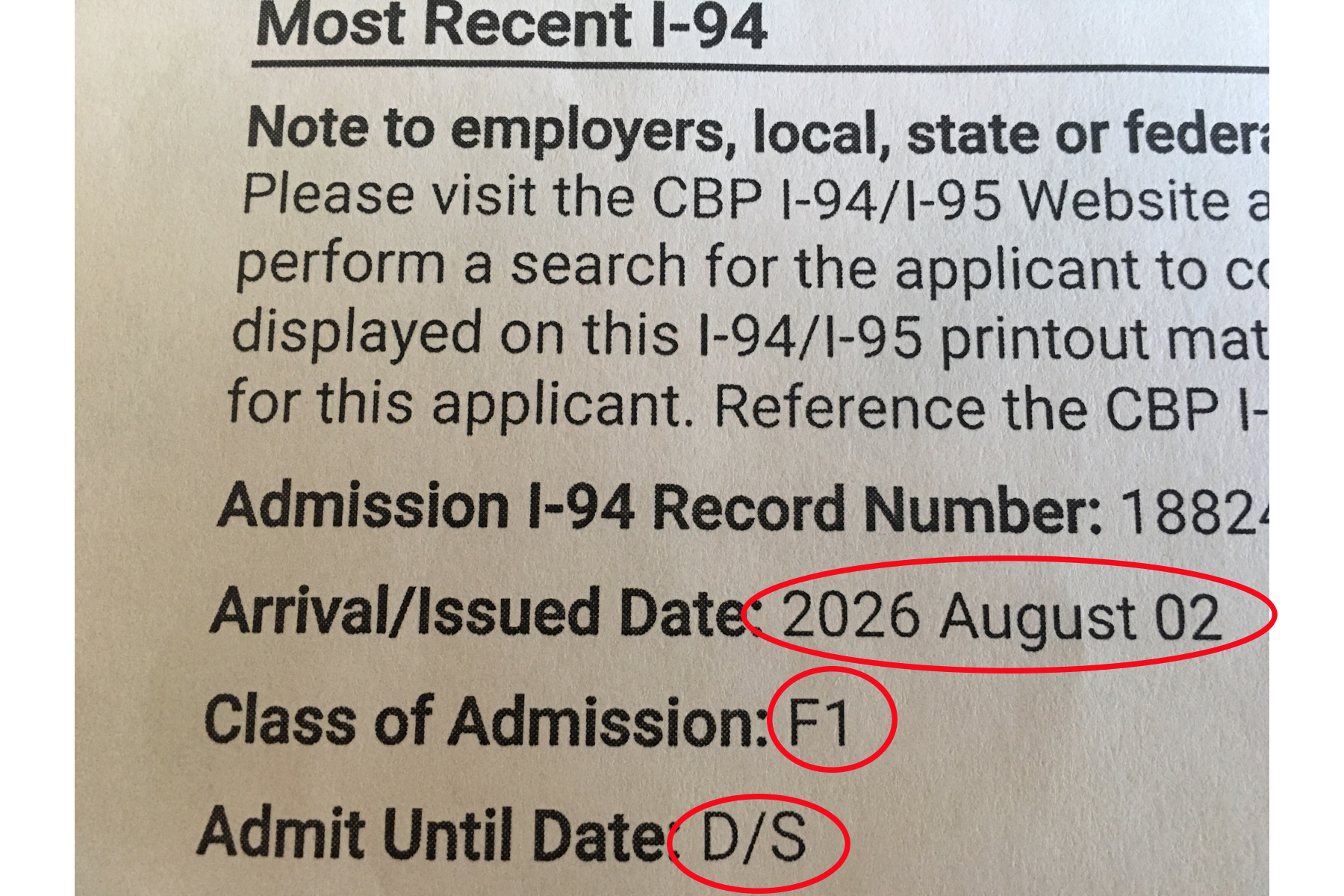
On the evening of September 14th, Eastern Time, the Federal District Court in Massachusetts issued a preliminary injunction, halting the final rule of the U.S. government to cancel the Duration of Status (D/S) policy for international students and scholars, preventing it from taking effect on the scheduled date of September 15th. This suspension applies nationwide to all those affected by the new rule, not just limited to the represented parties of the lawsuit.
The preliminary injunction does not revoke the new rule, but rather “postpones its effective date,” ensuring that the Department of Homeland Security’s (DHS) new rule will not be enforced on September 15th, allowing the current D/S system to remain in place during the litigation.
In the ruling, Judge F. Dennis Saylor agreed with the plaintiffs’ accusations against the government, stating that the new rule violates the federal Administrative Procedure Act, deeming it a “arbitrary” and “capricious” decision.
Saylor argued that the DHS failed to demonstrate a “reasonable relationship” between ending D/S and “national security”, bringing “significant potential harm” to affected individuals and the U.S. economy.
Additionally, the judge criticized the government for not exploring milder and more reasonable alternative solutions to address security concerns, nor providing a valid explanation for why a fixed four-year limit is superior to other alternatives.
In a footnote to the ruling, Saylor suggested that, based on the DHS’s concerns about potential “national security” risks posed by Chinese international students and scholars in academic fields, a more viable option would be to consider implementing stricter controls and monitoring specifically on individuals from China, rather than applying blanket measures on all international students and scholars, thus reducing the negative impact of the new rule.
Saylor extended the ruling to apply to all affected parties, not just those represented by the suing organizations.
The plaintiffs, including the Presidents’ Alliance on Higher Education and Immigration representing around 600 colleges out of the total 5000-6000 in the U.S., filed the lawsuit against the DHS in response to the new rule announced by the Department of Homeland Security on July 17th, tightening regulations on the duration of stay for three categories of individuals, including students. The new rule aimed to replace the current D/S policy with a fixed limit of up to four years, scheduled to take effect on September 18th.
However, on August 18th, the Presidents’ Alliance on Higher Education and Immigration, the Association of International Educators (NAFSA), the American Federation of Teachers (AFT), and the United Auto Workers (UAW), among other organizations, jointly sued the DHS, seeking a preliminary injunction and ultimately the repeal of the “canceling D/S” rule.
During the initial court hearing on September 3rd at the Federal District Court in Massachusetts, Judge Saylor did not issue a ruling that day. Subsequently, in court documents, Saylor expressed that he felt there was not enough time to make a fair decision on the case, but promised to do so before September 14th.
During the hearing, Judge Saylor raised concerns about the relationship between ending D/S and “national security.” He noted that the government tends to label many issues as “national security concerns,” questioning the rationale behind changing D/S to a four-year limit and its supposed link to national security.
Citing the example of “Chinese students photographing U.S. military bases” presented by the Department of Homeland Security, Saylor pointed out that even with a four-year limit, foreign students could still take photographs of U.S. military bases at any point during that period. He argued that there are various ways individuals could enter the U.S. for similar purposes, including through tourist visas. Saylor failed to see a valid connection between the new rule and “national security,” instead emphasizing the “significant and irreparable harm” it could cause.
Government lawyers, however, emphasized that the new rule simply sets an administrative review point after four years, not only considering national security but also preventing fraud, and ensuring foreign students comply with immigration regulations.
They argued that the SEVIS system currently used for student tracking is maintained by schools, and certain cases have shown school involvement in visa fraud.
In his ruling, Judge Saylor reiterated his stance from the hearing. While acknowledging the court’s restraint in addressing “national security” issues, he stressed the court’s duty to conduct a “reasonable review” to assess whether the government’s policies are based on valid reasons. He believed the DHS failed to prove the “reasonable relationship” between switching to a fixed term for D/S and “national security”.
Plaintiffs’ lawyers argued that changing D/S to a four-year limit would decrease the enrollment rates of international students, resulting in economic losses.
Government lawyers countered that international student enrollments had already declined before the introduction of this rule, emphasizing that the decision for foreign students to study in the U.S. depends on multiple factors. They maintained that there was no evidence to suggest that the change in the D/S policy would cause a drop in enrollments and result in the “irreparable harm,” including economic losses, claimed by the plaintiffs.