
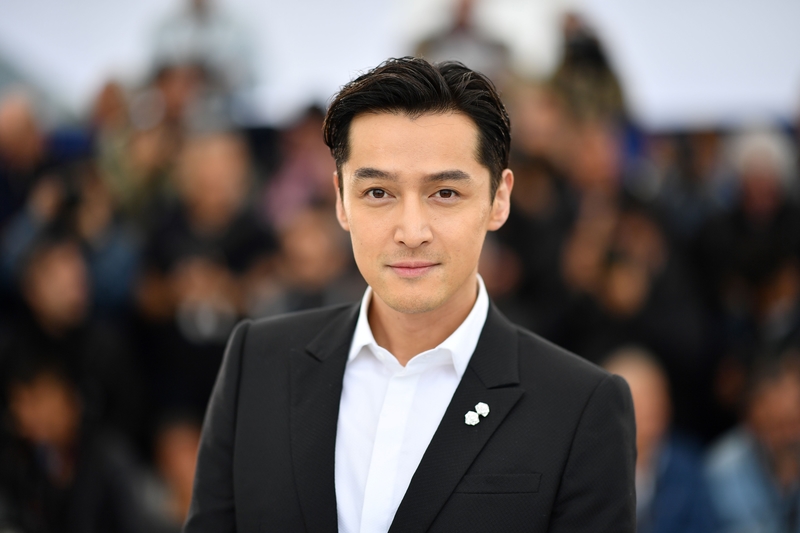
Recently, mainland Chinese actor Hu Ge graced the cover of the Chinese edition of “GQ” magazine. In an interview, he expressed his frustration at the current cold winter in the film and television industry and the downturn in the movie market. He lamented that he can no longer choose scripts according to his personal preferences as before, saying, “Now there’s no choice.”
Hu Ge rose to fame in 2005 with his role as “Li Xiaoyao” in the fantasy drama “Chinese Paladin.” In the following years, he starred in a series of works spanning different eras and styles, such as “The Disguiser,” “Nirvana in Fire,” and “The Story of Minglan,” reaching new heights in his acting career. In 2024, he won the Best Actor award at the Magnolia Awards for his role as “A Bao” in the television drama “Blossoms.”
Despite being a powerhouse actor in mainland China, Hu Ge recently admitted in an interview, “The movie market is very harsh. If you can’t break even, the opportunities become fewer and fewer.”
Facing the downturn in the movie market, Hu Ge frankly stated that he can no longer choose scripts based on his own preferences, whether he likes them, if the roles are challenging, or if the directors are worth collaborating with. He bluntly said, “Now there’s no choice.” He emphasized that at this stage, commercial success is prioritized over personal preferences, and he even plans to make commercial films to preserve his creative space.
In June of this year, the film “Catch the Spy,” directed by Feng Xiaogang and starring Hu Ge and Lei Jiayin, was released in mainland China, but the total box office revenue was only 1.19 billion yuan. Industry insiders disclosed that the film had a production budget ranging from 250 to 300 million yuan. Given the final box office revenue of 1.19 billion yuan, the film suffered significant losses, directly contributing to Hu Ge’s statement that “Now there’s no choice.”
Indeed, Hu Ge is not the only one feeling the pressure. Actor Zhao Youting also shared his frustration with the current icy situation in the film and television industry, describing it as a time where “we don’t even turn on the air conditioning at home in summer.” He lamented that “movies are already gone,” revealing that he had not been on a film set for a year and a half.
Renowned mainland Chinese talent manager Yang Tianzhen revealed in a podcast program that the filming volume for dramas this year is only about 30% of the previous year. The current industry norm is that even when actors have signed contracts with production teams, projects can still be shelved at any time. Due to a breakdown in the funding chain from investors and platforms withdrawing funding midway, many planned and prepped projects are forced to be “aborted” before they even start filming. Recently, actresses like Song Jia, who have won Golden Rooster Awards and Magnolia Awards, admitted that they have not been on set for a long time and have rare opportunities to “do some less busy things.”
Hu Ge has been torn between television dramas and movies in recent years. While he has achieved great success in TV dramas, with numerous awards and widespread popularity, his dedicated work in films like “This Land of Mine,” “Detour,” “Three Drops of Blood,” and “Catch the Spy” have all faced box office losses or fell short of expectations.
Feeling the pressure of the movie market, Hu Ge has now returned to his comfort zone of filming TV dramas. His new drama “The Taste of Life on Earth” wrapped up in June, and the costume drama “The Rise of Zhang Juzheng” is set to start filming soon.
Many young actors have openly stated that they are experiencing prolonged gaps in their schedules. Even in the realm of TV dramas, due to shrinking project scopes, reduced fees, and extended payment cycles, traditional drama actors are collectively seeking sideline businesses. This led to a trend in mid-August this year where a large number of actors in mainland China applied to hold concerts to maintain their exposure and supplement their income during the “no work to film” downtime. This includes more than 15 cross-border artists such as Zhao Lusi, Bailu, Luo Yunxi, Wang Hedan, and Yu Shuxin, who have announced their respective concert tours.