
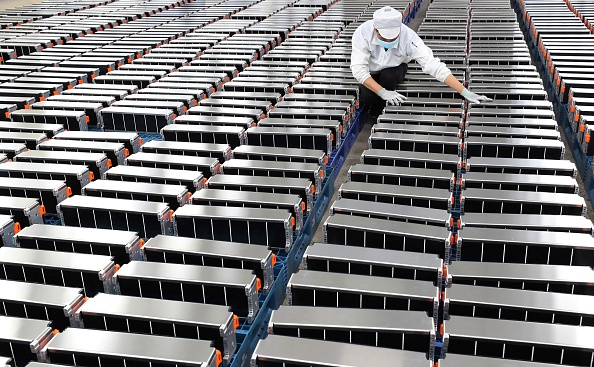
In recent years, mainland China has been facing increasingly severe issues of curtailed electricity in the new energy generation sector, due to the intermittent and unstable nature of wind and solar power. This has driven the rapid development of the energy storage industry.
Experts within the energy storage industry have pointed out that there are three major risks currently looming over the sector, including the risk of severe overcapacity, which could potentially lead to a situation similar to the struggles faced by the solar power industry and result in price wars.
During the 2026 World Power Battery Conference, Tian Qingjun, the Senior Vice President of Contemporary Technology Group in China, revealed that the planned new capacity for energy storage battery cores in China has already exceeded 800GWh this year, with an estimated completion capacity of 1.2TWh to 1.5TWh by the end of the year. The overall planned capacity surpasses 2TWh, far exceeding the actual global market demand.
Tian Qingjun further analyzed that similar to solar panel components, the production lines for battery cores have high start-up and shutdown costs, making them rigid in continuous production. In the case of overcapacity, enterprises are likely to engage in a “price war” to retain cash flow and market share, mirroring the challenges faced by the solar power industry.
An insider from an energy storage company told reporters from First Finance that the outdated energy storage battery cores below the 314Ah specification will gradually be phased out, leading to the gradual loss of survival space for a batch of less competitive battery companies in the market. The industry is expected to witness a cycle of capacity clearance in the coming years.
In addition to the issue of overcapacity and internal market competition, the energy storage sector is also facing risks related to the long-term operation of energy storage stations, as well as potential quality and testing verification problems that may arise during the process of scaling up these stations.
According to reports from Cai Nwen, Tian Qingjun mentioned that with the continuous evolution of the power market, related revenues may change accordingly. Factors such as frequency regulation services and electricity price differentials directly impact the economic viability of energy storage stations in the future.
Tian Qingjun cautioned that the economic analysis of the vast majority of energy storage stations currently in operation is based on assumptions, and given that the assets of these stations have a lifespan of 15 to 20 years, he predicts that many energy storage stations may become non-performing assets in the years to come.
He also highlighted the challenges faced by the energy storage industry during the process of scaling up energy storage stations and the potential quality issues that can arise if thorough testing and verification measures are not taken seriously.
According to statistics from the Zhongguancun Energy Storage Industry Technology Alliance, as of the end of June 2026, China’s cumulative installed capacity for new energy storage has reached 168.3GW, with an energy storage capacity of 448.7GWh, marking a 59% and 71% annual increase, respectively, compared to the previous year. New energy storage has grown by 15% compared to the end of 2025.
The intermittent and unstable nature of solar and wind power has resulted in the inability to respond in real-time to grid or user demand, leading to a significant issue of curtailed electricity during peak generation periods in the new energy industry.
According to the Power Industry Planning Research and Monitoring Early Warning Center’s report on the 2026 National New Energy Grid Consumption Situation released in February, the utilization rates of wind and solar power in China dropped to 91.5% and 90.8% respectively in January and February 2026, representing a 2.3% and 3.1% decline from the same period in 2025. The curtailed electricity rates in some regions have approached 10%.
For instance, Xinjiang had wind curtailment rates of 11.3% and solar curtailment rates of 14.4%; Qinghai saw wind curtailment rates of 8.1% and solar curtailment rates of 21.3%; Gansu had wind curtailment rates of 9.5% and solar curtailment rates of 17.5%; and Inner Mongolia experienced wind curtailment rates of 15.6% and solar curtailment rates of 9.2%.
While the solar power utilization rate remained as high as 98% in 2023, it dropped to 94.8% by 2025 and further decreased to 91.2% in the first quarter of 2026.
Energy storage stations serve as “power banks” and dispatch stations, storing surplus wind and solar energy to release during peak demand periods or when there is no wind or sunlight, thereby ensuring the safe and stable operation of the power grid.