
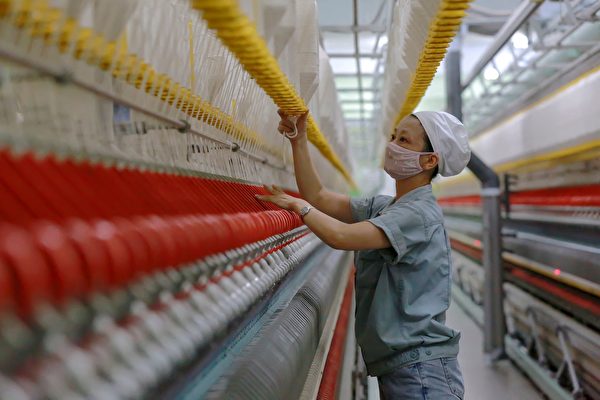
According to data from the Chinese textile and clothing industry, in the first five months of 2026, a total of about 1,500 textile, garment, and textile industry enterprises above designated size have shut down. Recently, reports of bankruptcies, factory closures, and adjustments to business operations in China from American and Japanese companies have emerged in cities like Jiaxing in Zhejiang, Guangzhou in Guangdong, and Suzhou in Jiangsu.
The Hong Kong Textile Association cited data from the National Bureau of Statistics of China, indicating that from January to May 2026, there were 20,806 textile enterprises above designated size in China, a decrease of 389 compared to the same period last year. The number of textile, garment, and apparel enterprises above designated size decreased by about 1,101 year-on-year. Industry analysts estimate that around 1,490 enterprises have exited the scope of designated size enterprises in the first half of this year.
Enterprises above designated size in the industrial sector refer to legal entities with annual main business revenue of 20 million RMB or more. Exiting the scope of designated size statistics does not necessarily mean complete closure of enterprises; it includes cases such as a decrease in operating revenue below statistical standards, mergers, reorganizations, cancellations, bankruptcies, and adjustments to statistical subjects.
A textile entrepreneur in Shaoxing, Zhejiang, using the pseudonym Yan Zhiqiang, expressed to Dajiyuan that this year, the orders received by companies mainly consist of shorter and smaller orders, with increasing demands from customers for delivery times, making it challenging to sustain operations due to tightened deadlines and increased scrutiny on tax and overseas income.
In September, several textile industry online platforms reported that the American-owned Jiaxing Kanglong Textile Co., Ltd., located in the Economic and Technological Development Zone of Jiaxing, Zhejiang, was nearing closure and planning to stop production at the Jiaxing factory by the end of 2026. Some of the denim production capacity will be transferred to Mexico.
Public company records show that Kanglong Textile Co., Ltd., established in 2005 with a registered capital of 35 million US dollars, employed over 800 people and primarily produced denim associated with the Cone Denim brand under the American Elevate Textiles group.
Posts on industry websites mentioned that Kanglong Textile had held farewell meetings for employees and arranged for compensation using an “N+1” method, with some long-standing employees receiving compensation ranging from 100,000 to 200,000 RMB. As of the publication deadline, Elevate Textiles, Cone Denim, and relevant departments in Jiaxing had not disclosed details regarding the closure date, number of employees affected, compensation packages, and arrangements for transferring production capacity.
Mr. Xu, a rights advocate in Jiaxing, mentioned that following the news of Kanglong Textile’s closure, some employees started focusing on compensation concerns. He emphasized the importance for timely and fair compensation, especially for those who had worked at the company for many years, expressing doubts about domestic private or state-owned enterprises meeting such obligations.
According to information released by the Intermediate People’s Court of Guangzhou, Guangdong Province, court proceedings for bankruptcy liquidation of Guangzhou Panyu Hengyi Garment Co., Ltd. were accepted in January this year, with a formal bankruptcy declaration made in May.
A professional in the garment industry in Guangdong, using the pseudonym Chen Chu, noted that many enterprises have been struggling to operate recently, leading to a return of migrant workers from other provinces to their hometowns due to lack of orders. He highlighted the challenges faced by enterprises in sustaining operations with a shortage of orders, leading to financial difficulties and eventual closures.
Apart from fiber, dyeing, and clothing enterprises, foreign instrument companies are also adjusting their operations in China. Data from the global locations of Japan’s instrument manufacturer HORIBA group revealed the closure of its Japanese subsidiary, HORIBA Technology (Suzhou) Co., Ltd., in August 2026, with subsequent inquiries being handled by its Shanghai affiliated company.
Public information shows that HORIBA Technology (Suzhou) Co., Ltd., established in 2018, primarily engaged in the research, production, sales, and logistics of clinical testing analytical diagnostic systems. A circulated Japanese document cited market competition and unmet revenue expectations as reasons for the decision to close the reagents factory and address the related assets’ value depreciation.
HORIBA’s Shanghai technical center, factory, and other sales operations were not part of the Suzhou business adjustment. There are no reports of employee complaints or labor disputes related to unpaid wages concerning the company.
Ms. Li, a management professional in foreign manufacturing enterprises in the Yangtze River Delta, mentioned that the closure of a production base by multinational companies might involve product line adjustments. Companies in Jiangsu and Zhejiang are redirecting production capacity to Vietnam or other countries in response to reduced orders, demonstrating a trend of streamlining operations and focusing on sales and technical services while shutting down unprofitable product lines.
Data released by the National Bureau of Statistics of China on August 27 showed that from January to July 2026, the operating income of textile enterprises above designated size was 1.23836 trillion RMB, a year-on-year increase of 2.2%, with a total profit of 32.68 billion RMB, up by 7.9%. During the same period, the operating income of textile, garment, and apparel enterprises was 562.63 billion RMB, a 3% decrease compared to last year, with a total profit of 16.81 billion RMB.
Ms. Li expressed skepticism towards the official data, suggesting that the reported profit increases in the textile industry amid shrinking operations seem implausible, referring to them as “fairy tales and nonsense” intended for government officials rather than reflecting the actual industry conditions.