
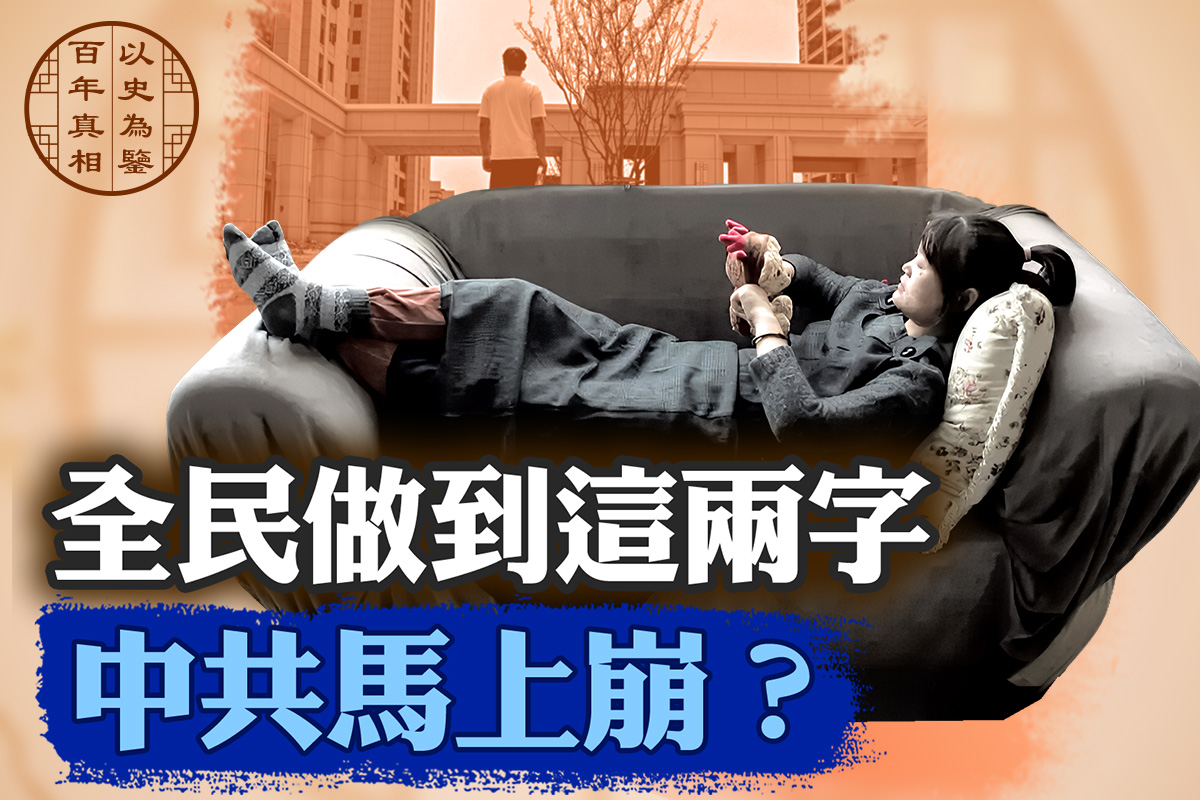
Greetings, dear viewers! Welcome to watch “Century Truth”.
Imagine a society where more and more young people are reluctant to strive for success, to buy a house, to get married, and even to have children; where civil servants are trapped in a state of “work for retirement, wait for the end of work”, what does this signify?
This is not a scene from a novel or a movie, but a reality happening in Chinese society today. And there is a precise term coined on the internet that perfectly summarizes this state – lying flat.
What is happening in Chinese society? Why are so many people collectively choosing to “lie flat”?
Today, let’s delve into the unsettling reality behind this social phenomenon.
People in China are well aware that from a young age, the CCP has been instilling a narrative to the youth: as long as you work hard, life will get better; as long as you endure hardships, you can change your destiny; as long as you believe in the “Chinese Dream”, the next generation will surely be more successful than the last.
However, since 2020, more and more young people are realizing that reality is far from that narrative.
Many college graduates join the ranks of the unemployed right after graduation. Even if they find a job, the pay is barely enough for basic necessities, saving money is out of question. Getting married and having children? That’s a luxury, unaffordable. Buying a house? After toiling for over a decade, saving enough for a down payment is still uncertain.
Faced with the harsh reality, many young people are beginning to doubt: is the “work hard to change destiny” belief they were taught since childhood already obsolete?
In early 2021, a shocking news shook the entire Chinese internet: a 22-year-old female employee of Pinduoduo suddenly collapsed and died on her way home after finishing work at 1 a.m. This incident had a profound impact on the youth. Many realized for the first time: one could actually work oneself to death.
What’s even more disheartening is the response from the official Pinduoduo account, stating, “Look at the grassroots people, who aren’t exchanging their lives for money?” It even directly stated, “This is an era where one has to strive using their life.”
This statement pierced through the hearts of countless young people, not because it is wrong, but because it bluntly laid bare the brutal reality of this era.
Subsequently, a sense of immense disappointment started spreading rapidly among the youth, much like thick fog.
In April 2021, an online article titled “Lying Flat is Justice” went viral on Baidu Tieba.
The author shared about leading a life of low consumption, at a leisurely pace. They worked only one or two months a year, spent their time “playing dead” at Hengdian Studio. However, they weren’t completely idle, engaging in activities like exercising, traveling, reading. They even described their “lying flat” as a life philosophy, somewhat akin to the ancient Greek philosophers’ detachment from worldly competition.
This article resonated with the youth. Some even remarked, “As long as you lie flat enough, you won’t be exploited.”
As a result, the term “lying flat” began spreading rapidly among Chinese youth, evolving into a popular culture phenomenon. T-shirts, phone cases, mugs bearing the slogan “Lying flat is justice” flooded Chinese shopping websites. Many young people even distilled this “survival philosophy” into “Six NOs”: no house, no car, no love, no marriage, no children, no consumption.
In reality, many Chinese youth today do not lack motivation. Instead, they realize that despite running tirelessly, they are akin to being stuck on a treadmill, making no progress. Sometimes, the harder they try, the more they suffer.
In 2023, a former senior journalist at Southern Weekend, aged 38, shared his story through a video.
He revealed being unemployed for half a year, sending out over 100 resumes without landing a job, resorting to becoming a food delivery driver. With a wry smile, he displayed his master’s degree from a prestigious university in the video, quipping, “I’ve long shed the attire of Kong Yiji.”
This statement resonated widely online as well. In the video, he recounted riding his electric scooter in the dead of the night, running several kilometers like mad, even falling during the journey, only earning 26.82 yuan, including a night shift subsidy of 2.4 yuan.
Following the video’s surge in popularity, a particularly poignant comment read: “I used to believe studying could change my fate, now I realize fate might have been predetermined long ago.”
Reflecting on a lot of Chinese youth today, from the moment they were born, they’ve been entangled in an endless competition: attending interest classes from kindergarten, fierce competition for school districts in primary school, striving for college entrance exams, pursuing postgraduate studies after university, aiming for government exams after graduation, working overtime post-employment, and by age 35 worrying about getting laid off.
Many describe it as “Chinese people aren’t living but rather participating in an eternal elimination game.” The most frightening part is, many end up not knowing why they live by the end.
It’s worth noting that today’s “lying flat” phenomenon isn’t limited to just emotional unrest among the youth. It has even infiltrated the Communist Party system.
In recent years, a popular phrase has circulated on Chinese social media: “Work while waiting to clock out, clock out while waiting for retirement.” Many grassroots civil servants spend their work hours on phones, playing games, online shopping, idling.
In the past, many aspired for promotions and wealth. But now, they merely wish to retain their jobs, hoping to avoid trouble.
At the core, the primary reason behind this shift is money. Due to deteriorating local finances.
2021 marked a significant turning point for the Chinese real estate market, transitioning from prosperity to decline. The crisis at Evergrande, a major real estate developer, triggered a domino effect within the industry, leading to the bursting of the Chinese real estate bubble.
Commencing from 2022, many local governments experienced a drastic reduction in revenue from land sales, accumulating high debts. This resulted in pay cuts, elimination of performance bonuses, and even wage delays for civil servants, teachers, health workers.
Some regions initiated downsizing or froze new recruitments. Many civil servants suddenly realized that the so-called “iron rice bowl” wasn’t as secure as it once seemed.
In 2026, an insider in Changsha, going by the pseudonym Tang Jie, revealed to Epoch Times: more and more civil servants are opting for passive resistance.
He mentioned that friends working in district governments in Shandong and Hebei shared that nowadays, many spend work hours chatting, playing on phones. Gone are the days of reading newspapers, now it’s surfing the web, gaming. Women shop on Taobao, JD; men watch videos, waste time. Those genuinely motivated to work are becoming scarcer.
He further highlighted that this apathy is particularly prevalent at the grassroots level. Many are aware that resolving local finance issues is a long-shot, and future income security is uncertain. While individuals harbored aspirations for advancement in the past, many now understand there’s little hope. Simply avoiding accountability, staying out of trouble until retirement, is the goal.
On April 28, 2026, the Chinese Ministry of State Security released a statement claiming that the “lying flat culture” among Chinese youth is being manipulated by “overseas anti-China forces”. The article even alleged that foreign organizations were funding “lying flat influencers,” indulging in “systematic brainwashing” of Chinese youth.
Many might wonder: why is the Chinese Communist Party so alarmed? Why is the State Security Ministry directly linking this to “overseas anti-China forces”?
Because the youth’s withdrawal signals an imminent danger to the CCP.
The Chinese economy heavily relies on real estate, demographic dividend, cheap labor force, and high consumption expectations. Once young people adopt a low-desire mentality, the entire economic cycle begins to hemorrhage.
In recent years, the birth rate in China has witnessed a continuous nosedive. Numerous kindergartens are shutting down, primary schools facing dwindling enrollment, and even obstetric departments are downsizing. While the CCP once extolled the benefits of the “demographic dividend”, China today is grappling with a population vacuum.
When looking back at recent decades in China, an intriguing pattern emerges.
The CCP has persistently emphasized on Chinese people to “strive.” During the Great Leap Forward, it was about “surpassing Britain and America”; post-Reform and Opening Up, it was about earning money tirelessly; during the real estate era, everyone had to buy a house; in the Internet era, it was 996 hard work; and today, the youth are expected to bear the burden of the so-called “national rejuvenation”. The entire society resembles a colossal machine being propelled at high speed.
However, when an entire generation of young people suddenly exclaims, “I’m tired,” “I don’t want to keep striving,” “I want to lie flat,” it transcends merely personal emotions. It signifies a response from a generation worn down by prolonged stress, internal competition, and disappointment towards the entire society.
As many analysts have noted, the massive “lying flat” phenomenon in China today isn’t the result of external forces’ manipulation but is an inevitable outcome of the CCP’s failed domestic policies.
That’s all for today’s show. If you enjoyed “Century Truth,” feel free to like, subscribe, and share with more friends. Until next time, farewell.
– Production Team of “Century Truth”