
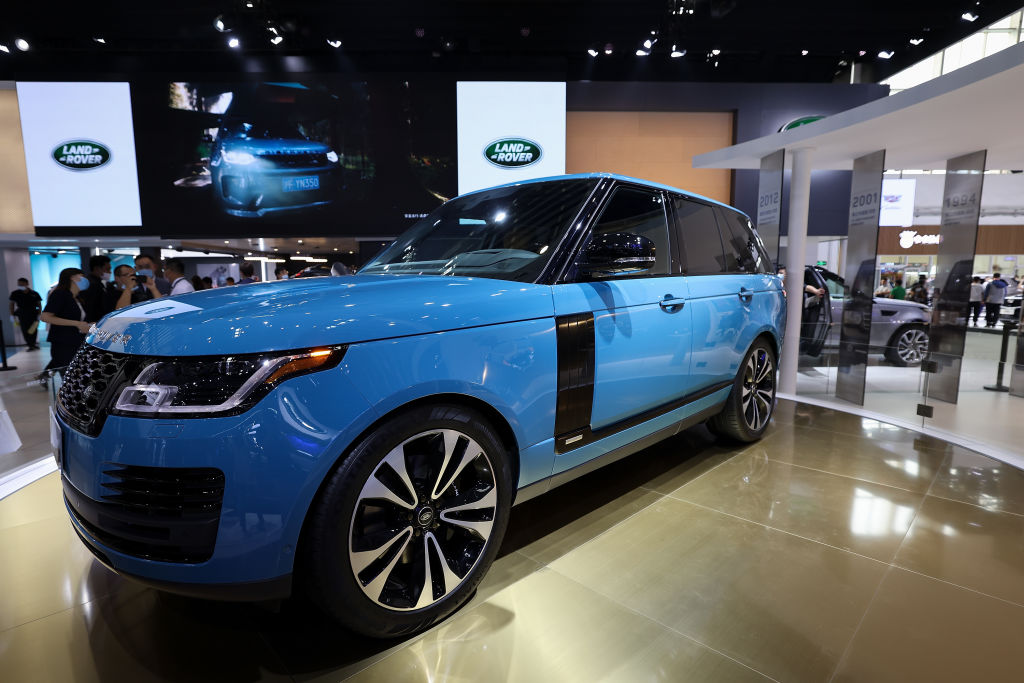
China’s economic slowdown has dampened the demand for luxury cars among the public, leading mainland luxury fuel vehicles to transition from previous price hikes to price cuts and continuous decreases in price. In Beijing, a Land Rover salesperson said that the store loses over 70,000 yuan for every Land Rover Defender 110 sold. Sales of brands such as Mercedes-Benz, BMW, Audi, and Porsche are also continually declining.
According to a report by “China News Network” on August 14th, Jaguar Land Rover launched a limited-time promotion from August 1 to September 30, with the starting price of the Land Rover Defender 110 HSE at 728,000 yuan, which is 171,900 yuan lower than the previous guide price of 899,900 yuan.
When this model entered the mainland market in 2020, popular configurations were selling for over ten thousand yuan above the original price and still difficult to acquire.
A salesperson at a Jaguar Land Rover store in Beijing stated that currently, selling one Defender 110 results in a loss of over 70,000 yuan for the store. Even incurring losses, dealerships must clear inventory, or they will face pressure from inventory depletion, financial chain issues, and manufacturer rebates.
Reportedly, Mercedes-Benz, BMW, Audi, and Porsche have significantly reduced prices on multiple models. The installment price for a bare BMW X7 is now around 757,000 yuan, over 280,000 yuan lower than the previous guide price of 1,039,000 yuan. Mercedes-Benz GLE450 has a cash discount of about 150,000 yuan. The bare car price of the Porsche Cayenne 3.0T Dreams Edition has dropped to over 700,000 yuan. In the Shanghai market, the limited-time sale price for the Audi A7L and Q6 has fallen to a starting price of 299,000 yuan.
A Porsche salesperson mentioned that the monthly sales volume of the Cayenne in a single store has decreased from over 60 vehicles to about 30 vehicles. Although price reductions attract more inquiries, many consumers are concerned about further price drops and choose to adopt a wait-and-see approach.
In the first half of 2026, Porsche delivered 14,500 vehicles in mainland China, a 32% decrease compared to the previous year; BMW Group’s sales volume in China decreased by 20.4%, including MINI and Rolls-Royce; Mercedes-Benz’s passenger car sales in China decreased by 28%; Audi’s sales in mainland China and Hong Kong decreased by 19.2%.
Jaguar Land Rover disclosed that its retail sales volume in the Chinese region decreased by 25.4% in the 2026 fiscal year, from April 2025 to March 2026.
Data from the China Automobile Dealers Association’s Passenger Car Market Information Joint Conference revealed that in the first half of 2026, the retail volume of fuel passenger cars in mainland China dropped by 26.4%, while the retail volume of imported passenger cars decreased by 29%. In June alone, the retail volume of fuel passenger cars dropped by 39%, and luxury car wholesale volume declined by 23%.
The price decline has also affected the second-hand car market. Previously reported by the Associated Press, the resale price of a 2024 Porsche Panamera, purchased by the original owner for around 1.4 million yuan and driven about 20,000 kilometers, has dropped to 950,000 yuan.
The news of price reductions has sparked discussions among netizens. One internet user expressed concerns about the plummeting prices of luxury brands and wondered who would underwrite the resale value for existing car owners. Another user on Weibo mentioned feeling a chill down their spine upon seeing significant drops in the prices of second-hand luxury cars. They emphasized that while new car prices continue to decline, without adequate support for second-hand car prices, ordinary families should not rush to “buy low”.
The Associated Press report highlighted Claire Yuan, the China Automotive Enterprise Rating Director at S&P Global Ratings, stating that the slowdown in China’s economic growth is a significant reason for the weakening demand for luxury cars. The prolonged stagnation in the real estate market has also led consumers to reduce substantial expenditures.