
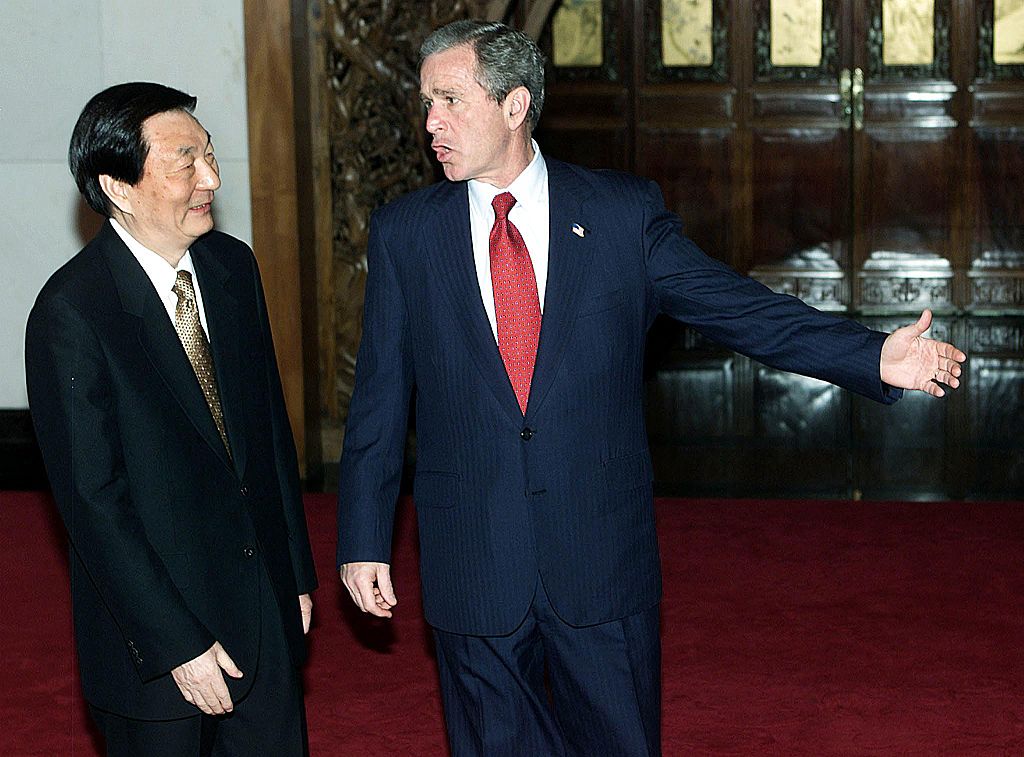
Former Chinese Premier Zhu Rongji, who passed away in Beijing at the age of 98 on Wednesday, is viewed by U.S. officials as a technocratic bureaucrat who upheld the Communist Party’s rule, while the outside world has overly emphasized his enthusiasm for the market while overlooking his commitment to CCP governance.
“He is a figure often misunderstood,” said a former U.S. National Security Council official responsible for China and Taiwan affairs.
Zhu served as Vice Premier and later as Premier of the State Council from 1991 to 2003, partnering with then-CCP leader Jiang Zemin.
Julian Gewirtz, who previously served as the Senior Director for China and Taiwan Affairs at the U.S. National Security Council during the Biden administration, posted on social media platform X, stating, “Zhu Rongji is a figure often misunderstood.
“He embodies many contradictions of China’s reform and opening-up era: seeking rapid economic growth while maintaining stable political control; desiring the benefits of markets and trade while seeking to limit chaos and vulnerability; wanting to engage with the international system while always upholding China (CCP) principles…
“Equally important, we must recognize that America’s description of Zhu Rongji as a liberal reformer is often too broad, overemphasizing his market enthusiasm but overlooking his commitment to a strong China and CCP governance.”
As a prominent younger generation strategist and player in U.S. policy towards China, Gewirtz has a deep understanding of high-level CCP politics. His latest book, “Never Look Back,” documents how the CCP elite circles politically purged Zhao Ziyang.
Gewirtz pointed out that Zhu Rongji, a technocratic bureaucrat, was promoted to a core position in economic decision-making by then CCP paramount leader Deng Xiaoping in the 1990s.
In a commentary published in 1991 that quoted Deng Xiaoping, it stated, “Do not think that a planned economy must be socialism and a market economy must be capitalism. Both are tools, and the market can also serve socialism.” This article was co-authored by Zhu Rongji and Deng Xiaoping’s daughter.
Deng Xiaoping also mentioned, “The current (CCP) leadership doesn’t understand economics, only Zhu Rongji understands economics.”
However, Zhu Rongji faced numerous challenges both domestically and internationally during his tenure, ranging from how to manage China’s vast rural labor force to addressing political obstacles from the U.S. to China’s accession to the WTO, for which Deng Xiaoping did not provide a clear roadmap.
Foreign media interpreted or reported Zhu Rongji as a reformist due to his adoption of different economic policies from previous CCP leadership.
In fact, even Zhu Rongji himself expressed dissatisfaction with Western attempts to fit him into a liberal model.
He once said, “I am not China’s Gorbachev, I am China’s Zhu Rongji.”
Gewirtz also warned that even in the economic field, Zhu Rongji staunchly opposed large-scale privatization of state-owned enterprises.
During a conversation between Zhu and former President George W. Bush, Zhu pointed out that China was not privatizing state-owned enterprises but transforming them into modern corporations. However, Bush confidently responded, “We know what’s going on.”
Mark Witzke, a former economic analyst at Rongding Group, noted that this dialogue highlighted that U.S. decision-makers generally failed to recognize that “China is not trying to fully integrate into the global capitalist system but is following its own path.”
“In fact, the U.S. did not understand the (China’s) truth at that time,” he said.
Internationally, Zhu Rongji’s greatest achievement during his tenure is considered to be gaining U.S. support to guide China into joining the WTO.
Gewirtz stated that Zhu Rongji cleverly positioned the issue of China’s accession to the WTO as a matter concerning the future of America rather than China’s interests.
In March 2000, Zhu publicly stated, “President Clinton said, if we don’t approve the (U.S.-China trade agreement) now, (Americans) may regret it 20 years later.”
“I would like to add, not just 20 years later. I am worried that thousands of years later, when the American people look back on this history, they will also regret the mistake they made at the beginning and sigh about it,” the former Chinese Premier added.
Gewirtz pointed out the irony that many current U.S. leaders are now “reflecting on this history, and sighing about it,” and all believe that allowing China to join the WTO was a mistake.
Explaining why many people have strong emotional reactions to Zhu Rongji’s passing, Gewirtz noted that even within China, Zhu Rongji’s legacy remains malleable.
“For some people, he symbolizes a past era of greater reform and opening-up in China, vastly different from today (under Xi Jinping’s rule),” he wrote.
American scholar Joseph Torigian shared a group photo taken by Xinhua News Agency on September 30, 1999, showing then-CCP leader Jiang Zemin and Premier Zhu Rongji posing with Xi Jinping’s father, Xi Zhongxun, at an event celebrating the 50th anniversary of the founding of the PRC.
“(Now is) the 100th anniversary of Jiang Zemin’s birth and the passing of Zhu Rongji. This is a moment for reflecting on old debates: structure versus agency, continuity versus rupture, possibility versus necessity,” Torigian wrote on X platform.
Known for his research on the Xi Jinping family, Torigian revealed that Xi Jinping once displayed this photo on his bookshelf.